Two Poems and a Triptych by Tracy Fuad
These new poems by Berlin-based writer Tracy Fuad evoke an overall feeling of entrapment: there is talk of borders, bodies encased within mirrors, rooms the size of a person. Told colloquially, as if recounting events to a friend, these two poems and a triptych are striking in the way they juxtapose banality with evil.
This piece is commissioned in tandem with Wasafiri 127: Solidarities.
Supported by a grant from the Open Society Foundations.
DEVOTION
I said that I couldn’t make any decisions, but then ordered the crudo, and ate it all myself.
How long have you been obsessed with containers, someone asked me, and I felt, momentarily, removed from my body.
Inside the cover of the book, the poet had drawn a country, or body of water, and in its borders, written the word HELP.
Once, at a different dinner table, my father revealed that Bruce next door had worked in weapons, which is why he was always going to the Middle East.
I wondered about guilt. But everyone agreed he likely had a different narrative.
Earlier that spring Carly told me of her friend’s job, tending to the banned plants confiscated at a border. It was illegal to transport the plants across the border, but also to destroy them. So they were planted and then cared for in a garden hidden from the public.
I can’t do jumps, I can’t do pirouettes, a stranger told her friend before the mirror in the art museum bathroom. But if you tell me, stand like this, I will stand like this for hours.
PURPOSE
I will forget this day, I sang all the way up the hill to the grill out, where a Dan told me, if I was against gas and oil, then I had to be for mining. Unless I was truly for radical degrowth, which I probably wasn’t, he added.
I was interested in Dan’s theory, but wanted only to talk to Bitsy, who said she was in favour of naming the baby Sappho, though mostly, people were not.
I did write on my knee, Marin's knee, my child told me. And I did write on my head, Marin's house. In his dream, he could write.
My song, I saw, had trapped the day like an ant in a bead of amber. I couldn’t forget it.
The problem, I saw, was that I did not always know exactly what it was that I was for.
Or that I didn’t know exactly how to say it.
My head is my only house unless it rains, I sang all summer, a cover of the Captain Beefheart song. Suddenly, everything, music.
Singing: I think it’s my living.
COMPLEX GARDEN
The trail guide was translated by an algorithm. This path, it read, contemplates the beauty of the juniper juniper.
The bullet hole in the door to the roof looked like an anus.
Plot is not this concrete thing. It keeps twisting around itself. The girl is walking with a scarf wrapped around her head, singing now is the only now is the only now.
She is afraid of being a person and afraid of being not-a-person.
She has built a room for herself exactly the size of herself.
She can’t get out!
COMPLEX GARDEN
There is all this, I thought, but a general lack of form.
I kept in my phone a folder called body which contains one image of my body in a mirror in the house of my grandmother, and one in a mirror in my house of my grandfather, both of whom have since died.
I also kept a folder of screenshots of men on Tinder posing before the Eiffel Tower. Posing with the Eiffel Tower.
If I set my radius wide enough, there were soldiers from all sides of the war, posing in distinct uniforms with indistinguishable weapons.
COMPLEX GARDEN
A memory appears as a vapour.
Vapour I can wear?
No, you must enter this room without memory.
A page turning. The sound of a page turning in any language.
The crisis of the year spent in any way.
The way one walks when sharp objects may be afoot.
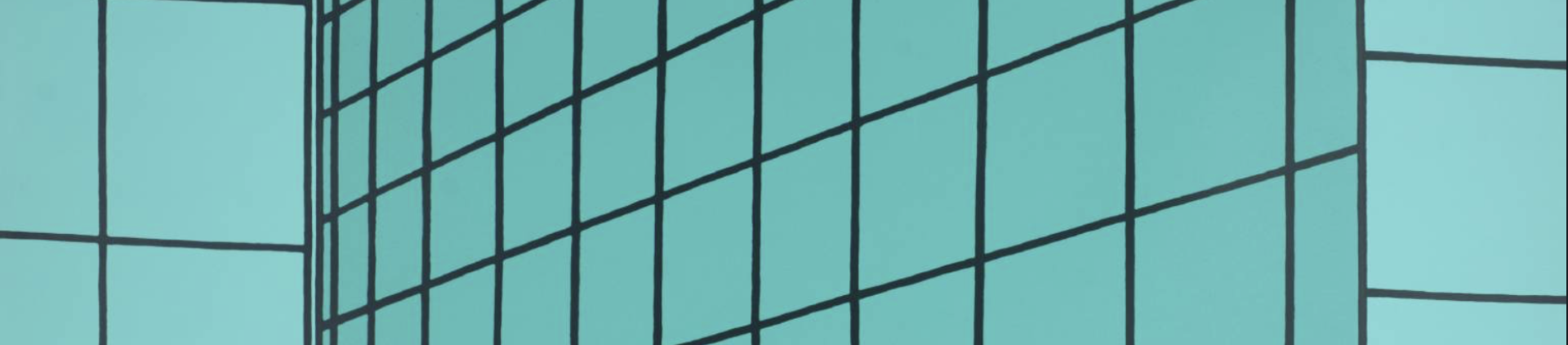
Cover image: Patrick Caulfield, 'Bathroom Mirror' (1968)

