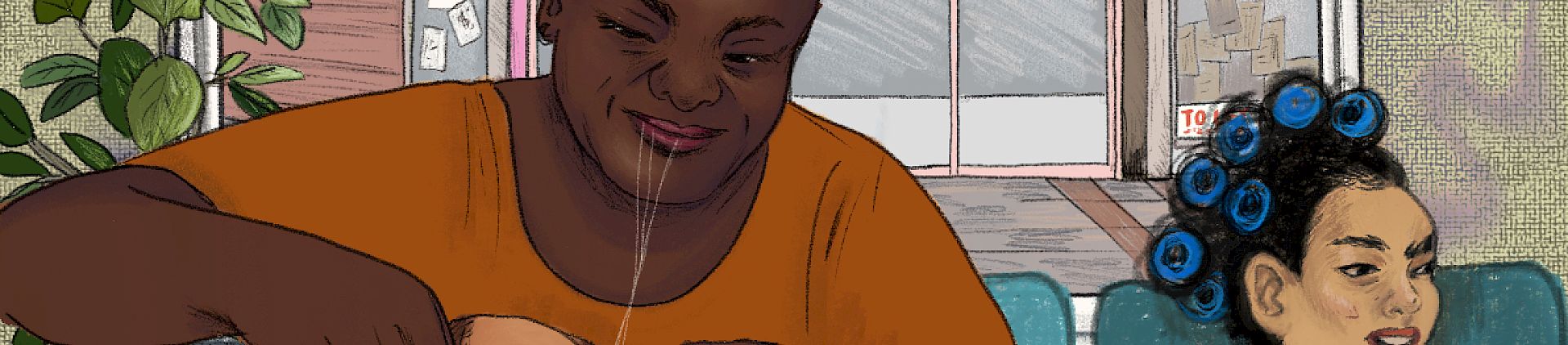
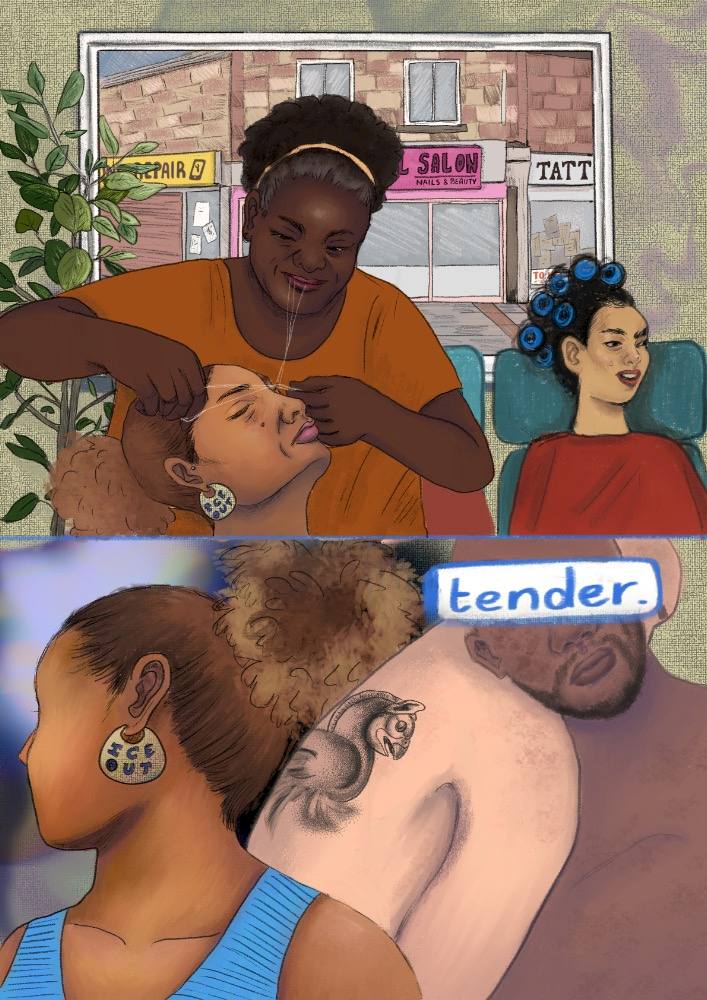
This World Poetry Day, we are sharing poems by Fatimah Asghar that speak to multiple communities, geographies, and crises in our world — where solidarities flower in beauty salons, ICE trucks cluster, grandmothers pray, empires collapse, and fists pulse. The poems thread rhythmically through equally horrifying and tender, grandiose and soft everyday images, nurturing resonances between our varied personal, communal, and political experiences.
With an illustration by Simone Khanyi Hadebe.
Supported by a grant from the Open Society Foundations.
Illustration by Simone Khanyi Hadebe
[somewhere, somewhere, someone]
somewhere, a legion of grandmothers prayed & the empire collapsed. somewhere an aunt dug a circle & buried a secret.
somewhere, a saint’s body birthed a tree. somewhere, the jinn sat in the banyans & watched. somewhere,
the planets danced & everyone’s birth chart tightened. embers in the chest. somewhere, the fish carried
the prayers to god. somewhere, an ancestor spoke in a dream. somewhere, the ICE truck is towed before the raid.
under the rubble a grandfather reached his hand to the sky. under the rubble, 400,000 hearts, slowing. somewhere,
a prime minister said violation of international law & no government did anything. the government kidnapped its own people.
somewhere, someone cried for help & something else answered. somewhere, an elder’s wrinkled hands sewed a blanket
for a child. somewhere, someone touched a tasbeeh. somewhere, someone lit a candle at their altar. the plantation burned
& water refused to give its gift. something else answered. someone pulled the tower. somewhere, someone survived
under the rubble, someone’s hand opened someone’s fist pulsed, someone stayed alive.
[ya latif, ya latif, ya latif]
chanted so fast my jaw numbs.
in the back of the masjid, the speaker goes & i can only hear the hum, the words
lightning so fast they become another word entirely. the stone in me waters.
i river. frantic & hairy i go to my waxer before my flight. the girls nah work today, the woman
says, resigned to her chair, beady eyes to the window. she points me to a shop
i’ve never been, too pink & bright. ICE trucks stop at every corner. orange
man’s fear, spittle at the podium & everyone scatters in the daylight.
one week into his re-rule & the photos come: guantanamo, men picked from
neighbourhoods like fruit, shirtless & tattooed, pressed besides each other.
neck crooned against neck, gentle. hiding their faces from the camera’s look.
ya latif, ya latif, ya latif. what kindness: hands bound & unclothed & still,
shielding each other with their bodies. tender. too tender. what is ours to look?
what is not? i couldn’t hold the gentle. intrusion. i carry them in my river. i chant ya latif,
ya latif, ya latif for each one in the photo, for each one not in the photo.
at the pink shop down the street, still no girls — just the owner papered
& safe. a gen z-er argues with her too long about a misplaced eyebrow hair. they stand
side by side, looking in the mirror for ten minutes. every time I come here, you
do this. the gen z-er huffs, then leaves. the block hot, the trucks move & she might text
a friend i’m never coming here again. i let the couple with the newborn go before
me. how old? the owner croons. three weeks. i watch the owner, thread between her teeth
her neck gentle, un-necked by others, bobbing, back & forth, its own dhiker in the waxing shop,
its tender metronome; ya latif/ ya latif/ ya latif/ ya latif
Fatimah Asghar'sDaughter of the Mountains (Penguin / Randomhouse) is forthcoming July 2026 and explores homecoming, spirituality, and ancestral homeland.
Fatimah Asghar, author of If They Come for Us and When We Were Sisters, is a poet, filmmaker, educator, and performer. Their literary work has been longlisted for the National Book Award and won the Carol Shields Award. They are the writer and co-creator of Brown Girls, an Emmy-nominated web series that highlights friendships between women of colour.
Simone Khanyi Hadebe is Wasafiri's inaugural Illustrator in Residence. She is an interdisciplinary storyteller from Botswana and Zimbabwe. Raised by her grandparents in Bulawayo during the height of Zimbabwe's economic crisis, she draws upon Badia Ahad-Legardy's research in Afro-nostalgia to investigate the visceral act of remembrance.
Subscribe
Subscribe to Wasafiri and get benefits such as saving 18% off the cover price.