Vietnamese Literature and Translating for the Anglosphere: Nguyen Binh Phương’s 'The Young Die Old'
Weaving in conversations with Vietnamese author Nguyen Binh Phương and publisher Kim Tràn of Major Books, Laura O'Connor does a deep dive into Phương's novel Những đứa trẻ chết già, which has recently been released in English by Major Books as The Young Die Old, translated by Khai Q Nguyễn. O'Connor explores why it takes so long for homegrown Vietnamese literary titles to reach the Anglosphere, the necessity of incorporating specific local myths and traditions in Vietnamese storytelling, and wider orientalisation of Vietnamese-language literature in global publishing.
This piece is commissioned in tandem with Wasafiri 127: Solidarities.
Supported by a grant from the Open Society Foundations.
Since its first publication in Vietnam in 1994, the novel Những đứa trẻ chết già (The Young Die Old) has become a modern classic. Its author, Nguyen Binh Phương, is one of Vietnam’s most celebrated writers, holding a leadership role with the Vietnam Writers’ Association, while continuing to serve as Editor-in-Chief of the Military Arts and Literature Magazine. Still, for over thirty years, Những đứa trẻ chết già sat untranslated into English, and Phương has remained underrecognised in the Anglosphere. In an exclusive interview, the author told me that he put the novel away years ago, saying he ‘returned to gathering the experiences and emotions that would nourish another book’ instead. Now finally, the English edition – translated by Khai Q Nguyễn and published in 2026 by Major Books – is giving the novel a new life in the English-speaking world.
Upon its release, Phương said: ‘… as I hold the English edition in my hands, I find myself reliving the same mixture of emotion and quiet wonder that I felt when I first held the Vietnamese edition. I like to think that this book is now setting out on a new journey, a new life, in a country far from its homeland.’
I first sat down to discuss The Young Die Old with Kim Tràn of Major Books, a publishing house dedicated exclusively to translating Vietnamese books to English and often working with experimental and transgressive writing, from Phương to texts on queerness to folklore retellings. The Young Die Old is their most recent title. Following my conversation with Tràn, I spoke with Phương himself about the book, his relationship to allegory and magical realism, and why it’s taken decades for the novel to become available to read in English. The author’s answers in Vietnamese were generously interpreted by Anh Thư Trương Nguyễn of Major Books.
*
Set in the mythical village of Phan, The Young Die Old is a winding, dreamy web of stories of local villagers searching for a treasure trove, while affected by the traumas of war, grief, and familial breakdown. Interspersed with local feuding is the story of an unnamed narrator (‘The Man’) travelling on a wagon to an unknown, far-reaching destination. He replays past memory fragments of war and bereavement for the reader. Time and place are experimented with: War and grief become multiversal, engrained in both the physical and metaphysical realms while stretching into the past, present, and future.
The book is ethereal, and the reader does not always know what is real: characters age backwards; adults revert back to babies; a nghê (a traditional Vietnamese mythical creature combining the physical features of a lion and a dog) is found in the jungle, guarding the treasure. This kind of magical realist writing has garnered Phương comparisons to the likes of Gabriel Garcia Marquez, even being called the ‘Marquez of Vietnam’.
But for Phương himself, this moniker feels complicated. At the end of The Young Die Old, there is an interview between him and translator Nguyễn, adapted from an earlier 2017 conversation for the Mekong Review. Nguyễn, by this point, was three years into translating the novel (and would take another seven), and he speaks with admiration to ‘The Stubborn Writer’. In their conversation, Phương explains that ‘Those templates and the nghê are [ultimately] oriental, with their history that spans thousands of years; they didn't come about a few decades ago, when Latin American literature was introduced into Vietnam.’ This was reiterated in my conversation with Tràn: there is common ignorance about Vietnamese culture and folklore when discussing Vietnamese literature, and a superimposition of a foreign, myopic gaze onto longstanding traditions.
Phương did not outright reject the label of magical realism, though. He reiterated that he is flattered by the comparison but is firm that his own folkloric writing is fundamentally rooted in Vietnamese traditions. ‘I lived among the imaginary and mysterious stories told by my grandparents from childhood. I read Lĩnh Nam Chích Quái and Việt Điện U Linh long before I ever encountered the term “magical realism,”’ he explained. ‘Yet, all the same, to stand beneath the umbrella of “magical realism” would be an honour, if I am truly worthy of that designation.’
The Vietnamese traditions Phương’s writing is rooted in refer to truyền ky, a form of written storytelling that often takes a ‘mode of the marvellous and the uncanny’, and chích quái, which Phuong described as ‘works that are written through elements of the strange, and the ambiguous space between reality and unreality.’ These traditions were ‘absorbed and lived with from childhood through the stories told by [his] elders.’ As readers, we see Vietnamese mythological creatures creeping through forests alongside local villagers in the novel, and we too can feel some of that awe from Phương’s childhood.
Phương also uses truyền ky and chích quái as important, necessary tools to decipher experiences of war and collective grief over generations. Realism, to him, didn't seem like the most appropriate artistic form for telling these stories. ‘In the twentieth century, Vietnam endured four major wars and the blood that was shed is beyond reckoning,’ he shared. ‘It often seems to me that the finest sons and daughters of my country were the ones who fell. Yet I do not believe that any work of realist literature could fully convey the brutality of those experiences.’
There is common ignorance about Vietnamese culture and folklore when discussing Vietnamese literature
In The Young Die Old and Phương’s work more widely, timelines are often blended, while towns and destinations go unnamed. The character of ‘The Man’, on his endless wagon ride, tells the reader of a time ‘his village lost all its sound’ when ‘his knife was deadly precise' and 'The victims didn’t have time to cry, they were forbidden to cry’ (Phương 94). These flashbacks of war are written in present tense, as The Man relives each moment in his old age while on his aimless journey. ‘Viewed through this lens of the fantastic, poised between dream and reality, war becomes less the reconstruction of a specific historical moment than a representation of a deeper human experience,’ Phương elaborated.
*
Tràn first read The Young Die Old in 2022 and was immediately sucked into the story’s sense of unreality. ‘The narrative thread made me realise I needed to try to publish this book at all costs,' she said. 'I wanted to follow that buffalo wagon – not necessarily as a passenger on that ride – to the end and beyond. That beyond, as it turns out, seems to be a never-ending loop, making you question both historicity and temporality.’
In her initial reading of the novel, Tràn was grabbed by Phương’s trance-like writing blending narratives from various timelines and unnamed locations. ‘Late twentieth-century Vietnam [was] a time of renewal, of attempting to “shred” the past and look towards the future, in a society still so deeply marred by ravages and remnants of the past,’ she said. ‘I think it was natural for writers to play with forms, genres, and narrative styles in this period, especially if they didn’t want to explicitly locate the central settings of their concerns.’
Using magical realism and allegory is also a practical choice. Phương explained that ‘placing the story within a fantastic world frees both the author and the work from blunt demands for factual verification: Where exactly did it happen? Is it historically accurate? Why is it portrayed this way when the facts were supposedly otherwise?’ For subjects particularly sensitive to scrutiny or censorship – like war and collective grief – allegory and magical realism can become useful tools for representing the core of the human experience or psyche, while bypassing debates about political nerve points.
I’m reminded of Deepak Unnikrishan’s Temporary People, (2017) which used magical realism to explore class and worker subjugation in the United Arab Emirates, where it is illegal to openly speak or question these issues. Or even Hamid Ismailov’s The Devils' Dance (2017), a novel-within-a-novel that tells the story of an imprisoned author writing an Uzbek folkloric tale, using myth and experimental form to comment on political injustice(s). Ismailov himself, when speaking of his own work and that of his contemporaries, has stated that writers commonly responded to Soviet-era restrictions by ‘creating a coded literature, full of hints, allusions and metaphors’, humorously noting that ‘Russian writers love metaphor’ (2016).
While The Young Die Old (including the title itself) is underpinned by themes of death, sex and reproduction feature just as strongly. ‘What cannot be denied is that women are the force that sustains this world,’ said Phương. Women face brutality at the hands of their husbands. They’re often erased: even the wife of one of the main patriarchs in the book, Tru’ong, who is responsible for passing down legends of treasure, is referred to only as ‘Tru’ong’s wife’ and never actually named. Tru’ong’s daughter-in-law is also only referred to as ‘Mrs. Liêm’, taking the name of her husband. As she cares for her father-in-law while her husband and children become more enmeshed in village politics and treasure hunting, Mrs Liêm is described as a woman who ‘silently fulfilled her duties as a wife and a mother. It seemed that she lived just for this life’ (Phương 278). Still, the women in the novel are not naïve and do not shy away from action (and wrongdoing) — from committing adultery to being able to intuit when their children will come home.
Sex and reproduction live alongside violence as forces of both harm and liberation
In that same scene where Mrs Liêm is ‘silently fulfilling her duties’, we see she is the only member of her family that is able to predict or accurately sense the return of her daughter Loan, who previously ran away from the family to be a sex worker. Throughout the novel, sex is seen as both a destructive force – from Phán, a villager who lusts after Loan, contracting and spreading gonorrhoea, to the stigma and judgement around Loan’s sex work coming from her father and brother – and an act of pure passion and release from dreariness or familial constraints. Sex and reproduction live alongside violence as forces of both harm and liberation.
‘When violence threatens to reach its most terrible extreme, it is the women who step forward to restrain the men's aggression and bring the conflict to an end,’ Phương said. He further unpacked the crucial, almost metaphysical relationship that several of the women in the novel have towards community and reconciliation, as well as the role of masculinity. In the book, we follow Loan’s brother Hải throughout his young adulthood, as he goes after the local treasure while sleeping with a local married woman, and berates his sister for her sex work. Hải develops a passion for martial arts under the tutelage of Trinh, who ultimately becomes his rival. Men and boys are constantly engaged in rivalry, whether it be in sexual escapades, martial arts, or flat-out war. Meanwhile, Hải’s mother Mrs Liêm repeatedly cuts through aggression by mediating between Hải and his father and silently observing the increasingly violent search for treasure between the villagers. Still, ‘the treasure in the hill meant nothing to her; it couldn’t help to heal her broken heart’ (Phương 279).
*
Khai Q Nguyen spent a decade translating The Young Die Old, after first discovering it in 2014. He became obsessed with the care and skill required to translate such a layered, stylistic text, especially one that had never been translated into English before. That the novel took so long to reach the Anglosphere begs the question of why. It also calls for an examination of the West’s fixating on Vietnam as predominantly a historical setting of war (particularly in Hollywood narratives) but not of homegrown literature. Films like Apocalypse Now (1979), which won two out of its eight Academy Award nominations, Full Metal Jacket (1987), and Platoon (1986), one of the highest-grossing films of the 1980s, have bolstered the well-regarded subgenre of English-language films about war in Vietnam. Meanwhile, English-language books by authors such as Tim O’Brien and Michael Herr have further cemented reader interest in war in Vietnam through the lens of English-speaking and often American narrators. While these are valuable perspectives, there is a clean overshadowing of homegrown, Vietnamese-language titles.
‘I think [The Young Die Old] has gone untranslated for so long because it shares the same fate as other excellent works of Vietnamese literature, especially ones that are not explicitly about/set in the Vietnam war (which is to say, a whole lot): in the eye[s] of the Anglophone literary sphere, we are not seen as a highbrow culture that produces noteworthy, highly literary texts,’ Tràn said. Beyond English, The Young Die Old has been translated into French and Korean. ‘Certain publishing traditions are more open to translated fiction, and it shows,’ added Tràn, underlining the imbalance between the Anglosphere’s approach to translated and Vietnamese writing as compared to other regions.
The incongruency between the visibility and celebration of Phương’s works in Vietnam versus in English is stark. For Major Books, The Young Die Old is part of their wider effort to bring more visibility to contemporary Vietnamese writing that goes beyond the Western gaze or is stuck in the mid-twentieth century. ‘[The Young Die Old] is a declaration that Vietnamese literature is very much still alive and kicking, with incredible authors still producing exciting works on par with world literature,’ Tràn said.
For Major Books and other publishers, translators, and authors of Vietnamese literary works worldwide, the Anglosphere’s fixation with gruesome war narratives and its orientalist freeze-frame isn’t just limiting, pushing out allegorical works like The Young Die Old. It measures the worth and authenticity of Vietnamese storytelling against its proximity to brutality and Western stereotypes. ‘I think that it is undeniable how important … war is to the shaping of our [Vietnamese] literary and cultural consciousness. However, it does not make up the entirety of who we are or what we are concerned about,’ says Tràn.
There is a clean overshadowing of homegrown, Vietnamese-language titles
Although written over thirty years ago now, Phương’s novel still very much represents contemporary Vietnamese writing today as it actually is: thriving. Phương continues to write from his Hanoi desk, alongside a growing community of contemporary writers in the country, such as Vũ Đình Giang (author of Parallels, a work of queer fiction also published by Major Books) and PEN Translates Awardee, Nguyễn Ngọc Tư.
‘When I wrote this novel, my thought was a simple one: although my country has lived through far too many wars, it has never become a barren battlefield, its spirit hardened beyond feeling,’ Phuong shared. ‘On the contrary, the Vietnamese soul has remained sensitive, capable of creating, nurturing, and preserving other forms of beauty – beauty that is mysterious, elusive, and enchantingly strange – through the lives of ordinary individuals.’ Life passes quickly and often without mercy. For Phương, his writing is meant to infuse youth into old age, to shift and bend and play with time, and to allow people to have ‘second chances’, righting wrongs from past lives or early life through fantastical means. ‘I believe that, whatever happens, we must go on living, if only to make this world more beautiful through the mystery that lies within human existence itself,’ he said.
For contemporary Vietnamese authors like Phương, these ‘second chances’ may exist not just in the stories themselves, but in the act of translation. After speaking with Phương and Tràn, I am left asking myself how many other Vietnamese-language stories – particularly those that undermine the Western gaze and seek to ‘restory’ histories of war and collective grief (Nghia and Gounari) – live in the ‘deleted’ folders of English-language publishing houses or in the shelves of writing desks in Hanoi.
Works Cited
Achebe, Chinua. Home and Exile. Oxford UP, 2000.
Ismailov, Hamid. ‘Writing in riddles: Too much metaphor has restricted post-Soviet literature.’ Index on Censorship, vol. 45 (3), 75-77. 2016.
Nghia-Nguyen, Minh, and Panayota Gounari. ‘Collective remembering and necropolitical discourse: The American War in Vietnam commemorated.’ Language in Society, 1–26. 2025.
Unnikrishnan, Deepak. Temporary People. Restless Books, 2017.
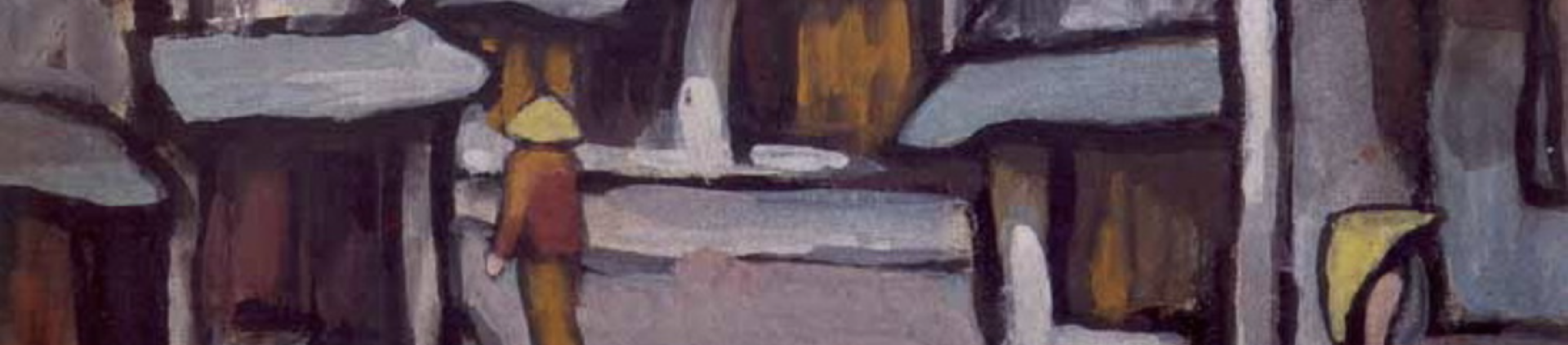
Cover image: Hanoi Street, ND © Bui Xuan Phai

