'What Happens If We Talk To Each Other?': In Conversation with Three Community-Makers (Part 2)
Khaled Esguerra, Juan Gonzales, and Carlos Páez González came to the UAE at different ages — Khaled was born there, Carlos arrived at age fifteen, and Juan as a young adult. They hail from different backgrounds and engage in various forms of visual and performance arts. Juan directs theatrical plays and manages an amateur troupe in addition to his regular job; Khaled is a former student at the American University of Sharjah who uses photography and visual arts to document the city; and Carlos, who studied at New York University Abu Dhabi, is now a teacher and theatre artist. At this time in the UAE, like elsewhere in the Gulf, when flagship cultural policies and investments tend to take centre stage, we gather these ‘community-makers’ and listen in for how their practice generates conversations, and weave collectives and audiences across different segments of UAE society.
This conversation covers further ground in addition to the topics covered in Part 1 of this interview in Wasafiri 122: The UAE Issue, also available via Taylor & Francis, under the title ‘The Least I Can Do Is Listen’.
Khaled Esguerra: I want to bring up something that has been recurring for a while: the idea of community. I'm interested in how we create community here, beyond our practice and beyond artists who share similar work. What would you say is your community in the UAE?
Juan Gonzales: To me, community is related to the concept of place-making. It's giving people a place or putting the people front and centre in how you plan the place. It includes giving them opportunities, a voice, and a space to socially engage with others. I make community by giving them the opportunity to be seen and heard through the stories we make.
In the performances we make, we notice that when people see themselves in the characters or the stories, they feel validated. They are reminded that they are valuable human beings. And I think this is what is being taken out of many stories and conversations about migrant workers in the UAE, where we are only seen as labour capital — as workers.
Carlos Páez González: For me, community building comes from consistency. Many things I try to do are explicitly about that, in the sense of recurring workshops or work in which I try to bring people in to do things. As a theatre maker, this is very relevant, because it's hard to make theatre with people just showing up one time but not returning.
I think I'm still in the process of seeking community here, and I haven't fully understood what that means for me. I'm starting to understand it in a personal sense — like having a friend group, which is something that I feel like I haven't had since high school. Now something is starting to form and it's such a joyous thing. But even beyond, it means having a community of artists to co-create with, who are willing to come in to look at and discuss your work. This is crucial especially in theatre, because we always make work in community but there's something missing.
When I go to visual art spaces, I always feel like I don't belong, and the conversations are not always relevant to me. The community around theatre and the performing arts is slowly building beyond the groups that are more interested in just doing theatre for fun — bringing in those who do theatre for the artistic conversations it creates. It's an ongoing conversation. I don't know what it will look like in the future, nor do I know what my role in it is. And I don't know if art – the way it's typically done here in the safety of institutions and bureaucratic approvals – is the way to create a community that really feels alive.
Community building comes from consistency.
KE: I feel like my community is the city. I'm very curious about the lives of individuals who inhabit this place with me. Like the taxi guy who said he has a Master’s, but is driving a taxi –– how did he end up here? I'm curious about this street cat a few buildings down from mine, who keeps coming to me whenever I’m near the door. I'm curious about Emiratis who, at first, moved inland to the city, but are now moving out to the suburbs, like Khalifa City or Zayed City, because the incentives (land offers, housing support, etc.) were too good to pass up. I'm curious to know how they feel now; what's their relationship to the city? I remember how I once worked on a book about bedspace advertisements around the city and noticed how specific they were: kabayans only; Indian Muslim only; Hindus only. I don't have to intervene by speaking on behalf of them, but the least I can do is listen. And then, if there is space, to share that. Maybe someone with the exact same upbringing as me would have the opposite feelings to what I do now. Or someone with a completely different background would have the same feelings.
I worked on another project called ‘Do Concrete Towers Dream of Golden Visas?’, about buildings being demolished, and that involved talking to a lot of people, like the security guards who guard these decaying spaces, residents who lived for over a decade in a tower being torn down, and demolition contractors. There's a lot I learned from those conversations. I can't remember who said this: the more personal you get about your own experience, the more universal it is, and more people will resonate and identify with it. That's why I'm very interested in individual lives, narratives, and stories.
JG: What happens if we, the people living in the city, talk to each other? I wanted to comment further on our tendency to retreat into our own bubble and people. Don't you think that it's also because of how the city is organised, socially and geographically? I feel like it affects how we interact with spaces and events. Or, even when we have spaces or events where people get together, how do we get them talking without anyone feeling inferior to another? Does the city provide us an opportunity to become civically involved and active in our neighbourhood? Or – in my own experience – because we are just programmed to be workers, we forget to care about being civically involved ...
KE: Urban planning says a lot about a city. A friend of mine once asked: Don't you ever think about how you just have one highway bisecting the entire city of Dubai? If you are facing the spot you want to go to (from the other side of the highway), you have to walk fifteen, twenty minutes in the heat to the metro station, go up the stairs, walk along the bridge, go down the stairs, and walk right back to the place you were facing. It’s just how the roads and neighbourhoods are planned out — and that says a lot.
A neighbourhood like Dubai Hills already has a specific, built-in context, versus when I speak of a place like Satwa or Karama. Or in the case of Abu Dhabi: Khalidiyah versus Hamdan versus Bateen versus Khalifa City. You already have a preconceived notion of what type of people live in these areas: economic class, nationality etc. On the one hand, there are these displays with low-rise towers and cramped apartments versus these places full of villas, gated communities, and CCTV. It's down to how the city is planned and organised, not just in terms of streets, but other markers too ... what's the term? ‘Community borders’. Those dictate much of the social dynamics too, and who gets to listen to whom. The only two places in Dubai where I think you don't have to be ‘someone’ to be there are Dubai Mall – everyone goes there, whether you're buying dinner or a 500,000 dirhams watch – and cafeterias.
CPG: I feel like in Abu Dhabi that's not true for cafeterias. Working at an international school right now, most of my colleagues are from the UK, Canada, or US. And they don't go to those places. They don't know about these things. They’ve never been to SeaShell Cafe, and will wonder: ‘Been where? Sorry, like they sell seafood?’
KE: They don't know about SeaShell?!
CPG: Well, I was the same because I was an expat when I came here. I didn't know anything. I lived in Khalifa City, where there was nothing, and my parents didn't really let me explore. I was ecstatic the first time I had a shawarma for five dirhams. It was so good! Five dirhams! It opened up a whole new world for me. And a lot of people don't understand that. When I go to cafeterias, it's very rare to see people from the US or the UK. I don't know if cafeterias are a space where you can go and avoid having to pretend like you're someone else. It goes back to that question about performance in our daily lives, right? How do we perform depending on where we are? Is there such a thing as a place where you don't perform a specific persona?
The only two places in Dubai where I think you don't have to be ‘someone’ to be there are Dubai Mall – everyone goes there, whether you're buying dinner or a 500,000 dirhams watch – and cafeterias.
JG: I think I'm guilty of that. One time I took a day off and went to Shindagha historical district. I was trying to call myself a tourist for one day because it was a place I hadn’t explored much over the eight years I'd been in Dubai.
About Dubai Mall: it is true, different types of people can go there but there are limitations to when or how often they can go. Take the matter of transportation. You know the labourers’ work schedule; they only have one day off and they live far from the metro station, so they cannot go that easily.
To add to the bit about us retreating to our own bubble — I think another reason for it is that there are few opportunities for us to interact in a more meaningful and organic way. When I first came to Dubai, I lived in Al Nahda and was looking for art places. I researched Alserkal Avenue, but that was too far. It made me wonder how I might engage with artists or art if I always have to travel that far? My commute already takes two tiring hours. And compared to other large cities, there aren’t as many events for us to create a more holistic community. That is why, even in the theatre group I have co-founded, we have only Filipinos, despite wanting people of other nationalities to join us. I don't know how to merge them into the group if we're talking about Filipino concerns. I need to develop or learn new ways to do that. I would want to have frequent interaction and opportunities to talk like this. But it doesn't happen all the time.
KE: I want to know what your individual relationship with temporariness is. Is it something that you always think about, in terms of a date where one is going to have to leave — whether it's tomorrow or fifty years from now? Is it something that influences not just the work, but also the pace you work at, to accomplish a certain body of work to feel it is enough? Or is it the opposite, resisting this idea?
JG: I used to say that I will stay in the UAE for ten years maximum or create five projects maximum and then I will leave. But because of my anxiety, I’ve had to learn to deal with each day as it comes and just respond to these things more organically, rather than thinking about the past or the future as much. I was very anxious about the temporariness of my stay in Dubai. But now, I just live it as it is.
CPG: I don't think about the moment when I leave anymore. I did that as a student at the international high school where I’ve ended up working now. I remember a college counselor once told me: ‘The rule is, nobody stays.’
Recently, I was in New York as part of the SEAF (Sheikha Salama Emerging Artists Fellowship) residency. Amid all the conversations we had, and the galleries and artist studios we visited, I thought I’d rather be in Abu Dhabi, making work and learning about the art there than in New York. The conversations I'm interested in are here. However, a lot of people around me talk about leaving and the opportunities in other places. So, I do think about who I won't get to work with anymore. I think about the communities I'm part of, and those crumbling and falling apart.
I have a friend from NYU Abu Dhabi who did her capstone thesis about the Abu Dhabi Choral Group, the city’s most successful community theatre group. She argued that the reason they've been hanging around for so long is because the group itself is porous, allowing anybody to be a part of the show. So, the community stays regardless of people going in and out. There's also a lot of effort to make the community feel like a community — they have a person who plays the role of an events organiser. The group is resilient to the temporariness of its people, something other groups couldn’t find. A theatre group I once performed with crumbled when their leaders left — much like another group, Beyond the Veil. So, I worry about what temporariness does to the resilience of communities and the places we build together.
I was very anxious about the temporariness of my stay in Dubai. But now, I just live it as it is.
KE: It was always present when I was a kid, especially within the household. I heard it in my parents’ voices: ‘This place is not our home. If your dad loses his job, we all have to leave.’ Several years later, as an adult, I try and resist by saying, no, I'm going to stay. But I'm still not sure what that means. 
I'm in the process of applying for a Golden Visa, but don't know what that means either. It grants me security for ten years, but what if I can't afford health insurance? Can I renew it after ten years? I don't have these answers. I try and stay adamant about where I'm from because that's also my safest option.
JG: It seems that we all agree that we are staying in the UAE until we can, but there's still that phrase: until we can. Don't you feel some kind of resentment toward that? We don't feel a sense of security, or it always keeps us on our toes ...
KE: I've lost friendships over discussions about the concept of privilege or passport hierarchy. Regardless of our experiences, there is a clear distinction in terms of how we are seen. I'm not negating their stories by talking about mine — I just need you to listen to me for a second.
JG: I like that. There is bitterness, but hope too. And what we do as artists can drive change, hoping for something better to come out of it.
KE: One of my professors at university asked, ‘So if I gave you the passport tomorrow, are you going to feel totally secure? All those feelings and experiences, gone?’ No. It will grant some security, some benefits that we haven't had access to. But all those past feelings won’t change. How is it that we desire something that might not have that much impact?
CPG: What's the greatest barrier for you about making work here?
KE: Money.
JG: I would say the same.
KE: A camera is not cheap, printing is not cheap, framing is not cheap. If I want to photograph somewhere where I absolutely cannot without a permit, a permit is not cheap. I have to run around institutions with my proposal to get money. And then there are regulations in terms of art and where it can exist. I believe that my work belongs in the same informal spaces as the bedspace advertisements, the stickers and massage cards on the street, the sidewalks, more than it belongs on a white wall in a gallery. The moment that I start exhibiting work in these public spaces, I feel like this would be the biggest barrier to knock down.
I've lost friendships over discussions about the concept of privilege or passport hierarchy. Regardless of our experiences, there is a clear distinction in terms of how we are seen. I'm not negating their stories by talking about mine — I just need you to listen to me for a second.
CPG: Right now, grassroots spaces are starting to appear around the UAE – places where we hope conversations about a range of subjects can flourish – talking about what it's like to make work under bureaucratic constraints.
So, my answer to this question would be space and fear. You can't do theatre without a space, especially accessible rehearsal space. Once, I was directing a play for Short + Sweet Dubai. I lived in a small apartment and we went outside to Reem Island to rehearse for a bit. A security guard came and started throwing a bunch of questions at me, and nothing happened but we were all a bit shaken. After that we just continued the rehearsal in my living room, which was tiny. That also goes back to money, because with money you could rent.
And then there’s fear, something I kept coming back to. Fear of saying the wrong thing; fear of just straight up speaking and then realising that you don't have the permission to speak in the place you were speaking. I don't know. It's always the fear that you'll offend the one wrong person who can take the whole thing down.
JG: Khaled and Carlos, I appreciate this conversation I had with you. It's been inspiring and empowering. Thank you for sharing your experiences and thoughts.
This interview follows on from Part 1 of the conversation ‘The Least I Can Do Is Listen’ in Wasafiri 122: The UAE Issue.
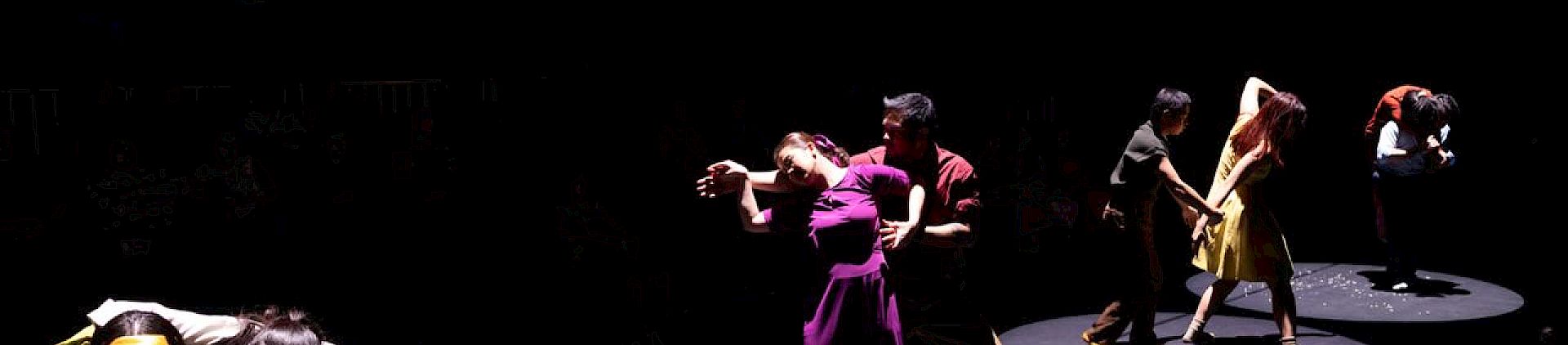
Image courtesy of Juan Gonzales. Photo credit: NYU Abu Dhabi


Our summer special issue, guest co-edited by Laure Assaf and Deepak Unnikrishnan, explores the United Arab Emirates’ literary and creative scene — away from monolithic representations of the region. Its contributors are makers – of books, arts, texts, and community – with ties to the United Arab Emirates and/or the Gulf. They are brought into conversation across generations and disciplines, reflecting on what this place is for them, and what it does to them. They talk about risk, memory-making, taxis, and televised dreams — pushing the lines, or treading them carefully.
