A Poetics of the Unbearable
Reflecting on the insufficiencies of public and media attention on what has been termed 'the forgotten war' in her home country Sudan, our International Writer in Residence Safia Elhillo examines how a poet can make themselves genuinely useful to a cause, developing a craft and poetics that is utilitarian and refuses the 'unbearable'. 'Pity', Elhillo argues, is simply 'not a productive, long-term strategy'; the work of 'doing language' requires solidarity that 'calls for imagination and improvisation.'
You can also read Safia Elhillo's Lead Feature poem, 'Psychogeography' in Wasafiri 127: Solidarities.
Supported by a grant from the Open Society Foundations.
In the three years since war broke out in my home country of Sudan, international media coverage has been overwhelmingly silent — an occasional uptick of attention after a headline-making act of violence, before settling back into the baseline of silence. This silence has led to the probably well-intentioned coining of the term ‘the forgotten war’ to refer to the war in Sudan, a term that, at the peak of its usage, appeared in almost all mainstream news coverage about the war.
In the scramble to harness global attention, I have found Sudanese people like myself, as well as our allies, using every kind of strategy of appeal. We speak in superlatives: The war in Sudan has created the world’s largest humanitarian crisis; the Sudanese comprise the largest population of displaced people in the world. We share pictures of our bombed houses and displaced family members; of our gardens; our looted antiquities; the pyramids; the Nile. I used to tell anyone who would listen about the way my poet grandfather’s bookshelves were dragged across the floor to cover the shattered windows of our home, in the hope that the pages would protect my family from the bullets aimed into the house. I’ve written those shot books into dozens of poems, in an attempt to create a lasting image in the reader's or listener’s mind.
We've tried to startle the world into action by harnessing the spectacle of atrocity, of images of corpses, of statistics and facts that feel so horrifying as to demand a response. By now, you would have surely come across these facts yourself: Early in the war, Sudanese folks began reporting how birds began to change their migration patterns in order to feast on piles of unburied corpses left out to rot in Khartoum. Bodies became unreachable for burial rites because of the gunfire and shelling collapsing the city. Bodies surfaced in the rivers during the flood season. Last October, the blood that soaked the earth in El Fasher was visible from satellites in space. It was all anyone could talk about for a week.
None of that attention has lasted, because it came from pity, and pity is not sustainable. We are constantly bombarded by demands for attention from crises all over the world and in our neighbourhoods. However, without a broader framework for how these crises are related, and without direct calls to action, these demands for attention simply ferment into pity. Pity is not a productive, long-term strategy. The cries – for help, for attention, for the world to keep its eyes on Sudan – have been misinterpreted solely as calls for pity and an impossible, abstract rescue of suffering people, instead of the calls for solidarity they were intended to be.
The solidarity I am asking for calls for imagination and improvisation
I recently encountered an image superimposing a map of Sudan over maps of the US and Europe to give a point of reference for those who have no sense of the physical size of Sudan and the scale of its suffering. I understand the practicality of this comparison, and also find the simile contained within it to be deeply painful: If Sudan is thought of as the US, as Europe, then maybe the scale of suffering there will finally be considered unacceptable, an aberration. The counter being that when Sudan is simply itself – what it is rather than what it’s like – no one who doesn’t already care is going to be convinced to care.
Allegory, analogy, simile (‘this thing is like this other thing’) and comparison as a means of clarification — all these devices have a hierarchy embedded within them. They take the thing that is being discussed and subordinate it to something else as a form of comparison. To take the reality of war, violence, genocide, mass murder, and sexual violence, and recast it in terms of something more familiar or more interesting or more beautiful is a gesture I’m not particularly interested in, because of its inherent hierarchy.
This wasn’t always the case. I used to love the simile for its ability to make a known thing unfamiliar. And one day I hope to be returned to a world where I can relearn that work of beauty. But in this moment, my primary responsibility is towards clarity, because of the fatal work being done by a poetics of obfuscation, evident at every level of the language used to talk about the horrors of our time. This is a moment where the passive voice has been weaponised to make the deaths of thousands of Palestinians living under occupation seem like force majeure, like something that just happens, without the murdering verbs originating from any named, specific entity. This is language such as ‘a blast occurred’ to refer to a hospital being bombed.
I don’t say this only because I am a Sudanese poet, writing in a time when Sudanese people comprise the largest population of displaced people in the world, caused by a war that, at the time of writing, has been ongoing for 1,192 days and whose intermittent coverage is often outweighed by long stretches of silence. This silence is not the absence of language but a language of its own, the same language being used in the phrase ‘the forgotten war.’ As if I or any of my people could forget. But it’s not our memory that is being centred by this language.
What, then, are possible ways of shifting the centre? If this is the kind of language that is populating the historical record about this moment, then do we not have some responsibility to crowd out that language with our own? Toni Morrison says, ‘This is precisely the time when artists go to work. There is no time for despair, no place for self-pity, no need for silence, no room for fear. We speak, we write, we do language. That is how civilisations heal.’
I am thinking about what we allow to happen when we tell ourselves ‘This is normal, just the natural order of things’
I have often experienced that the act of writing poetry is one of paying absolute attention. It’s a commitment to radical presence, a refusal to dissociate and go numb. A commitment to startling us back into the unbearable present, and for the present to remain unbearable in order for it to be non-negotiable that the circumstances have to change.
At the start of the war in Sudan in April 2023, I was experiencing the stark cognitive dissonance of moving through my life in Los Angeles and hearing birdsong while my family sent me voice notes of gunfire and shelling, then later, dispatches from their journey into the desert, to the Egyptian border. The only penance I could come up with for myself – as punishment for the unfairness of my safety while my loved ones ran for their lives – was that I made myself watch every video I encountered in my daily doomscroll. For weeks I did this — videos of a collapsed downtown Khartoum, of blood and gore, of screaming. And then a strange thing started to happen. What had at first been so shocking, so jarring, began to be strangely familiar. Normal, almost.
Normalcy has always been fluid, a moving target, and I am constantly alarmed by what we are able to get used to. I am thinking about what we allow to happen when we tell ourselves ‘This is normal, just the natural order of things’, that what is familiar is safe, that we are powerless against the inevitable. And I am thinking about how one of the functions of poetry is to defamiliarise, to look at the everyday or mundane or familiar but look at it in slant, or too closely, or upside down, or through a crack in the wall.
As a reader of poetry, I remain jarred, surprised, startled into feeling when my same eye can read a headline now crowded with the dead, and I feel primarily a detached sort of horror that doesn’t entirely register in my body. I read the headline about the poet Refat Alareer’s daughter, Shaima, killed by an Israeli airstrike in April 2024 along with her husband and newborn baby. She is the daughter to whom Refaat, also killed by an Israeli airstrike a few months prior, addressed his poem ‘If I Must Die’. It isn’t until I reread this poem that my nervous system kicks into action, that the unbearable feeling rises, because of the tenderness of the direct address, of the word ‘you’, because I remember that it was a father saying to his child, ’you must live’, that intimate and familiar ‘you,’ full of love, full of looking …
Now both the ‘I’ and the ‘you’ in the poem have been killed.
In the poem’s original Arabic, the title, ‘ فال بد أن تعيش أنت’ – which translates to ‘So you must live’ – draws particular emphasis around this ‘you,’ – ‘أنت’ – the intimate pronoun of direct, tender address. Something about the ‘you’ jolts my sludgy, overcast brain back into technicolour; I remember the fact of flesh and blood, of each and every one of the dead being a ‘you’, and it does something that numbers haven’t been able to achieve in me for some time now — it crowds the facts with the fact of individuals, flesh and blood individuals. Fully formed, irreplaceable. I am startled back into the reality of it, the aberration.
Nothing is normal.
All of this is the work of doing language. Referring to the war in Sudan as ‘the forgotten war’ is doing language. A headline referring to Hind Rajab, the six-year-old child killed by the IDF in January 2024, as ‘found dead’ is doing language. There is craft at work in these statements, creative writing being done, language being worked to populate the historical record, to manufacture consent. It is not work we have the luxury of abandoning. Poetry does not accomplish, of course, the entirety of the work to be done. But I am investigating the utility of poetry because it is where my skills lie, and I commit to using my skills to make myself useful, to do my part. We do not have the luxury of self-pity, of throwing up our hands because our small corner of the larger work doesn’t feel important or heroic enough. We have to do the language; we have to hold the line. ‘We must write in such a way,’ writes Fargo Nissim Tbakhi, 'that there is no business, there is no usual.’ ‘Less than that,’ writes June Jordan, ‘less than a scream or a fist, less than the absolute cessation of normal events in the lock of abnormal duress is a lie.’
The act of writing poetry is one of paying absolute attention
It is an undeniable truth that whatever we allow to be done to the most vulnerable will soon come for the rest of us. The atrocities in Sudan, in Palestine, in the Congo, in ICE detention centres in the United States, in Kashmir, and beyond, are a litmus test. This narrative – that our struggles are in competition with each other – is a strategy, designed to keep us from the knowledge that we are the many, the majority, and that we vastly outnumber the murderers who have ruined our world. There is, of course, the fact that even within the majority, we are mired in so many hierarchies. This is a competition designed by our enemies.
My training as a poet under empire calls for me to use beautiful, subtle, careful language — to ornament, to be decorative. But that kind of poetry is for a version of the world that has become unbearable to me. A world where we sit in the halls of power and act like the work is somehow beneath us, that the world is someone else’s problem to fix. In rejecting that version of the world, and of poetry, I have to use language at its ugliest. So, I learn to say our enemies, murderers, genocide.
Everything is craft, and craft is inherently utilitarian. I have learned to ask myself: For whom are my craft decisions useful? Whose comfort is tended to by my choice to obfuscate? Who am I giving permission to look away, and what do they get to attend to instead? I recommit to being useful to my people, to making everyone else uncomfortable until my people are free. I will no longer participate in the cruelty of trying to make it bearable. I will no longer attempt to write anything less than a scream, less than a fist, until the world breaks. Until the better and gentler one arrives to take its place.
Pity is not a productive, long-term strategy
I am learning to say: Do not pity me or my people; join us, learn with us. Ask us: what imagination, what tools, would you harness to address these horrors if these were your people being slaughtered, exploited, forgotten? I don’t even mean your people in the national sense. What if these were your loved ones? What would you do then? Because these are your people being slaughtered and exploited and forgotten. We are not so different from you. We are not even that much unluckier than you. We are a vision of the future that will come for so many others.
So I invite you, as I am inviting myself, to figure out what it means to do something, what that something is for you individually, whatever your skills may be. I am figuring out what it means for me, a poet, trying to stretch that title into something utilitarian. What are we, each one of us, capable of, if we believe ourselves to be useful? If we stop outsourcing the decision of what that could mean? The solidarity I am asking for calls for imagination and improvisation, not just the following of a set of premade instructions. There is something that only you know how to identify which makes you uniquely helpful.
Yes, it’s unbearable. May it remain so. Yes, the blood is visible from space. The birds have changed their flight. So let the heartbreak make us useful.
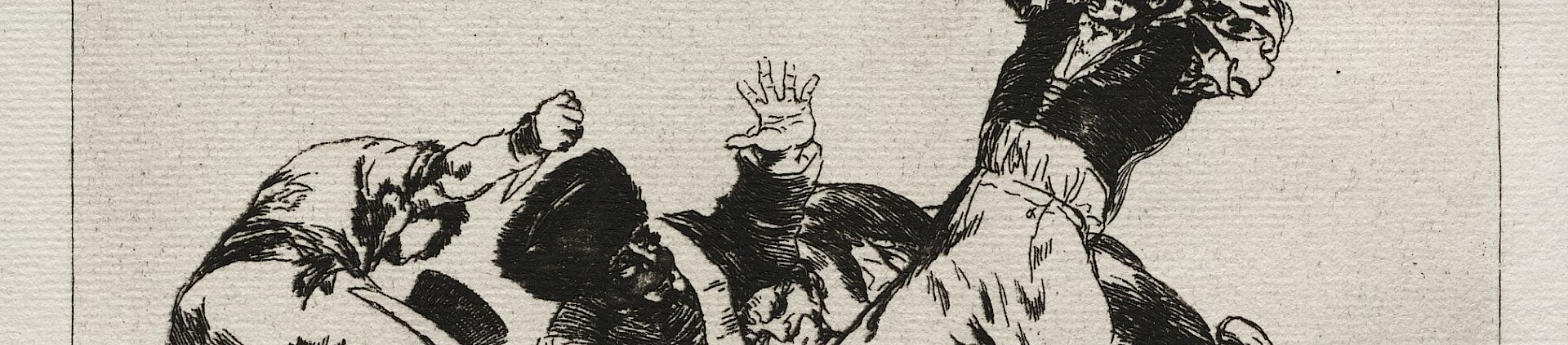
Cover image: Francisco de Goya, Plate 3 from The Disasters of War (Los Desastres de la Guerra): The same (Lo mismo), 1810 (published 1863)


What shapes do solidarities take in these strange times we are living in? How can we find and forge solidarities when faced with genocides, human rights violations, and inexplicable injustices daily? Can storytelling play a role in liberation?
