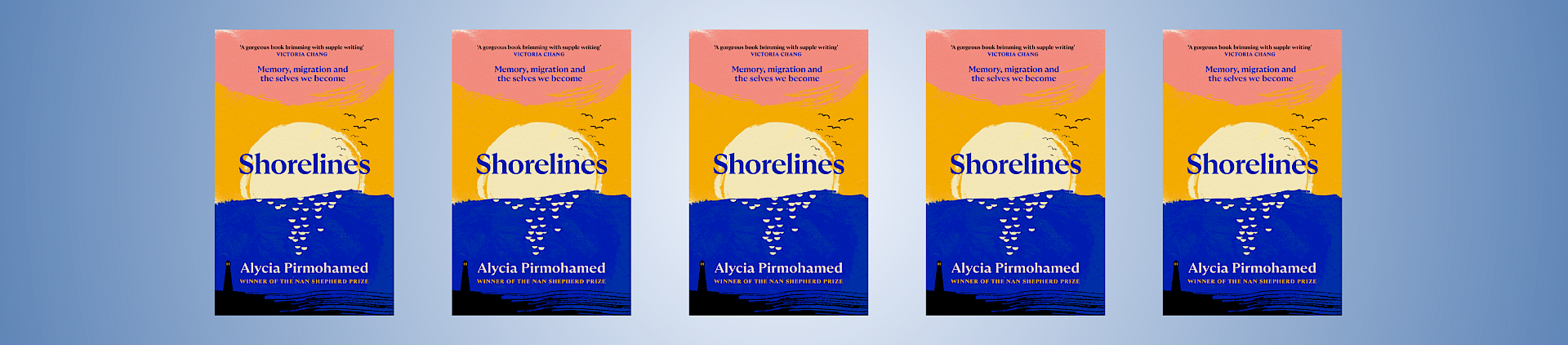
Extract: Shorelines by Alycia Pirmohamed
Read an extract from Shorelines: Memory, migration and the selves we become, the Nan Shepherd prize-winning debut nonfiction book by Alycia Pirmohamed. The Canadian-born, Scotland-based writer reconciles her identity and memories with those of her family across landscapes of place, faith, and community. Playing with the expectations of the nature writing and memoir forms, the immersive, lyrical narrative travels between the British Isles, East Africa, Midwestern Canada, and the Pacific Northwest, as well as Pirmohamed's home city of Edinburgh.
55.9533° N, 3.1883° W
Echoes in the garden
Stones of Scotland / ‘(a)version’
Faith, like everything, has a form. I wake up some mornings, and prayer finds me as naturally as language. The ritual of recitation tugs me forward into the whole of my day with its vast energy. Last night, I dreamed that my younger sister and I were together and preparing for evening dua — though we are, in actuality, over fourteen thousand kilometres apart and with a deep, mysterious ocean between us.
This dream is strange. Of all of us in my immediate family, my younger sister and I have strayed the furthest from our faith. But it also reminds me that, yes, I carry a strong remnant of spirituality within me. I catch myself praying all the time, unthinkingly, as if it is a bodily process as automatic as breathing. Prayer even appears within the metaphysical boundaries of my dreams. I teeter back and forth in its wind, participating in push and pull: I practise my faith and then I let it go. I pray to Allah and then I displace Them to the back of my mind. I am aligned and then I am not.
/
I have a complicated relationship with my Muslim upbringing. When I think I need it the most, its comfort and belief, my faith eludes me.
In the spring of 2020, two things coalesced. This season marked the first lockdown in Scotland, and it marked the holy month of Ramadan. In self-isolation, afraid and lonely, I found myself withdrawing. I was unable to feel connected to most things, but I felt especially disconnected from Islam. I was displaced from my family, who remain the strongest link I have to my faith. And during this season, the distance between Edmonton and Edinburgh seemed greater than ever, too great a distance for even my dreams to travel.
As a result, Ramadan took on a different, unrecognisable shape, one edged with trepidation. I responded by resolutely listening to prayers through my old phone speakers, though they were ribbed with static. I tried to appreciate digital moments with my family more completely. My mother and father and aunts and uncles all separately sent me images of spring flowers annotated with blessings in lieu of videos of family gatherings. And in my pursuit to feel close to my faith despite these new chasms, I vowed to be more self-reflective, meditative, and generous with myself and with others. At a time when relationships felt out of reach, I wanted to connect more deeply with my local surroundings — and ultimately, as became evident over those asymmetrical months, with the natural world.
Although I wouldn’t realise it until much later, over those first months of lockdown, I was collecting. I was beginning to squirrel away the anxiety of the pandemic in my body, which has unfurled now into its new, marked and unequivocal margins. I didn’t know it then, but four years into the future, I would be weighed down by these abrasions. Eventually, my body would transform into the kind of emotional and physical shape that could just barely contain the disquiet.
As the cracked screen of my phone became not quite a home but a place I certainly lived in, someone I trust advised me to find a way to dislodge what is lodged — swim in a river, perhaps, she said.
I thought a lot about those words, how they made me notice something invasive and unbelonging in my body. Within a few months, I was also forced to turn to the question of how to contend with the inevitable act of lodging. The process. The way by which trauma leaks into a system, a body, and calcifies.
/
Earlier that month, I was meant to read at my friend Pratyusha’s launch for her work bulbul calling in a forest near London. This was one of many things made impossible by the pandemic. Instead, her hand-sewn pamphlet arrived in the mail near the start of Ramadan. Both this fact and the book’s significance to me as an object became important to my spring observation: I began an intentional practice of reading a poem by a South Asian woman outdoors every day, and I started with the pages of bulbul calling. I thought doing so might help me feel the connections I longed for, and even, perhaps, help me to dislodge. The poem as it was reified against the contours of spring — that was my river.
With mosques closed for the foreseeable future and communities scattered across the city, this routine and its rhythm were, I believed, one way I could feel closer to other voices and ultimately, through intentionality, to my religion. It became an act of religious observation and a form of spirituality in itself. I began my endeavour at the start of Ramadan and continued until Eid. In this way, walking and prayer intertwined.
/
Seeds and their scattering are irrefutably linked with metaphors of displacement: of errantry, of wandering, of migration. Agents of pollination are part of this cycle: the orchid, the moth, the wind. This is a compelling mythology.
In Cultivation and Catastrophe: The Lyric Ecology of Modern Black Literature, the scholar Sonya Posmentier writes that ‘hybridity and diaspora are etymologically related to organic life’ and she suggests this signals the need to consider these cultural concepts as ‘living metaphors’. As I walked through Edinburgh’s various landscapes, I couldn’t help but reflect on movement and migration. Amongst those green spaces, I found my thoughts automatically straying to reflect on my diasporic identity.
I had decided early on that one of my treks during Ramadan would be toward Salisbury Crags, Edinburgh’s city cliffside; I was drawn to their unavoidable proof of this city’s natural verticality. One morning that spring, I had set out with the intention of walking there, but weather cut short my journey. I found myself scattered instead near Easter Road, where I was jostled by the wind and unable to continue to the path that would eventually lead me to the foot of the crags. Instead, moving against a rough ecological friction, I turned abruptly and made my way to Regent Road, succumbing to the vectors of strong winds that gasped around me.
The wind speed that day was thirty-one miles per hour. According to the Beaufort Scale, I could call this a moderate gale. The moderate gale ushered me away from what I knew and toward the unexpected, as if I was a seed being carried along to some resting place where I’d eventually root, and bloom, and flourish.
‘Wind was the invisible force powering colonial expansion,’ writes poet and interdisciplinary artist J R Carpenter. The Beaufort Scale informs the structure of her multimodal piece This is a Picture of Wind, where poetry is ‘randomly generated in part by live wind data and in part by the inexorable passage of time’. I felt taut within these ideas, within the inability to make my own path here in Edinburgh. I thought about the strong pull of imperceptible forces that led me to myself over a long history of forced displacement.
The wind, I have come to realise, is a cartographer — a mixture of biology, art, and technology. It is a system that surveys the past and tells the future.
/
I’m both uncertain and reassured when it comes to definitions of diaspora. I find the image of the wayward seed compelling, but I’m also distraught by it. I crave rootedness but then I’m jolted by the sharp reminder of what I ache to root into — a place where modernity and Westernisation, heteropatriarchy and capitalism are prioritised.
Writer and documentarian Dionne Brand writes, ‘belonging does not interest me. I had once thought that it did. Until I examined the underpinnings. One is mislead when one looks at the sails and majesty of tall ships instead of their cargo.’ When I do lament for a homeland to which I belong, which happens regularly in spite of myself, I understand I am doing so as a reaction. I employ the diction of difference in response to the violent misrecognitions of my identity by the nation I live in. A tried and tested way for a country to uphold its physical and metaphorical borders, to sew shut with finality its own identity, is to create a borderland in which someone is always feeling unmoored, and unaccepted, and un-homed.
In Insurgent Empire, Priyamvada Gopal interrogates ‘the tenacious assumption that the most significant conceptions of “freedom” are fundamentally “Western” in provenance’. As I reflect on belonging, I think also of the mathematical asymptote: the long line that can get close, so close, to touching its nearby curve. Line and curve are in proximity, the difference between them almost becoming zero. But they do not touch, and they never will. The asymptote is the limit. I am the limit by which the oppressor can know themselves.
All of this because once my ancestors were forced by the wind and arrived elsewhere.
/
As an immigrant and settler in Canada, I, too, am marked by Westernised modernity. I am part of an ongoing colonial precedent. Although I am easily marked by differences that place me at the very fringes of commonality within certain nation states – by aspects like my race and my religion – my personal archive is also filled with the lived experience of being educated in the West, of working in the West, and of submitting to academic models of the West, where the concept of decolonising the institution is contradicted by the institution’s very existence on stolen land.
Drifting, scattering, planting, rooting, blossoming, drinking in the Scottish rains, being pulled by its wind — yes, I embody all of this. And simultaneously, all of this is rupturing. I double or triple or multiply into an octet, continuously, until I am relational to everything all at once: river and stone and wind. Until I am the asymptote journeying forever toward infinity.
/
In the UK, three years after my green project, pandemic restrictions ease and I find myself reading my work aloud to predominantly white audiences. Under harsh lighting, with my body pointed toward a room of unfamiliar faces, I recite my poetry about the solitary heron at Lochend Park, about elk and their muscular strength in Jasper, about Florence, Oregon, where oysters gather on oceanic ridges of the Pacific Coast. These poems are tinged with the complexity of my Muslim faith. I river between sexual desire, queerness, and womanhood, touching on the way these aspects weave together with my religion. The elk, their antlers poised against green vine, are symbolic of a lesson: it is as if Allah himself has approached me to impart Their divine knowledge. I want to undercut insidious thought processes that categorise me as: either a Muslim writer or a nature writer, but never both.
Kazim Ali writes, ‘the body is not the opposite of the spirit, nor are physical matters oppositional to abstract ideas of the spirit’. I have grappled with my sense of self in a world that thrives on dichotomy. I have felt the grief of trying to split myself apart, as if body and spirit, as if faith and queer desire, are incongruent. As if I have to close off one to wholly belong in the other.
I return to Ali’s work often; it was his poetry that first made me feel safe within my identity as a queer Muslim woman. Through my writing, through its sinews of imagery and introspection, I attempt to accept the alternating calcifications and softnesses of my body. I try to find a way to accept my body as it exists beside my religion. Eventually, over time, I allow myself to feel at peace when I pray and when I don’t. I allow myself to feel distraught when prayer eludes me. I allow my body to be my body, whether engaged in the religious experience of counting or gathered in the arms of an intimate partner. I remind myself that belief is also a plot of land on which we can grow the seeds of what we love.
Shorelines: Memory, migration and the selves we become by Alycia Pirmohamed is out 13 August with Canongate Books

