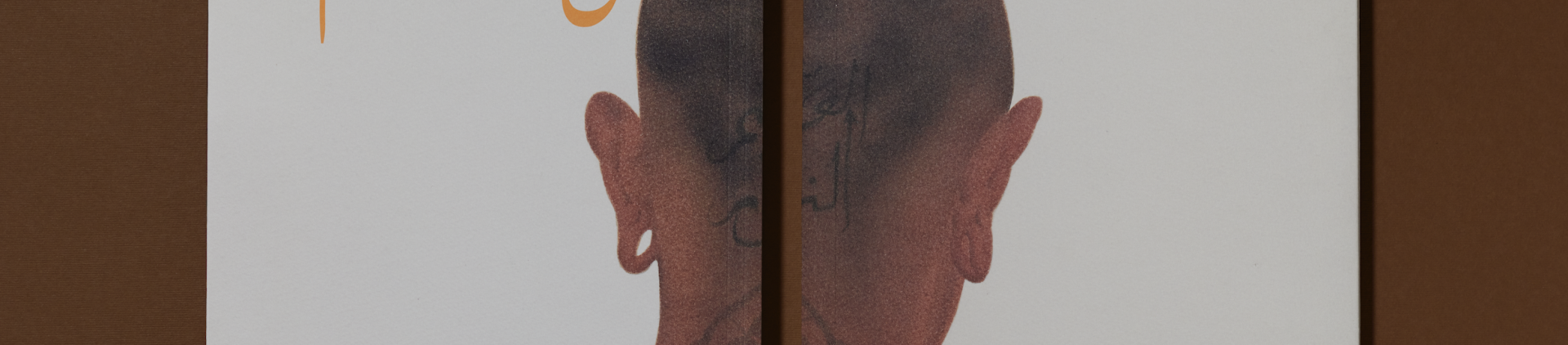
Imagining Briefly Through Urdu
Saira Ansari anchors this essay in Pakistani artist Ali Kazim's recent Urdu Worlds exhibition and an accompanying publication called the Urdu Qaida/Alphabet Book, which explores the qaida as historically a cultural, social, religious, and political object, beyond its intended function as a pedagogical tool. Along the way, Saira reflects on her own relationship to and memories of learning and speaking Urdu while bringing Kazim's work into conversation with the artist Zarina. She further considers what it meant for each artist to turn to the book form as a way of holding onto a linguistic world.
Supported by a grant from the Open Society Foundations.
In early 2026, Pakistani artist Ali Kazim had a large survey exhibition in Dubai at Ishara Art Foundation, a nonprofit space dedicated to contemporary art from South Asia, platforming well-known emerging and established practitioners from the region. The foundation is the first of its kind in the Gulf. Though South Asians – in particular Indians and Pakistanis – form the larger part of the expat population in the UAE, they haven’t been represented in local and regional artistic dialogue nor have they had visibility in art institutions at the same scale. While the considerable and considered work carried out in the past decade by the Sharjah Art Foundation (SAF) – and, to quite some extent, Jameel Arts Centre – has platformed critical practices from South Asia, Ishara remains the only institution dedicated to the region.
Kazim’s exhibition, titled Urdu Worlds, running from 16 January 2026 to 8 June 2026, was additionally anchored by the production and release of a special artist publication by Kazim, the Urdu Qaida/Alphabet Book (Ochre Books). An exhibition in the UAE centring Urdu, at this juncture in time and within this geopolitical framework, has many undercurrents and riptides. And because it is my mother tongue, it is hard to keep out the personal. So, I won’t.
*
One of the most common languages in the streets here in the UAE is a mixed plate of Urdu-Hindi-Arabic — a pastiche lingua franca that bridges peoples and the authorities in a way that little else could. It developed primarily out of the need to communicate with the extraordinarily large labour and blue-collar force that has been coming to the Gulf, mostly since the post-oil-boom construction industry of the 1970s and the service industry soon after. But linguistic contact has existed in other ways through centuries-old Indian Ocean trade links and pilgrimage too. And so, there is a pidgin native only to the Gulf and the cultures that have developed around it. Languages are like that — organic, constantly shifting, finding ways to keep people talking, thriving, surviving.
Historically, assimilation has been the very life source of Urdu. At the risk of flattening history, from the thirteenth century onwards, with the expansion of various Muslim conquests of the subcontinent, Urdu developed through North Indian vernaculars absorbing Persian, Arabic, and Turkic linguistic traditions. Its literary traditions and poetic conventions flourished through the seventeenth and eighteenth centuries, followed by the systematic codification of grammar, prose, and written forms in the nineteenth. Following Pakistan’s creation in 1947, Urdu’s designation as the national language expanded its institutional role in education, government, and media, while it continued to develop in both Pakistan and India through literature, cinema, poetry, journalism, and popular culture. While closely related to Hindi, it is written primarily in a Perso-Arabic script, usually in the Nasta'liq style. Despite centuries of change, it retains a recognisable grammatical core, making much of the older texts still legible.
In the nineteenth and twentieth centuries, British colonisation brought another linguistic layer that was folded into Urdu and other local languages (‘office’, ‘file’, ‘rail’, ‘platform’ …), and similarly, many words and terms from India were carried back with the colonisers (‘coolie’, ‘bazaar’, ‘khaki’, ‘chutney’ …). Such is the nature of language: transactional for the sake of coherence, bureaucracy, beauty, and war.
The Urdu I grew up with in Lahore is jested about as a bastardised version, with its liberal use of Punjabi terminology and phonology. My mother’s maternal family speak a beautifully lyrical dialect of Punjabi, and my father’s entire family, originally hailing from Uttar Pradesh in India, speak a very crisp form of Urdu. As I went back and forth between households, I learnt to code-switch long before I knew what the term even meant. My English-medium school fined us for speaking in Urdu during classes, so my Urdu sentences outside of it almost always had a liberal sprinkling of English. Our Ghalib-quoting Urdu teacher despaired.
*
Hammad Nasar, the London-based curator of Urdu Worlds, reflects in his essay for the Qaida on the loss of a linguistic inheritance and his own desire, as a Pakistani raising his family in the diaspora, to reconnect with Urdu in a meaningful way. His text suggests that one can inhabit or recognise the cultural worlds of Urdu even without full literacy, as literacy is only one mode of belonging.
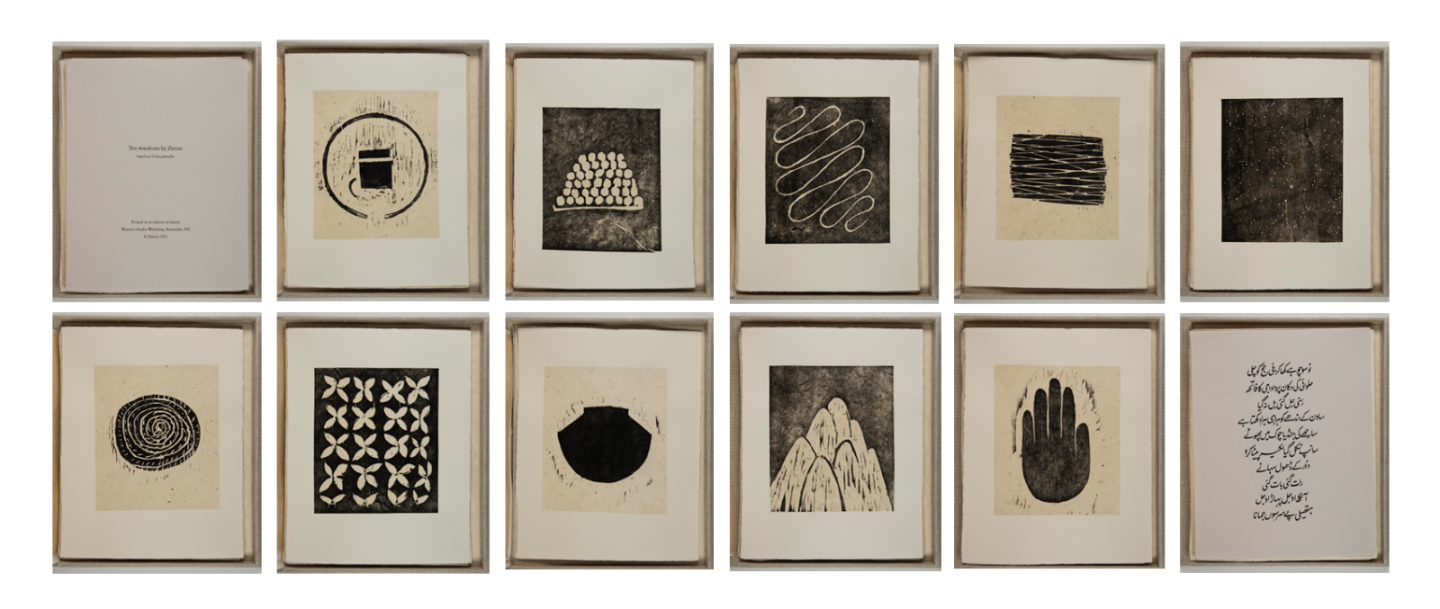
Urdu Worlds framed Kazim’s presentation in dialogue with work by the seminal Indian-born, New York-based artist Zarina (1937–2020), whose minimalist practice returned repeatedly to the memory of home and the language that still connected her to it. Nasar positioned Zarina’s 1991 artist book Urdu kay aik so aik mahavray (101 Urdu Proverbs) at the centre of the main exhibition as an anchor. The book contains a hundred and one proverbs in Urdu selected by the artist’s sister, Rani, along with ten woodcut prints produced by Zarina at the Women's Studio Workshop in New York.
Zarina’s relation to Urdu was bound up with displacement, Partition, migration, remembering a home she could never return to, and the portability of language. The Urdu proverb book became a loving gesture to pass on the joy of the language to others. The artist gifted these books generously, and Nasar’s two sons each have inscribed copies — sons raised in the UK and Hong Kong, unable to read or write the script despite being able to speak the language with varying degrees of fluency.
While Zarina approached language as a tool to remember what she had left behind after living outside of India for most of her adult life – and perhaps to remain tethered to her identity through it – Nasar approaches it as an entryway for his children who are cultural strangers to the language. Years later, the same book inspired him to collaborate with Kazim on an Urdu alphabet book – a qaida – bringing together over twenty years of Kazim’s artistic practice, including new works commissioned for the publication.
Rather than a conventional primer, the book pairs Urdu letters and words with Kazim’s images of people, landscapes, animals, and everyday life, offering a visual entry into the cultural worlds of the language. Nor is it simply a catalogue of works. The artist’s deliberate selection of words and corresponding images reveals layers of historical and cultural associations that unfold gradually. Urdu Qaida/Alphabet Book has been published by Anita Dawood (Ochre Books), Nasar’s wife and long-term collaborator, with whom he co-founded Green Cardamom in 2004.
Such is the nature of language: transactional for the sake of coherence, bureaucracy, beauty, and war
*
When I first pick up Kazim’s qaida, I instinctively open it from the English side, reading it left to right. Since it is designed to be bilingual, a reader can start from either end (if you’re just reading the essays). But the alphabet itself only starts from the Urdu side — the right side. I switch sides and start with Alif.
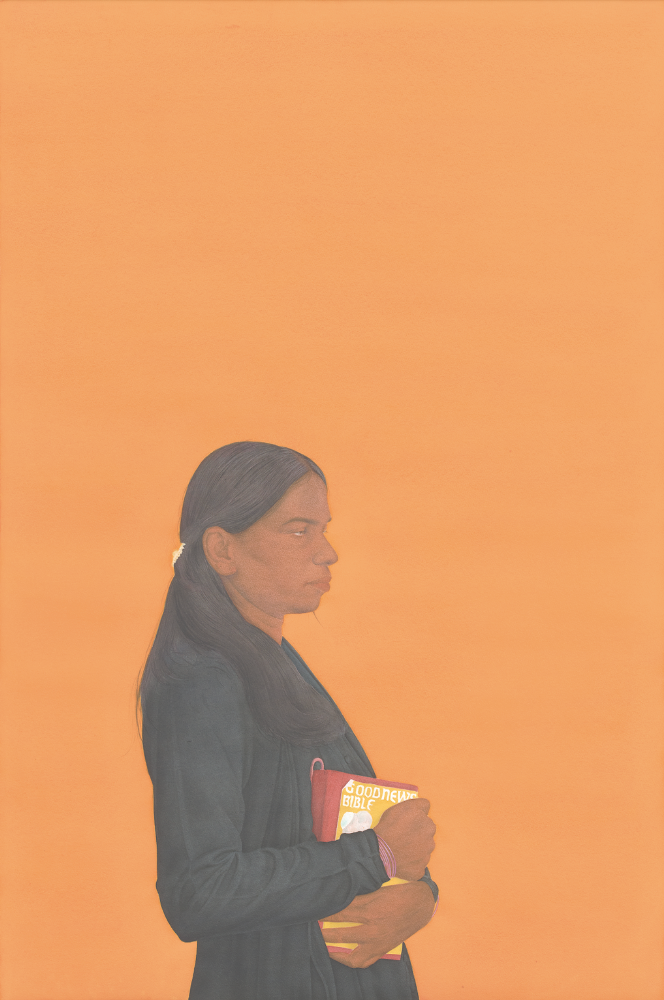
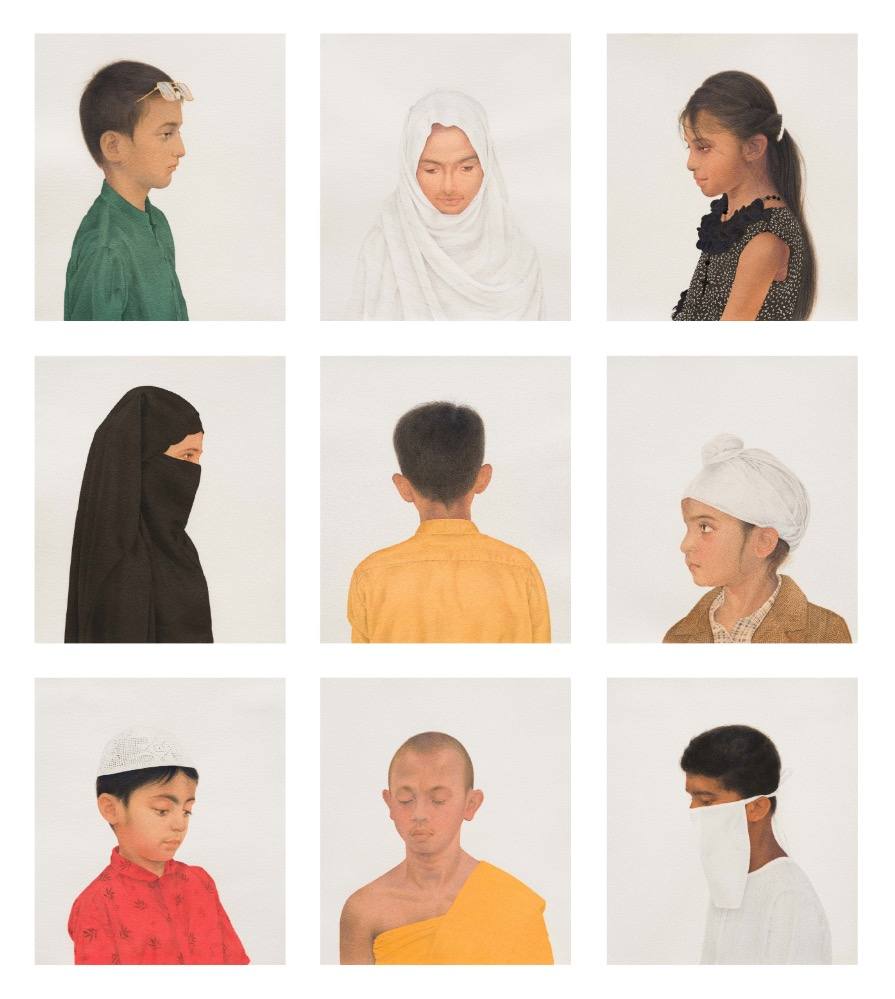
(ا) Alif se imaan (faith). Illustrated next to it is a painted portrait of a young Christian girl holding a Good News Bible.1 As I flip through, two more spreads of artwork follow alif with images of girls, boys, and young men practising different faiths, portrayed only by the clothing they are wearing or the inscribed marks on their bodies. It’s hard not to pick up the inference or the importance of such choices in a country plagued by religious discrimination. Immediately after, the page turns to (آ) Alif mad aa se aank macholi, with an image of children playing hide and seek.
I attempt to try to think back to my first qaida, and although the recollection is not chronologically correct, I think of the Noorani Qaida. This is a foundational alphabet book that many of us used to learn the Arabic script to read and recite the Quran. It does not have images, though it can be colourful and have embellished borders. Because Pakistanis already learn the Urdu script in school, I understood, quite erroneously, that the Noorani Qaida was a religious text. And, like countless others, I learnt to read the Holy Book without ever understanding what I was reading. There are memes dedicated to Pakistanis thinking Arabic songs are sacred words because we ascribe the text and its script immediately to our religious training.
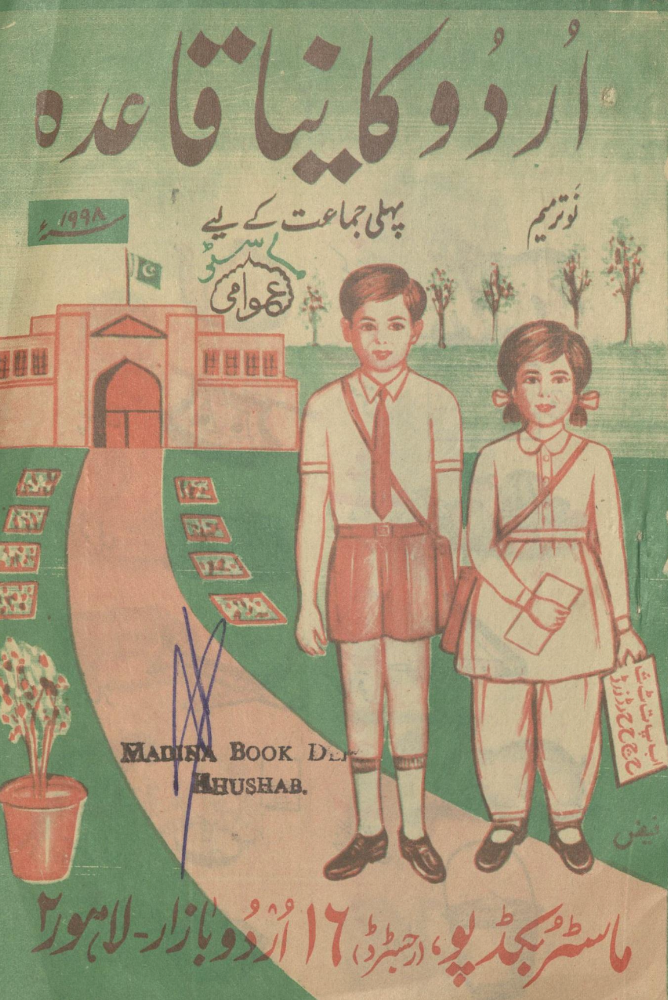
But when I think harder, I remember, vaguely, the Urdu and English alphabet books and charts that were in my classroom nearly four decades ago. A for apple / (ا) alif se aam. B for ball / (ب) bey se balla, billi, batakh …
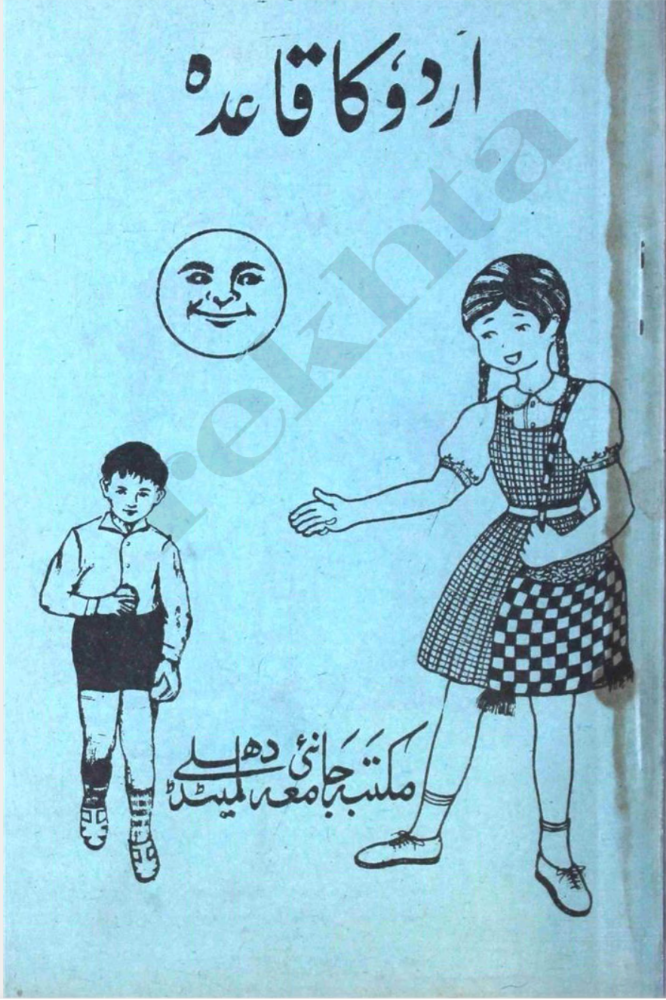
Urdu qaidas are beginner primers usually aimed at children, but they are also culturally interesting objects in their own right. A qaida carries a world of images, values, memories, and cultural associations. In a more conceptual sense, a qaida is a method for entering a language. Because Urdu is written in Nasta'liq, learning the script is not only about recognising letters but also learning proportion, joining, spacing, direction, and visual rhythm. The qaida has always sat between education and childhood memory, but as one begins to dissect it further, it is about conditioning too –– in extreme cases, even indoctrination.
An article published in 2011 in Dawn (Pakistan’s premier English-language newspaper) argues that educational books have increasingly been used to instil state-approved ideology in Pakistan, more perceptibly and aggressively in and after the 1970s — nearly twenty-five years after independence from the British, and almost immediately after Bangladesh seceded from Pakistan after a bloody struggle.
One can argue that almost all foundational textbooks across the world teach a state-approved version of history, identity, and nationhood. But this article pointed to something more sinister. A specific version of the qaida, developed for a volatile region in the north, referenced very violent imagery — for instance, (ب) bey se bandooq (gun). As if the use of a weapon as a teaching example wasn’t itself immensely problematic, the letter was then illustrated with a Kalashnikov, a firearm that proliferated in Pakistan after the Soviet invasion of Afghanistan in 1979, and the subsequent Afghan Jihad, during which Pakistan became a major conduit for weapons supplied to the mujahideen through the CIA–ISI network. Other examples in that qaida included, according to the author, references to Jihad and the Twin Towers.
A qaida is a method for entering a language
While this may be an exceptional example, there has been an increasing push for conservative religious values in these textbooks over the last few decades. Several Pakistani academics critical of the national curriculum mandated by the government discuss how imagery is positioned to highlight ‘gender-appropriate’ dressing, roles, and behaviours. The little girls wear a hijab and help mostly with household chores or perform domestic tasks. The boys have more outdoorsy roles and may either appear in a Western-style uniform or prayer garb. At surface value, for many back home, these are innocuous decisions.
*
Ali Kazim was born in Pattoki, an agricultural city in the Punjab province of Pakistan, more endearingly known as the City of Flowers because one of its main trades is the cultivation of rose, jasmine, gladiolus, and more. Somehow, this little factoid explains so much about the elements that appear in his images. Over the years, Kazim has come to be recognised for his incredibly fine treatment of drawing and painting, achieved through excellent draughtsmanship and multiple layers of pigment wash similar to the South Asian miniature painting tradition. He works slowly, very slowly, and saturates the paper surface, bathing it in colour, then drawing again upon it, until he reaches a final version of the image. His works have often included portraits of himself, other men, flora, fauna, objects, landscapes, clouds. And more recently, children and women.
I asked Kazim about the writers Nasar mentions as influences in the curatorial essay — Naiyer Masud, Gopi Chand Narang, and Muneer Niazi. These are figures whose Urdu fiction, criticism, and poetry circulated across the literary geographies of India and Pakistan from the latter half of the twentieth century into the early twenty-first. I was intrigued by how Kazim described his delight in the wit of these writers, their exploration of the unknown, and their fascination with the everyday man in their stories. In particular, Kazim leans into the people in these stories who have characteristics that are undeniably present in his own artworks.
Speaking of Masud, who is known for his atmospheric writing, Kazim brought up the short story, ‘Miskeenon ka Ahaatah’ (Destitutes Compound). Kazim pointed to the clever writing of two characters whose attributes and mannerisms stay embedded in memory long after the story itself, such as the ever-present andhi nani (the blind grandmother) who always sits on the porch and can identify the comings and goings of the protagonist by the sound of his feet. Even after the story moves ahead sixteen years, she stays in the same place, cracking betel nuts and recognising footsteps. Or the hairless, baby-faced, tender-voiced man whom everyone simply called Bachpan ki Mohabbat, meaning childhood love.
Kazim has a proclivity towards poetry and its lyricism, fascinated by how a whole world can exist in a representation. He explained that these texts already populate his worldview and can eventually seep into what he is thinking about when he paints. But it is never a matter of direct inspiration. His paintings also add flesh to simple characters from villages and cities who may otherwise seem inconsequential or unimportant but have worlds within them. These figures populate his imaginary and pour out into his artwork, as well as into the Urdu qaida. Perhaps the qaida flips here from being a primer into language to a dictionary of Kazim himself.
*
In a discussion panel that I moderated at Urdu Qaida/Alphabet Book’s launch, Taimur Hassan, an avid collector of both art and historical knowledge, raised an interesting question. Kazim’s work, he said, had never seemed overtly political before, but several new works in the qaida are decidedly anti-colonial.
Hassan was referencing the following works: (ل) laam se loot features drawings of treasures stolen by the British Empire. The irony of taking the Sanskrit word ‘loot’ and absorbing it into English is not lost on anyone. The page features Tipu’s Tiger, a mechanical tiger made in wood that, when operated, seems to maul a British soldier trapped under its paws; the elaborate octagonal Throne of Maharaja Ranjit Singh that was pillaged by the East India Company; pottery shards from archaeological sites; and, of course, the infamous 105.6-carat Koh-i-Noor diamond that is now part of the crown jewels and is a subject of passionate repatriation demands every few years by different parties across Pakistan and India.
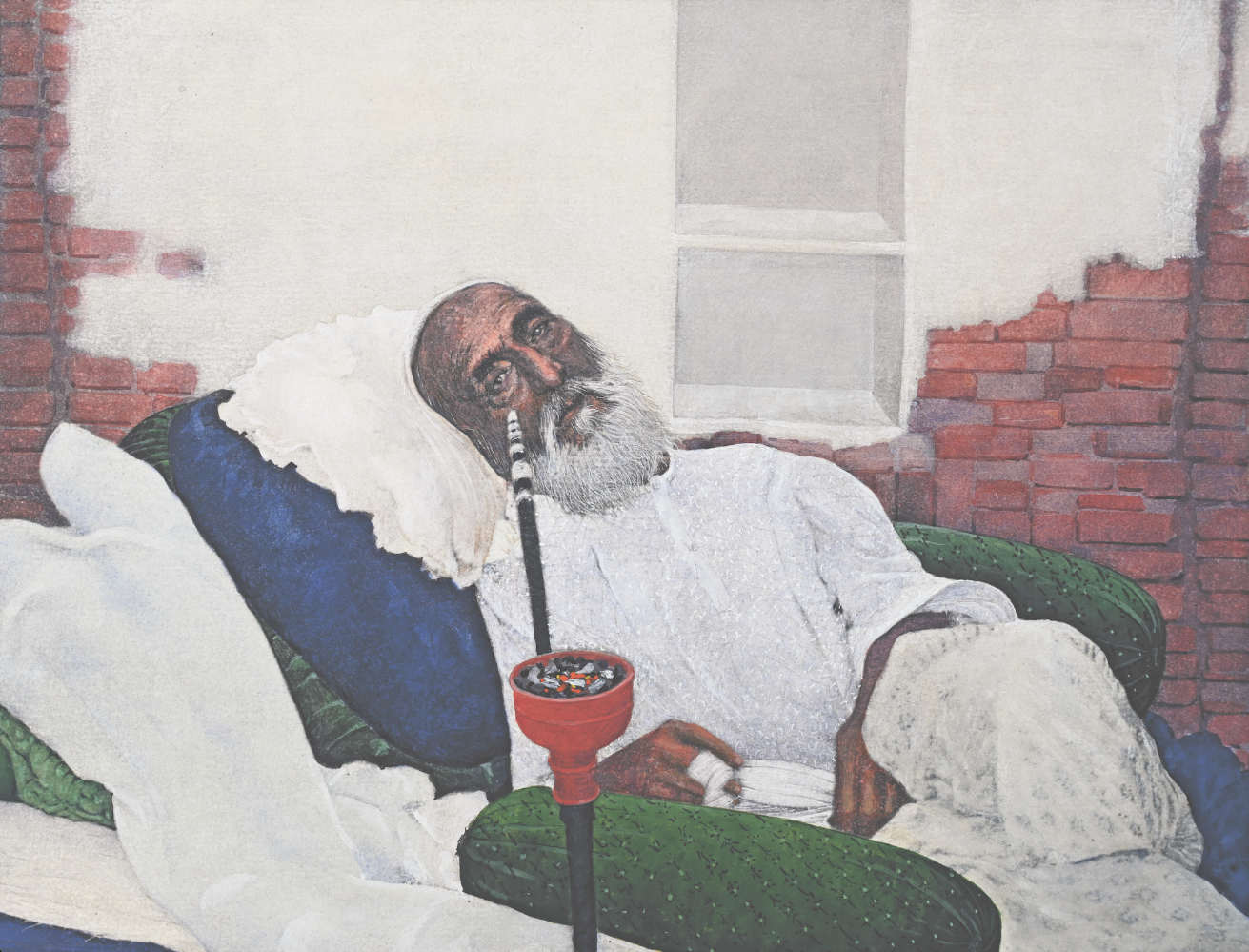
Finally, a drawing from an 1858 photograph of the last Mughal emperor, Bahadur Shah Zafar, as he lies fading, illustrates (ض) zu-ad se zaeef (weak or elderly). This photo came to represent the end of the Mughal Empire, which had begun to weaken long before him; he is pictured as old, humbled, a prisoner about to be forced into exile by the British. Zafar, who was a poet, was said to have scrawled poetry on the walls of his compound with charcoal in the end, because he was not allowed paper or pens.
... the qaida flips here from being a primer into language to a dictionary of Kazim himself
For Kazim, this was not meant as a new direction but as a continuation of his practice. He considered an earlier drawing of the Priest King, made in 2005 and featured next to (ك) kaaf se King Priest, as part of the same interest. This ancient stone sculpture from the Indus Valley Civilisation, circa 2000–1900 BC, juxtaposed with the frail image of the Last Mughal from the nineteenth century, opens up different possibilities of identity- and image-making.
Whether or not these works mark a political shift in Kazim’s practice, their inclusion in the qaida offers a decidedly loaded encounter with the histories that have shaped us.
*
Urdu Qaida/Alphabet Book also operates as a catalogue of the Urdu Worlds exhibition, complete with the curatorial and additionally commissioned essays. Nasar and Dawood said the qaida is technically utilitarian, can be used on its own, and has been published as a trade book. It is idealistic and beautiful, but beyond the love of art and our limited art world networks, it may always remain a niche project. They added that the book is expensive to produce and may not be able to achieve a cheaper retail price for any kind of mass consumption in Pakistan, where the currency continues to struggle against the dollar. I think of the rigidly structured national curriculum in Pakistan and wonder if something like this would ever be able to slip through into schools. Perhaps not. But if it were to find its way organically into homes person-to-person, or into bookshops, imagine the possibilities, the questions, the curiosities …
I have approached Kazim’s qaida entirely as an artist book. I believe this publication format allows artists a different kind of freedom and power to express themselves. Artist books are so much more than the tome-sized monographs they are often confused for. The latter imposes limitations and a specific lens through which to study a life and practice. The artist book, instead, allows for more of a creative endeavour on the part of the artist. Furthermore, books provide a kind of circulation that the art economy doesn’t always allow (even when considering the distribution and pricing challenges of this book), permitting possible creative choices artists would not necessarily make within their artworks.
Zarina’s artist book, 101 Urdu proverbs, sits a little differently. For one, it now exists only in institutional collections and in the hands of people she gifted it to. But apart from such reduced or limited circulation, something else happens here. The book appears within a body of work that liberally used Urdu as part of its visual and conceptual vocabulary.
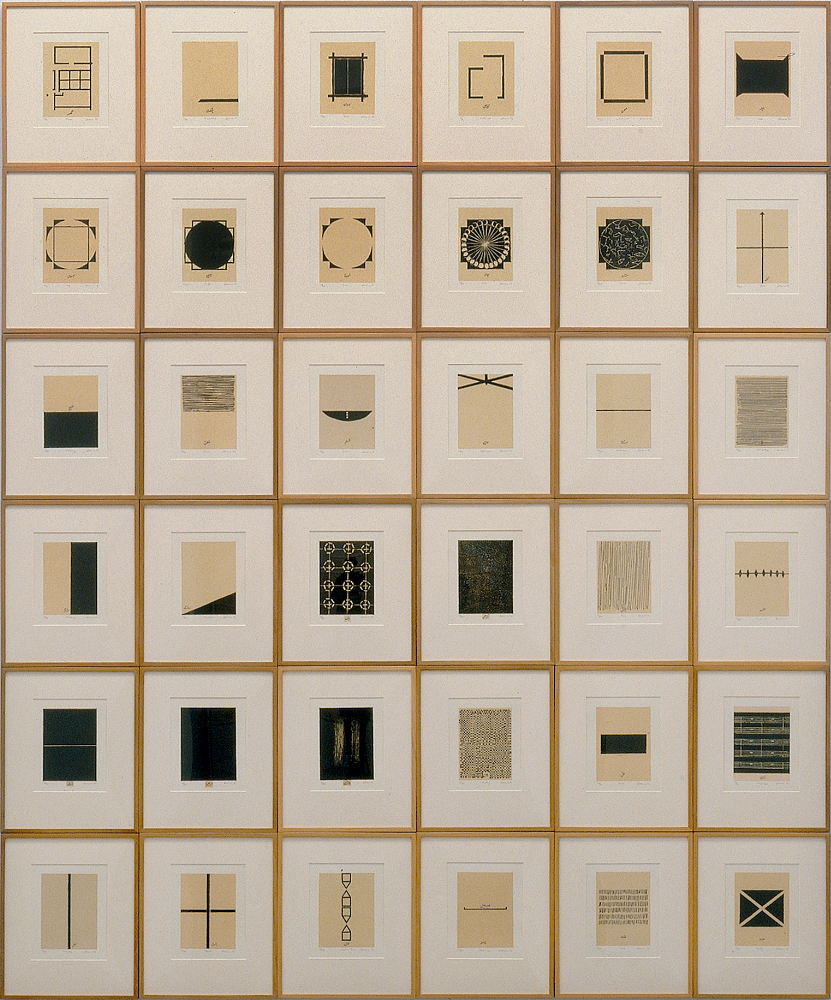
The first work of Zarina’s that I encountered in person was 'Home Is a Foreign Place' (1999), which includes thirty-six woodcuts on paper with minimal images and Urdu text printed beneath them. Back then, I had been moving from home to home, across houses, cities, and countries, for over thirty years. This work moved me in a way I had not expected. I ended up penning an ode to one woodcut in particular – 'Dopahr / Afternoon' – that had three criss-crossing strokes at the top of the image representing a ceiling fan. Therein lay a core memory, which evoked a visceral flashback to hot summer afternoons in my mother’s home, nodding in and out under the soporific sound of the pankha.2
*
I recently started teaching a class on art theory and critical discourse in a graduate programme in transdisciplinary design. The students are intelligent and come from a variety of academic backgrounds, mostly graphic design and film, and none of them have any fine arts training that would traditionally have given them a primer on general art history. My challenge is understanding how we can take apart the canon without knowing what the canon has been. And, so, we have begun with the basic task of looking at images and explaining what we see and feel. Putting the image back into words and descriptions we feel comfortable with is an eye-opening practice for self-awareness. Or self-policing.
The thing is, the canon exists so ubiquitously but also so inconsistently across different worlds, that at some point we don’t even realise it has been dictating how we understand visual culture (ours, theirs, yours), what we ascribe taste to (that dreaded word), and, most importantly, what role the hierarchy of images has in writing our history. Images, as we all learn at some point in our learning or teaching careers, have a way of communicating at a deeply enchanting level that never really goes away, that is persistent or haunting, regardless of age or experience.
When I began writing this essay about Urdu and the different forms of placehood it creates for many, I realised that by asking my students to learn what it means to look, I was repeating an experience very similar to how we learn to read. A mother language allows us our first medium of communication, but an alphabet book is one of the first places where we learn precisely that relationship between word, image, recognition, and meaning. We learn to talk about what we belong to.
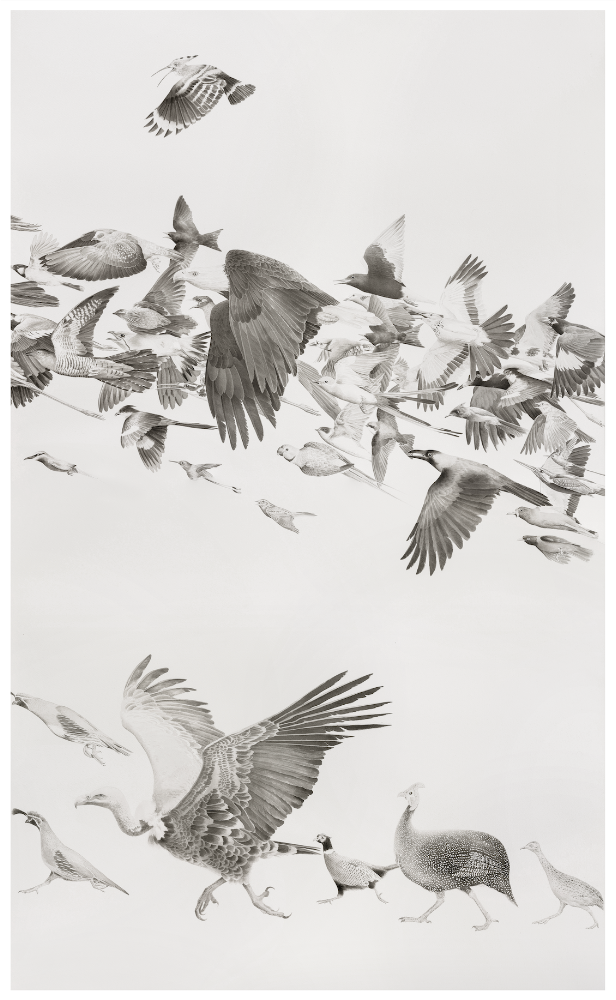
Kazim’s qaida therefore becomes less of a lesson in the alphabet than a proposition about what can be recognised and imagined through it. For (ہ) Choti Hay (or Gol Hay), Kazim uses hudhud, and illustrates the wise hoopoe from Farid-ud-Din Attar’s twelfth century poem, The Conference of the Birds. Lyrical and mythical traditions of the Sufi saints are venerated across Pakistan by people from multiple faiths, and this reference presents a plurality of experiences, love, hope, and fear, that one imagines a saner world could offer. In his little book of the Urdu alphabet, I imagine Kazim allows us to believe that could be true for everyone.
Endnotes
1 Good News Bible was published by the American Bible Society in 1976 and uses clean, simple, straightforward English instead of the original literary or archaic style. It is widely used by people for whom English isn’t the first language.
2 Saira Ansari, 'Dopahar: The Home Totem', Canvas, January/February 2019 issue (15.1), pp. 82.
Cover image: Image courtesy of Ochre Books

