Witnessing Palestine: On Apartheid, Censorship, and the Counter-Archive
In this essay, Allison Young examines questions of archival assertion and absence in the art world following 7 October 2023, emphasising the importance of recording, witnessing, and testifying to an ongoing genocide that is simultaneously hypervisible and invisible: livestreamed from social media, yet just as quickly erased at an institutional level. She particularly engages with the work of artists Gabrielle Goliath, Nan Goldin, Mary Hazboun, Ahmed Hmeedat, and Emily Jacir, among others, while reflecting on her positionality as an American of South African and Jewish descent, as well as historic solidaristic action between the global South African and Palestinian anti-apartheid movements.
This piece is commissioned in tandem with Wasafiri 127: Solidarities.
Supported by a grant from the Open Society Foundations.
‘So we record to document not for their sake but for ours … We record for future generations, to tell them this is what truly happened. That we stood here, demanded our rights, fought for them, and were annihilated. We record not to humanise ourselves for others, but so that future generations will remember who we were and what we did … to warn them against attempts at erasing our existence.’
- Asmaa Abu Mezied
‘To “see” Palestine means to act in support of its freedom.’
- Nicholas Mirtzoeff
‘What does it mean to declare support for Gaza? To simply resign ourselves to the task of seeing?’
- Fatima Joumaa
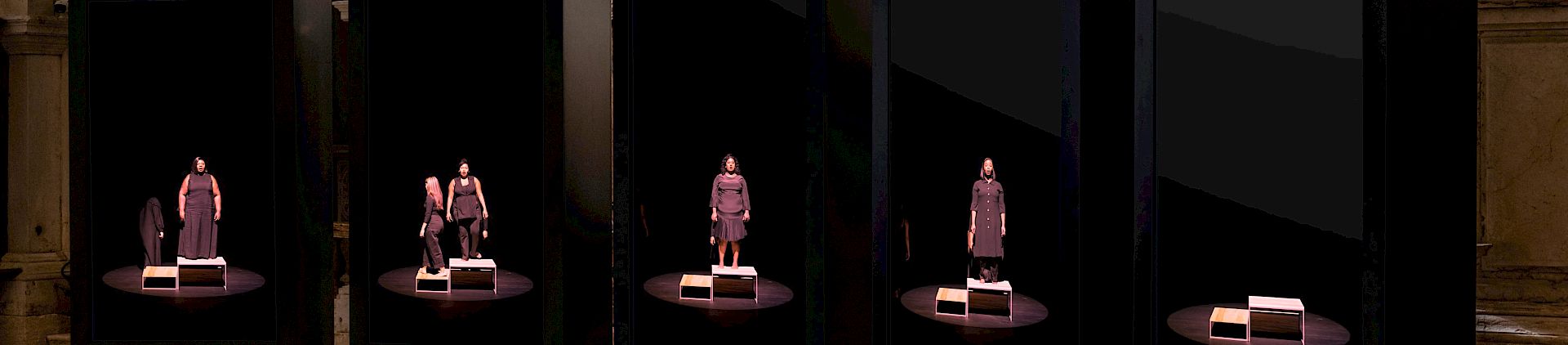
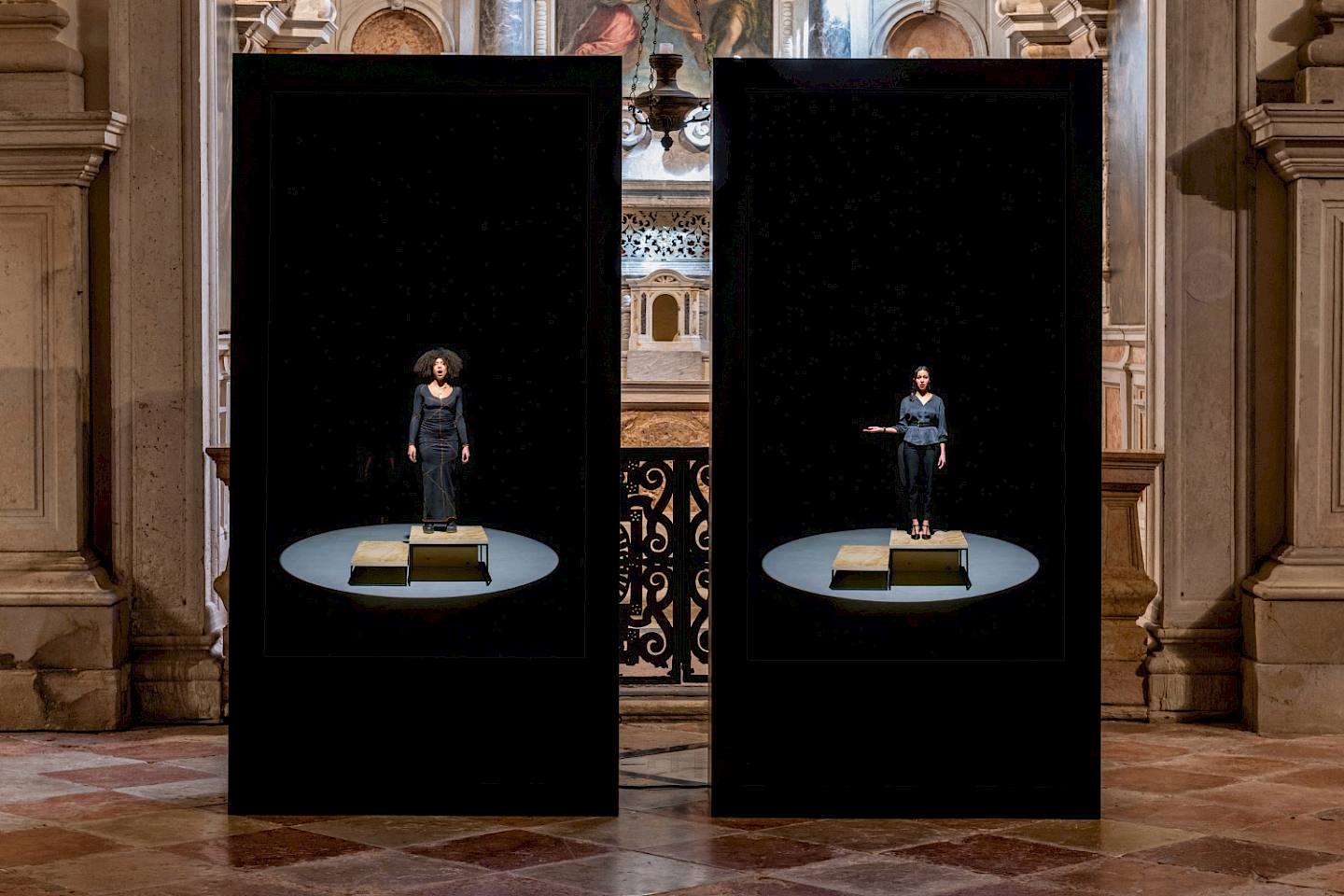
Standing in the historic Chiesa di Sant’Antonin in Venice this past May, I was held rapt by the solemn, monotonic soundscape emanating from South African artist Gabrielle Goliath’s video installation 'Elegy' (2026), now also on display at Ibraaz London until 17 January 2027. Arranged as a sparse polyptych of five tall screens, 'Elegy' presents five parallel choral performances, each following the same choreography: a vocalist, dressed in black, ascends a short platform to sing a single vibrato note. As she gradually exhales the long fermata and her breath starts to deplete, she turns to her right and steps down from the dais. Another vocalist, behind her, takes her place. For a few moments, the singers’ voices overlap, as if passing a flame between two candles. The cycle continues, such that the chain of voices is never broken (Fig. 1).
Goliath started making 'Elegy', an ongoing project about grief and remembrance, in 2015. Each iteration features a small group of femme singers of colour, who collectively eulogise an individual or group who have been victim to acts of femicide, hate crimes, or state violence. The installation in Venice, for instance, was dedicated to the Nama women killed by German colonial forces in Namibia; South African teenager Ipeleng Christine Moholane, who was murdered in 2015; and Palestinian poet Hiba Abu Nada, who was killed by an Israeli airstrike in Gaza in October 2023. Black, femme, Indigenous, and queer lives are often at risk of being omitted from official histories. Goliath compels viewers to communally witness, listen to, and repeat these stories. To not do so would be to perpetuate historical and archival silence — the single greatest threat to history and memory, and thus to our collective future.
There is a tragic irony, then, to 'Elegy'’s appearance in Venice’s Chiesa di Sant’Antonin, which was not the intended venue for the exhibition, however beautiful of an ambience it provides. In December 2025, a jury appointed by the organisation Art Periodic unanimously selected curator Ingrid Masondo’s proposal to present Goliath’s work for the South African Pavilion at the 61st Venice Biennale. It would have been shown on the second floor of the Sala d’Armi, where South Africa typically exhibits. Less than a month later, however, the Pavilion was terminated by Gayton McKenzie, South Africa’s Minister of Sport, Arts, and Culture, who referred to 'Elegy' as ‘highly divisive’ and misaligned with national interests. This decision, by a Minister known to have Zionist sympathies, was triggered by Goliath’s specific intention to memorialise a Palestinian poet. So, visitors to the official South African Pavilion this year were instead greeted by an empty gallery and a small group of protesters outside keeping vigil. They handed out bookmarks that read: ‘The South African Pavilion was silenced. Not our voices.’
The South African Pavilion’s cancellation was only the latest in a torrent of politicised and cowardly acts of censorship that have swept the art world since 7 October 2023. But this case was particularly jarring for me to witness, personally, as an American of both Jewish and South African parentage. It would be impossible, then, for me to reflect on the work and its silencing without admitting my own complicated positionality. For me, the incident reveals a haunting entanglement of South African apartheid with the ongoing occupation of Palestine, and offers an opportunity to reveal how pervasive mythologies surrounding national origins, identities, and histories are impacting our political actions, both personal and collective, in the present and future.
Like Goliath’s performers, I wish to briefly ascend the platform to sustain a collective sounding in my own voice, in the hope that more voices will follow as we keep communal vigil. This essay positions contemporary art as a vital facet of our necessary, collective witnessing of Palestine — or what the writer Zoé Samudzi, writing on 'Elegy', has called the ‘shared memorial responsibility of the living.’
Throughout this text, I interweave personal vignettes related to my experience of un/learning the Zionist mythologisation of Israel. Nicholas Mirtzoeff calls this process ‘seeing in the dark’ and asserts that one must recalibrate one’s vision to confront that which has deliberately been cast in shadow by statecraft and mass media. I also take inspiration from the long, global history of South Africa’s freedom struggle, including the ways in which the African National Congress (ANC) and the Truth and Reconciliation Commission (TRC) each opted to identify multiple pillars of the struggle, or multiple definitions of truth, respectively, reflecting an understanding that neither political progress nor national healing is a linear process. We each have different roles to play, and a diversity of coordinated actions is often more effective than the validation of only one form of resistance or reparation.
I consider, first, questions around memorial culture, acknowledging both the importance of publicly memorialising victims of oppression and the fact that collective memory is frequently politically manipulated so as to suppress any historical evidence that does not fit a state-sanctioned narrative. In light of such distortions, I show how contemporary artists have engaged both in the production of counter-archives (by recording the forgotten names, cultural artefacts, and cartographies of Palestinian history) and in sustaining communal memory of the ‘named and unnamed alike’, as Samudzi puts it. Art can offer, in other words, many paths towards the performance of ‘wake work’, to borrow Christina Sharpe’s term for practices of care and mourning in the aftermath (and ongoingness) of collective trauma. Contemporary art is uniquely positioned to facilitate the kinds of poetic experiences in which personal growth, ‘seeing in the dark’, and new seeds of solidarity can take root.
*
In 'One Normal Day', a 2018 painting by the Palestinian artist Ahmed Hmeedat, a man relaxes in a chair and leans forward as he inhales smoke from an ornate hookah (Fig. 2). He is seated within a radiant yellow field, as a former Israeli checkpoint looms in the distance. The checkpoint, however, has been emptied of soldiers, flags, barbed wire, and security cameras. There are no queues of desperate residents, no snipers. On the side of the building, Hmeedat has written the words: ‘Checkpoint Memorial’.
Hmeedat grew up in the Dheisheh Refugee Camp in East Bethlehem. Today, he maintains an artistic practice, runs a Palestinian artist consortium, and teaches classes on human rights and activism at Al-Quds University in East Jerusalem. What strikes me about 'One Normal Day' is that, even while envisioning a liberated Palestine, Hmeedat still includes the infrastructures of Israeli occupation within its landscape, like ever-present shadows or ghosts. The checkpoint hasn’t been bulldozed but is, instead, transformed into a museum. Sites of trauma, from concentration camps to political prisons, are often preserved in order to educate future generations about history and sufficiently memorialise victims of oppression. Here, Hmeedat acknowledges the importance of such monuments and public spaces for remembrance.
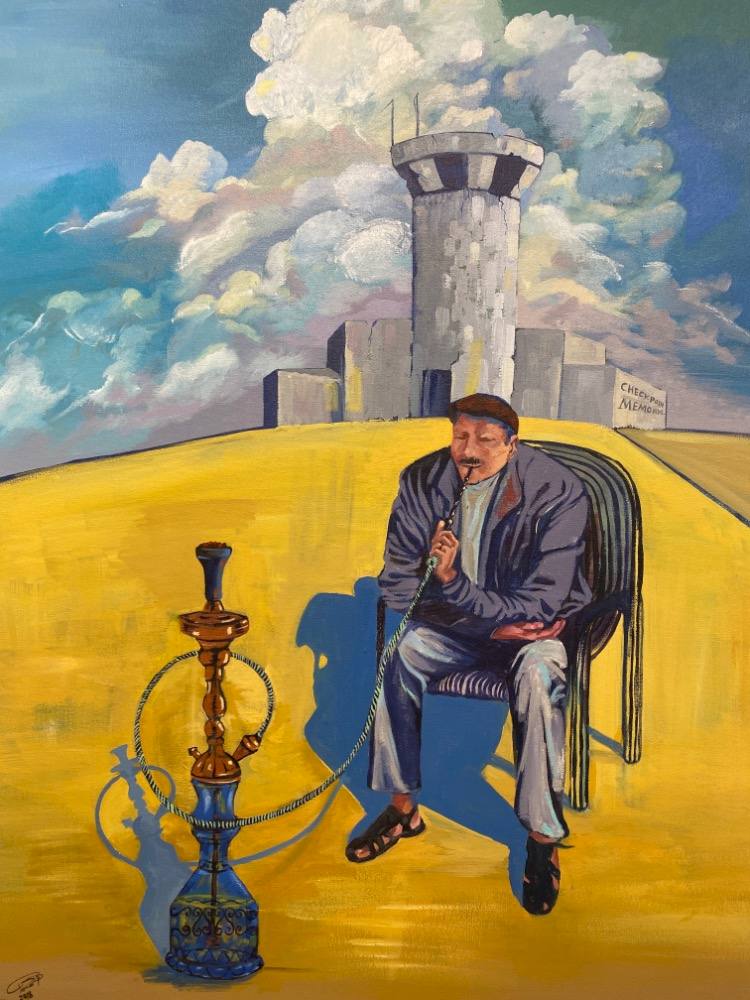
The refrain to ‘Never Forget’ will be familiar to many readers. It is often uttered in the context of Holocaust remembrance as a mandate to grieve the over six million Jewish people killed by Nazi forces and prevent a future recurrence of any tragedy at that scale. Yet this very human desire for commemoration has also been weaponised by the US and Israel as a means of garnering support for Israel’s ongoing militarised occupation of Palestine. At the same time, evidence of the state violence perpetrated by Israeli forces against Palestinians over the past eighty years has been intentionally obscured. The imagined ‘Checkpoint Memorial’ in Hmeedat’s painting would, if realised, help to counter this erasure.
I have witnessed the distortion of Palestinian history firsthand. Growing up in the suburbs of New York City, I was exposed to a healthy dose of Zionist propaganda, and learned to take for granted the centrality of Israel in the Jewish diaspora imagination. I attended Hebrew school on weeknights, had a bat mitzvah, and spent many summers at a Jewish camp. In each of these environments, I listened as elders imparted lessons about Israeli culture (much of which is, of course, appropriated from the cuisine, music, and aesthetic traditions of Palestine and Lebanon) or described the mitzvahs of planting trees in Israel or making aliyah, not yet knowing that these are all coded ways of supporting the Zionist settler project.
I signed up for a Birthright Israel trip in 2006, seduced by the offer of all-expenses-paid international travel. Our group of Jewish American young adults toured heritage sites, beaches, deserts, museums, and cities; we walked the ancient corridors of historic Jerusalem and floated in the Dead Sea. Each activity was designed to instil in us a belief that Israel was our true home and holy land. Yet nothing was said of what lay beyond the barbed wire fences and guarded checkpoints. The only moment of exposure to a Palestinian presence that I can remember was our visit to a Bedouin camp in the Naqab/Negev desert, where members of this historically nomadic community welcomed us for tea. In hindsight, I realise that Birthright Israel likely used this moment to frame Indigenous people in Palestine as culturally backwards, ‘pre-modern’ or ‘primitive’. Their ‘nomadism’ contributed to a myth that there was no settled civilisation here prior to 1948: the land lay waiting. By the end of the trip, we were expected to feel not only a sense of our belonging in Israel but a yearning — a desire for lifelong connection to this place.
The scholar Issam Nassar has written on the process of ‘biblification’ (or the intentional negation of Palestinian modernity) that I saw at play in our visit to the Bedouin camp. As Nassar points out, the nineteenth century saw a surge in European tourism to Palestine, fuelled by ‘colonial and scientific interest in the region’ and ‘revived Christian interest in biblical studies’ (319). Souvenir photographs from this time often depict unpeopled vistas of ancient ruins, captioned not with the place names used by modern Palestinians but by Biblical references: The Dome of the Rock, for instance, became ‘The Site of Solomon’s Temple’. Such retranslations ‘provoke in the viewer the feeling that Jerusalem was an empty place, for some of the liveliest places in the town were reduced to sites of ancient uninhabited ruins’ (Nassar 320). As Beshara Doumani has written, Europeans wished to ‘discover the land without discovering the people’ (8). Indeed, the nineteenth-century Zionist slogan, ‘A land without a people for a people without a land’, actively constructs and perpetuates this myth.
In 1947, the British began their retreat from Mandatory Palestine (designated as such from 1920-1948) and partitioned the territory along religious lines, granting the Jewish minority population the majority of the land. After an outbreak of sectarian violence, Israel declared its own independence in 1948. But, as Ariella Azoulay cautions, terms like ‘independence’ or ‘liberation’ – which Zionists deploy to describe this history – seem to imply a ‘decolonisation project, liberation from a foreign power’ (7). This language is inaccurate; the ‘Palestinians were certainly not the foreign power from which liberation was necessary’ (Azoulay 7).
Such examples show how language and archival evidence can be warped towards the mythologisation of national history and identity. Many artists have, in turn, sought to recover and record evidence of Palestinian life that has been erased, collectively building a counter-archive as a form of resistance. Indeed, Sharpe writes about the ‘myriad silences’ and ‘absences in the archive’ also faced by scholars of slavery and its afterlives (12). One must ‘attempt to find the “agents buried beneath” the accumulated erasures, projections, fabulations, and misnamings’ in order to commence this work (Sharpe 12).
Palestinian artist and filmmaker Emily Jacir’s installation, 'Memorial to 418 Palestinian Villages Which Were Destroyed, Depopulated, and Occupied By Israel in 1948' (2000/ongoing) was created over three months of collaboration with friends and allies who visited the artist’s New York studio (Fig. 3). Together they stitched the names of the villages listed in Walid Khalidi’s book All That Remains: The Palestinian Villages Occupied and Depopulated by Israel in 1948 onto the fabric surface of a refugee tent. Of the estimated 436 villages from which approximately 750,000 Palestinians were expelled (and 13,000 killed) during the Nakba in 1948, Khalidi was able to recover the names of 418 villages. Austere yet inviting, the tent now stands as a quiet monument to places that exist only in memory.
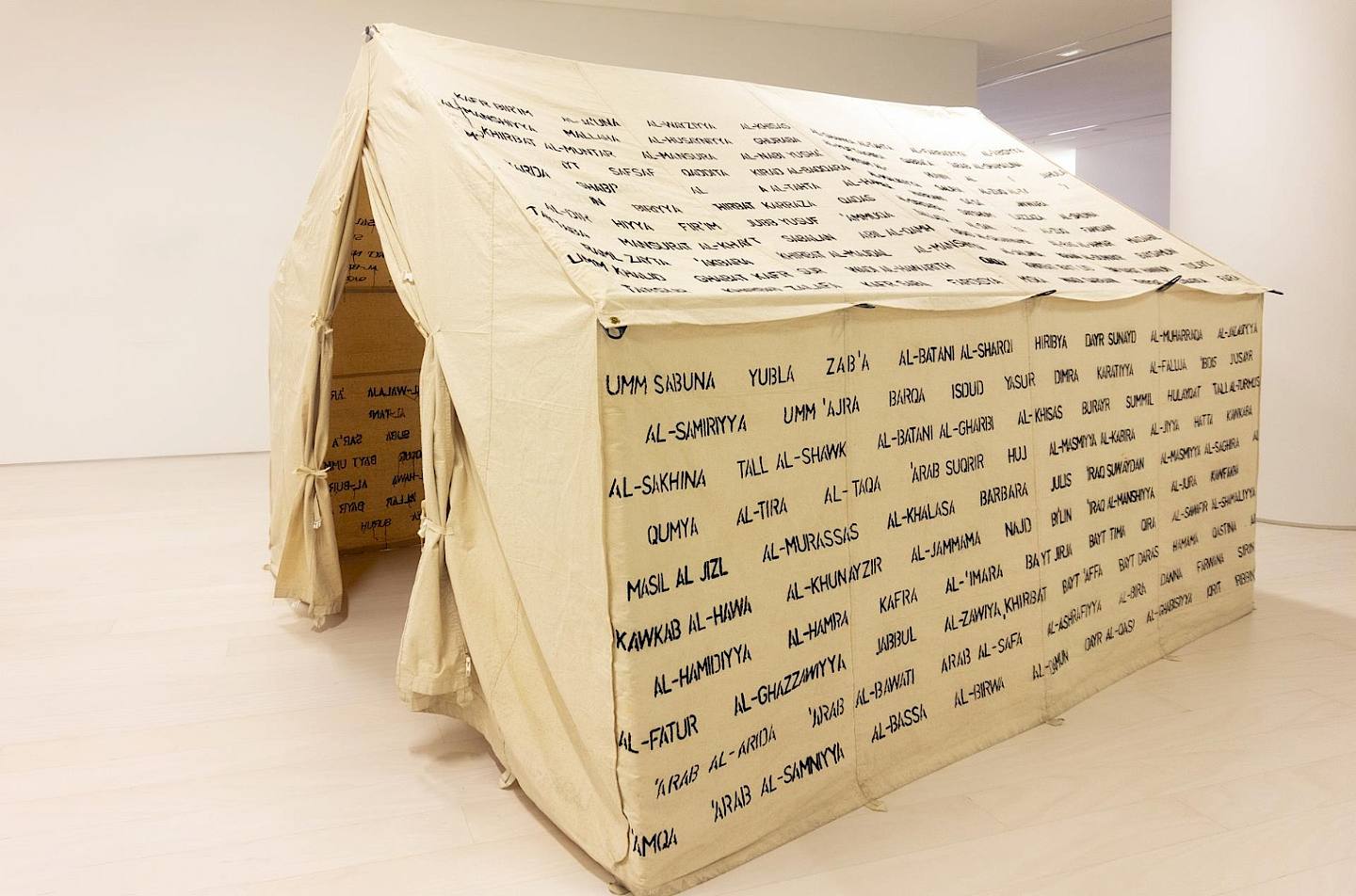
Among Sharpe’s generative definitions of (the) wake is the act of keeping ‘watch or vigil [over the dead] . . sometimes accompanied by ritual observances including eating and drinking’ (10). Jacir’s collaborators, many of whom are fellow Palestinians in diaspora, recounted personal memories and played Arabic music as they gathered to stitch each name onto the tent. In an interview for Electronic Intifada, Jacir has explained that she gave the work its lengthy title so that newspapers and magazines would be forced to print it in full; ‘Otherwise, with my experience with speaking about this issue, they always try to obscure what happened … These names are not in history books’ (Gheith).
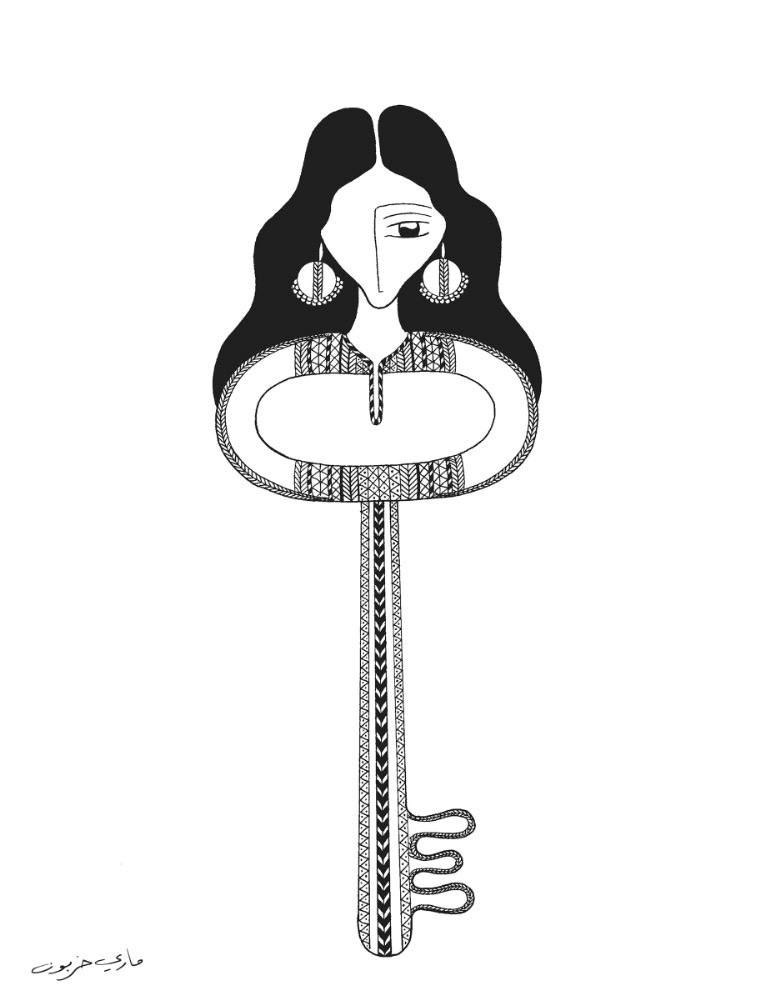
Mary Hazboun’s 2017 drawing 'Sometime Ago, I Turned Into a Key' reflects on the long aftermath of these displacements while centring the human (Fig. 4). In this image, a female figure with flowing black hair and tasselled earrings transforms into a stylised metal key, symbolising the collective body in diaspora. Many Palestinian families still possess and safeguard the keys to the houses from which they were evicted during the Nakba. The key represents their legal right, as refugees, to return to those homes they were forced to flee. The Right of Return is safeguarded by international law but is not recognised by the Israeli government. Hazboun’s drawing exposes the intimate connection of land and body — gesturing towards Palestinian stewardship of land as kin, while resisting the Zionist colonial framing of land as territory.
*
In 2006, in college, I befriended a Palestinian classmate named Walaa. One day, a small group of us took a day trip to the beach, and Walaa asked me to photograph his new tattoo of Handala, inked between his shoulder blades. Looking through the viewfinder, I asked him what it represented — I had never seen this image before. Handala is a barefoot child with spiky hair who clasps his hands behind his back and turns away from the viewer. A cascade of cross-hatched markings indicates the ragged state of his clothing. As Walaa spoke about the visual history of Palestinian resistance in exile, I experienced the kind of personal awakening made possible through dialogue with another.
Handala was created by the cartoonist Naji al-Ali, who became a refugee in 1948 when he was just ten years old. He invented the character in 1969, two years after the Arab-Israeli War (which resulted in Israel’s annexation of the Gaza Strip, Golan Heights, West Bank, and East Jerusalem). Handala is forever ten years old, representing the Nakba as experienced through a child’s eyes. Ali was assassinated in London in 1987; the case of his murder, however, remains unresolved.
I noticed that Walaa’s tattoo was placed on his body such that, like Handala, he would have to turn away from anyone who wished to view it. This gesture is meant to signify the boy’s refusal of any political solution backed by foreign powers that does not account for Palestinians’ Right of Return. As such, I was facing Walaa’s back as I listened to him, silently realising that I, too, was implicated in the coordinated global disavowal of Palestinian liberation. I am able to claim my right to legally emigrate and settle in Israel, simply by virtue of being an American-born person of Jewish descent, even with no familial ties to the land; I have no such key, unlike the woman in Hazboun’s drawing.
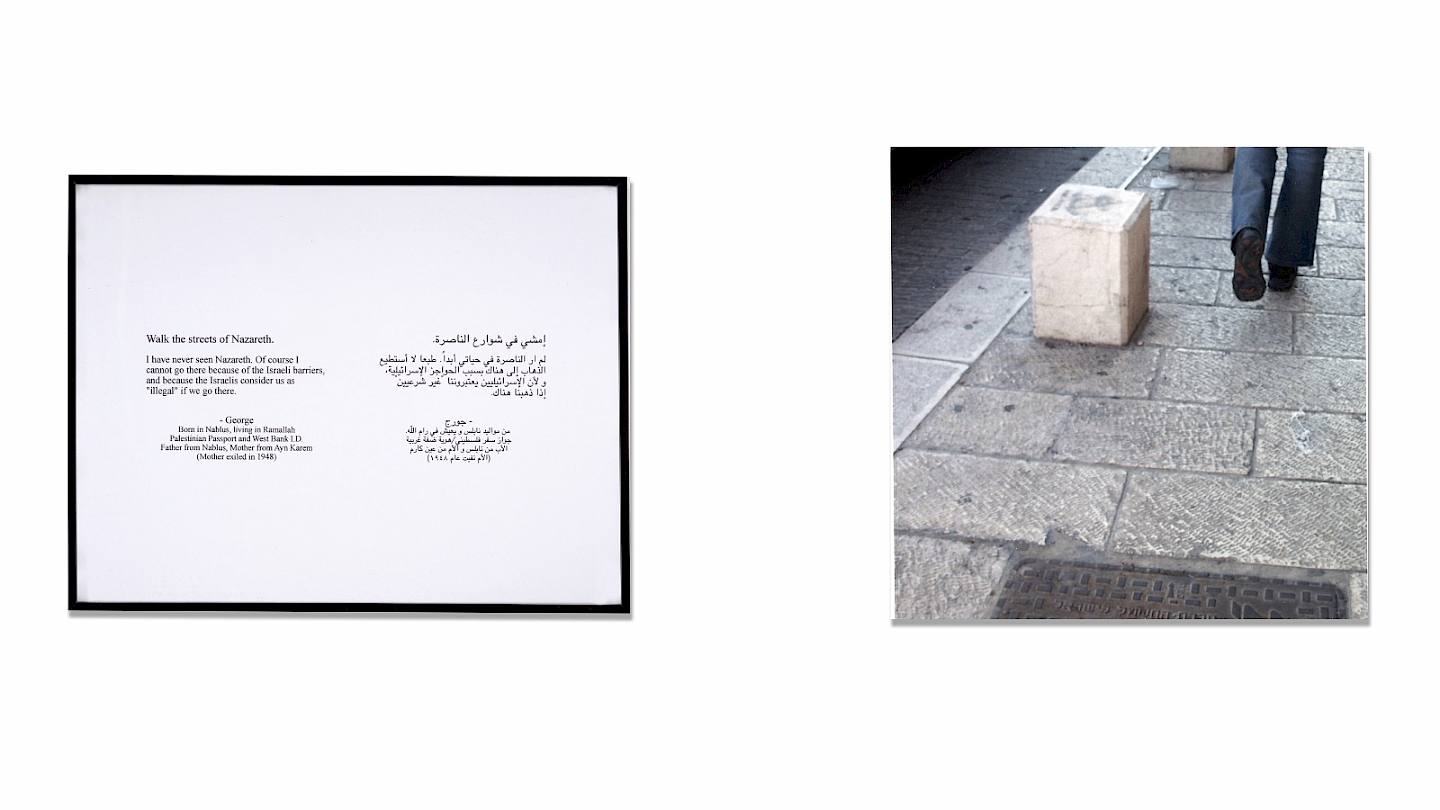
Emily Jacir’s series 'Where We Come From' (2001-2003) generates a similarly dissonant effect for viewers, especially Americans who may be unaware that the ability to travel freely to and within Israel is not shared by Palestinians. The artist, who holds a US passport and thus can move freely throughout Israeli and annexed Palestinian territories, asked Palestinian acquaintances living in annexed territories, ‘If I could do anything for you, anywhere in Palestine, what would it be?’ The resulting pairs of text and visual documentation elucidate heart-wrenchingly mundane desires of people who cannot return to their homeland (Fig. 5): ‘Go to my mother’s grave in Jerusalem on her birthday and put flowers and pray’; ‘Water a tree in my village of Dayr Rafar. I am forbidden entry into the 1948 areas’; ‘Walk the streets of Nazareth … I cannot go there because of the Israeli barriers and because the Israelis consider us “illegal” if we go there.’ The artist explains that this work exposes the ‘deliberate fragmentation of our lands and the isolation of our people from each other by the Israelis’ (Rahman). The piece, she goes on, is a ‘memorial to untold stories’ in light of disappearing Palestinian archives (Demos 59).
The image of Handala, and its repetition on Walaa’s body, indicate the ongoingness of the catastrophe. Just as Sharpe reminds us that being in the wake of slavery does not mean it is over – that, in fact, the contemporary Black experience is haunted by the shape-shifting spectre of slavery in today’s racial violence – each successive generation of Palestinians in diaspora continues to occupy the ‘as yet unresolved unfolding’, to borrow Sharpe’s turn of phrase, of the ruptures wrought by Zionist occupation (14). While museums might function as sites of reparation, they do so by positioning us in relation to the past. But, as Sharpe asks, ‘How do we memorialize an event that is still ongoing? . . . How does one memorialize the everyday?’ (20).
My knowledge of South African history is another part of what helped me to break through the wall of misinformation about Israel. As a senior art history major, naturally curious to deepen my engagement with the place of my father’s birth, I enrolled in a graduate seminar on Art and Coexistence and decided to write on the role of artists in the struggle against apartheid in South Africa. The more I learned, the more concerned I became about my white South African family’s complicity in a system that privileged us at the expense of the majority population’s human rights. I also started recognising the parallel unfolding of these two nations’ histories.
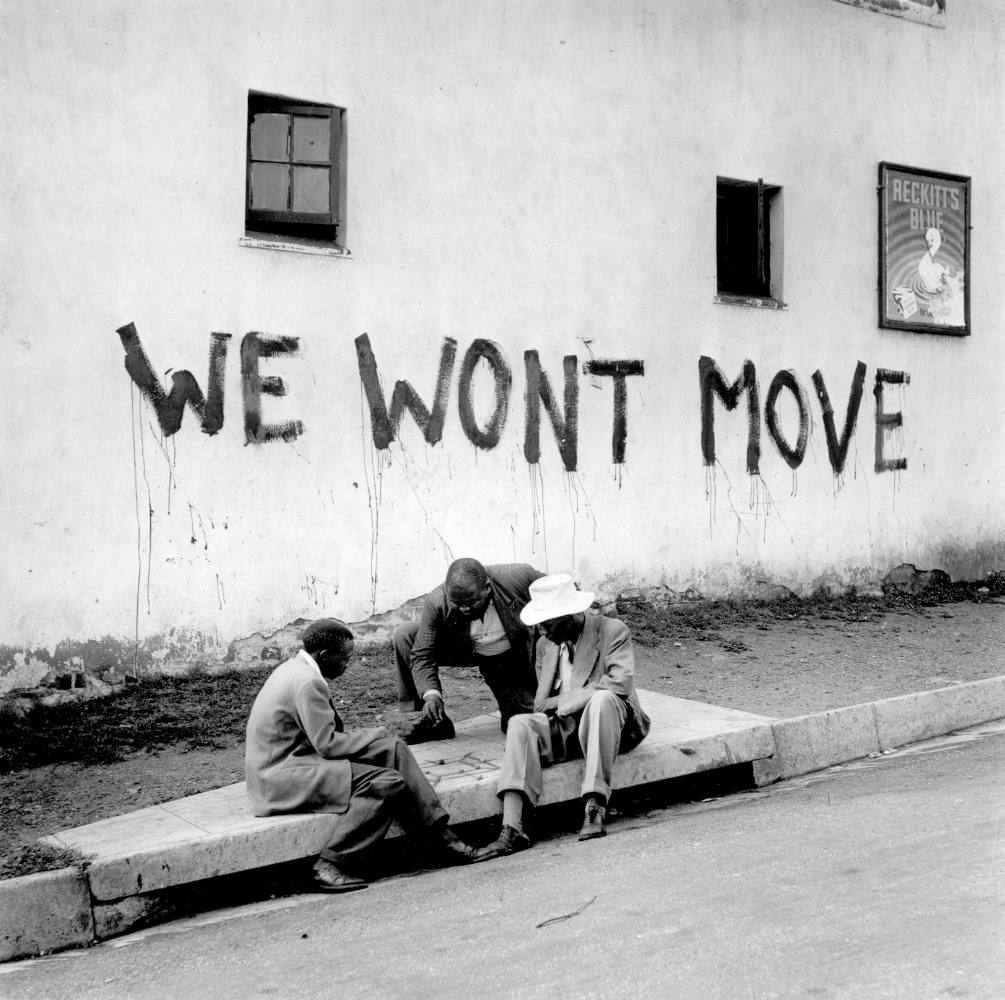
Emerging contemporaneously to the occupation of Palestine, South Africa’s system of apartheid was legally declared in 1948, when the right-wing National Party came to power (in an election that excluded the participation of Africans). As in Palestine, non-European residents were disenfranchised, denaturalised, and displaced from their native lands. Echoing the Zionist movement’s claim to a ‘land without a people’, the Voortrekkers (Dutch-speaking settlers of South Africa) had once believed they were divinely ordained to settle the country’s ‘empty’ hinterlands, even falsely asserting that there had been no inhabitants there before the arrival of European settlers in 1652. So, apartheid made South Africans foreigners in their own home. With the creation of Bantustans in the 1950s and 60s (segregated ‘homelands’ to which Xhosa, Tswana, Zulu, Venda, and other groups were forcibly relocated), the apartheid government effected the displacement of approximately 3.5 million people and stripped them of South African citizenship. The Group Areas Act of 1950 set into motion the relocation of Black residents of urban neighbourhoods, like Cape Town’s District Six or Sophiatown near Johannesburg, to distant, neglected townships (Fig. 6). Under apartheid, in both South Africa and Palestine, identity documents could either grant or restrict one’s freedom of movement on the basis of the document holder’s ethnic or racial classification.
In August 2010, I spent a month living in Cape Town, conducting research towards a masters’ thesis on the work of South African artist Penny Siopis. One evening, Penny and her now-late husband, Colin Richards, invited me to join them for an event at the Michaelis School of Art: a debate amongst prominent artists and activists (including William Kentridge, a white South African artist of Lithuanian Jewish descent) on whether to support a cultural and academic boycott of Israel. Many attendees remembered the impact of such boycotts in eroding the global standing and legitimacy of the apartheid government. I listened as speakers recounted the power of this collective action in their home country and spoke of the human rights violations in Palestine that would warrant such an act of solidarity necessary. The discussion was incredibly heated. I was as stunned by the level of polarisation as I was impressed by the deep commitment that many former anti-apartheid activists felt toward the struggle for Palestinian liberation.
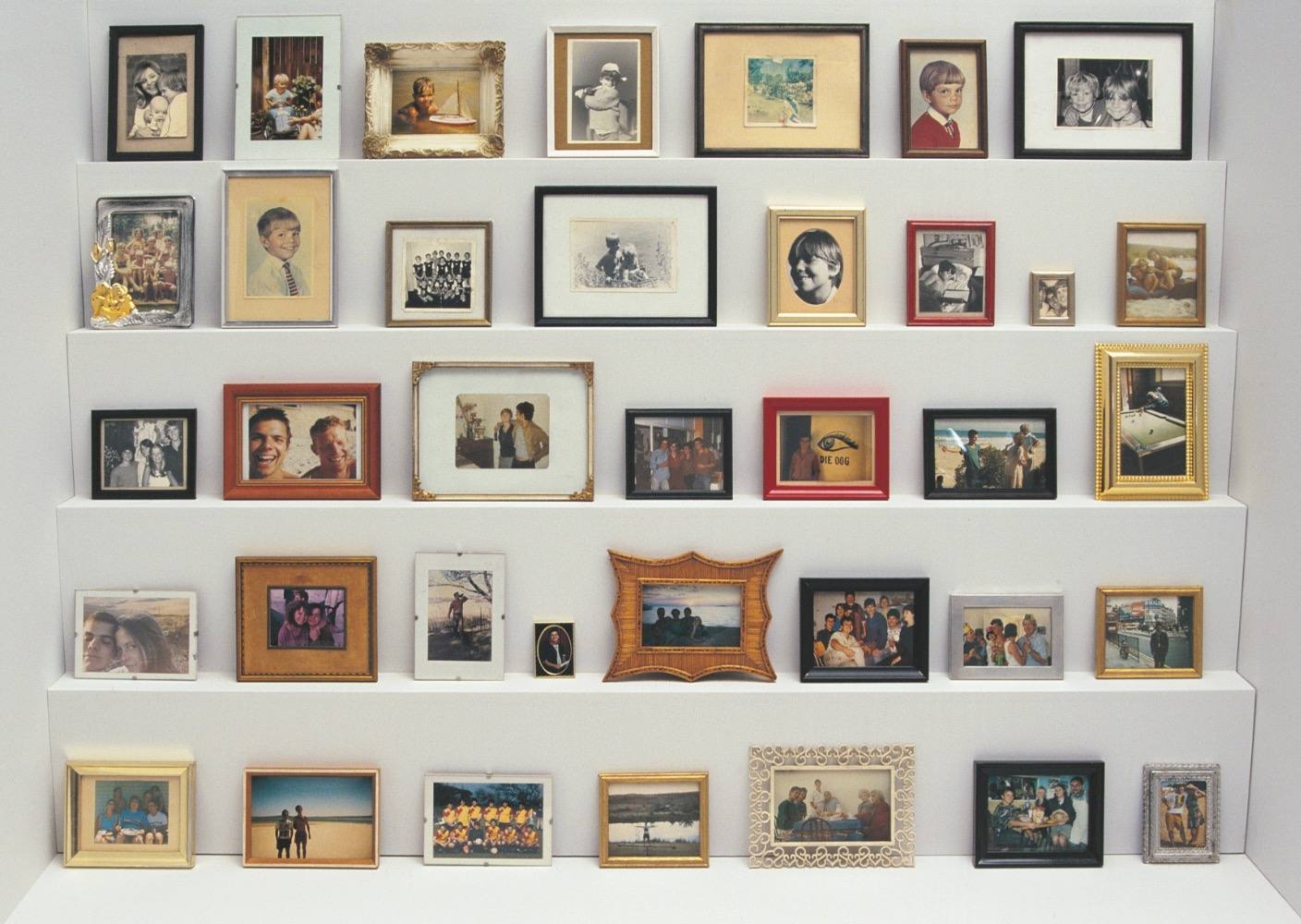
As I sat beside Siopis, I thought about her 2002-2005 series of paintings titled 'Shame'. Begun in 2001, these small works express the complex, psycho-social shame felt by the nation in the aftermath of the Truth and Reconciliation Commission (TRC) of the mid-1990s, when many white South Africans finally began to fathom the horrific scale of state violence committed by the apartheid regime. I thought, as well, of Brett Murray’s 'Guilt and Innocence' (1962-1990), an installation of the white artist’s childhood photographs which he mounted on the walls of Robben Island in 1997 (Fig. 7). Murray was born only a few months before Nelson Mandela was imprisoned there in the early 1960s. Scanning his quaint school portraits and snapshots of birthday parties, viewers can observe that the artist enjoyed a normal, middle-class upbringing – just like members of my own family – during the same years that were stolen from imprisoned and exiled activists. 'Guilt and Innocence' mines complex feelings of complicity and shame among those living in societies where oppression, segregation, and state violence are so normalised as to become nearly invisible.
Mirtzoeff has written recently of the sense of shame he has felt since October 2023 about sharing some responsibility ‘for the killing being done in my name, as a Jew’ (12). That evening at Michaelis also prompted me to reflect seriously on my own privileges and connections to apartheid – in two places – and on how to mobilise this shame into solidarity.
*
The African National Congress recognised four key pillars of the freedom struggle. Each played a role in the eventual fall of the apartheid regime. These were: political mass mobilisation, underground or grassroots actions, international solidarity, and the armed struggle. In South Africa, the armed struggle referred to the paramilitary group uMkhonto we Sizwe. Nelson Mandela founded the group after the Sharpeville Massacre in 1960, when South African police opened fire on a group of demonstrators who were protesting the expansion of the Pass Laws, killing hundreds of men, women, and children. In his statement during the 1964 Rivonia Trials, when he and others were charged with treason, among other crimes, Mandela pointed out that he did not celebrate violence. But non-violent forms of protest had been criminalised by apartheid legislation, and violence was frequently being carried out by the state, which ‘met our peaceful demands with force.’ At this stage, there were few viable alternatives.
On 7 October 2023, approximately 1,300 Israeli civilians were killed and 44 taken hostage in coordinated attacks on a music festival and various residential areas less than five kilometres away from the Gaza Strip, by the political organisation Hamas. Learning of the breaking news, my stomach twisted in knots as I anticipated what would come next. The disproportionate force of Israel’s collective punishment of the people of Gaza was almost immediately evident to those who knew to look out for it. Within just one week, over 2,000 Palestinians living in Gaza were killed and nearly 10,000 wounded by Israeli airstrikes and retaliatory attacks. The current death toll in Gaza, at the time of writing, has surpassed 70,000.
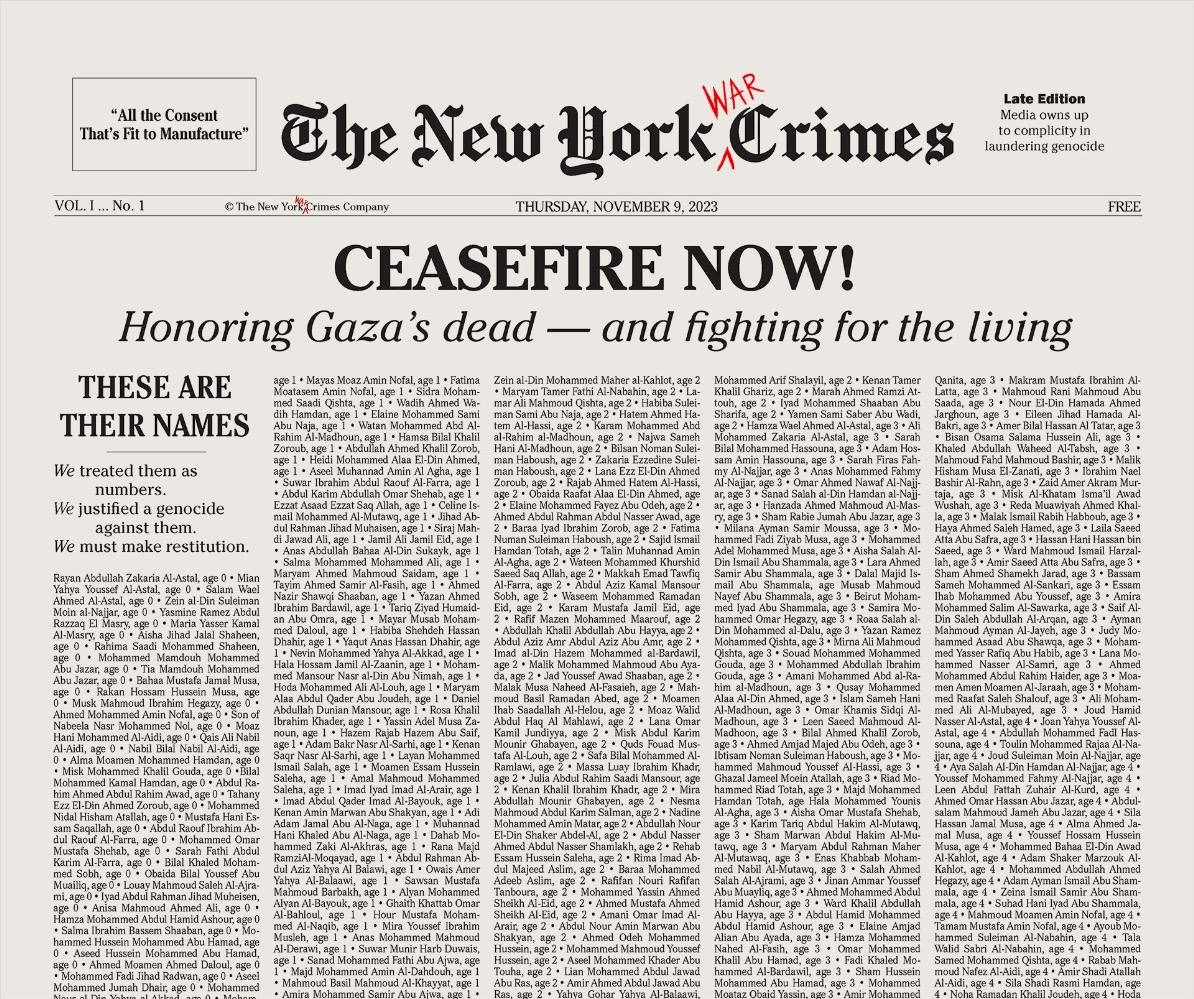
The New York Times allegedly prohibited its writers from using the words ‘slaughter’, ‘ethnic cleansing’, and ‘Palestine’ when reporting on the ‘war’ in Gaza. In response, Writers Against the War on Gaza published the first issue of The New York War Crimes as part of a boycott on the paper. The front page contained the names of 2,260 known residents of Gaza who had been murdered by Israel up until that point (Fig. 8). While mainstream news downplayed the suffering of Palestinians under Israeli bombardment, the genocide was being broadcast live on my social media feed. I saw terrible images and videos of unutterable destruction that are difficult to even describe: A father holds his infant’s body, and it has no head. Trapped in the shell of a burning car, a human being has been reduced to a writhing silhouette in a cloud of black smoke. A woman frantically washes grey dust from a young child’s eyes, but the girl stares blankly, in shock, while her body shakes uncontrollably.
International solidarity, as in apartheid South Africa, is an important pillar of any freedom struggle. The artist Nan Goldin (who is Jewish) channelled her own experiences of shock and overwhelm into a video work, simply titled 'Gaza', and produced collaboratively with filmmaker David Sherman. It presents a mournful record of who and what has been lost since 7 October. ‘I have no more words,’ Goldin wrote, on deciding to make this piece. ‘This is my way of speaking out.’
'Gaza' compiles video footage sourced on social media, including ‘scenes of normalcy and atrocity. . . of pain and beauty’, and thus permanently archives the fleeting digital artefacts that have populated our screens over the last three years (Azimi). Zaatar flatbreads being packaged, hot from the oven; a father lovingly smoothing his son’s hair before wrapping his arm around the child, bringing him close enough for a kiss on the cheek; stocked grocery shelves. Beachgoers walking along a scenic coastline and children flying kites. Fresh mango at a market stall. And green, so much green: lush palm fronds, grape vines, sage brush.
Less than two minutes in, a cloud of grey dust rises from the desert sand. We begin to see rubble and demolished buildings ... but somehow life goes on. A group of boys perform cartwheels and parkour-style flips across the bombed-out shell of their city. A child lowers a bowl of food to the ground for a group of kittens swarming around her ankles. A man bends over to pour food for stray dogs. The explosions intensify: a fireball erupts into a massive plume of smoke behind a line of tents. The film is still a work in progress. As Goldin explains, ‘It remains unfinished because it is not over.’
The writer Asmaa Abu Mezied reflects on why Gazans continue to record the destruction of their homes and livelihoods. She cites the Israeli military’s deliberate removal of documents from state archives ‘… which describe the killing of Palestinians, the demolition of their villages and the expulsion of entire Palestinian communities’ (Abu Mezied 29). ‘We record not to humanise ourselves for others,’ Mezied explains, ‘but so that future generations will remember who we were and what we did … to warn them against attempts at erasing our existence’ (30). The urgency of Goldin’s witness to the suffering of Gazans under Israeli bombardment might be understand in connection with her most-known work, The Ballad of Sexual Dependency. Originally conceived as a slideshow, and then a photobook, The Ballad features candid photographs taken between 1976 and 1985 of her friends – mostly queer and allied artists and activists living in New York City – amidst the onset of the HIV/AIDS epidemic. At times joyous, devastating, and intimately mundane, The Ballad served as a crucial archive at a time when queer communities faced censorship, fear, and erasure, and it honoured the whole lives of her subjects: before, after, and beyond a diagnosis. Goldin spoke about it as a ‘diary’ that ‘enables me to remember’ (The Ballad of Sexual Dependency).
In much the same vein, Negar Azimi has responded to the more recent ‘Gaza’ project by affirming the urgency of our collective witnessing: ‘The images presented here make any number of demands on the viewer. But above all, they insist: Do not look away.’
Many institutions and individuals have done just that, however. On 26 October 2023, the prominent contemporary art magazine Artforum fired its longstanding editor-in-chief, David Velasco, for authorising the publication of an open letter written by cultural workers in support of a ceasefire in Gaza. In January 2024, Indiana University at Bloomington cancelled the first US retrospective of the 87-year-old Palestinian painter Samia Halaby, which was scheduled to open just two weeks later at its Eskenazi Museum of Art. Goldin is among the many visual artists (including Ai Weiwei, Nicole Eisenmann, and others) who have lost exhibitions, museum acquisitions, or other opportunities on account of their pro-Palestinian activism. Institutions ranging from the Whitney Museum to Columbia University have been involved in suppressing expressions of solidarity within their communities.
It has been uniquely troubling to witness the ferocity of censorship within the art and culture sectors, which we naively assume to be bastions of free speech and leftist politics. As Velasco has written for equator, ‘a fog of silence continues to dominate the field: few expressions of solidarity forthcoming from institutions, and too few artists willing to speak out via social media, much less their own work.’ Édouard Louis has likewise lamented that ‘our own milieu has betrayed us. The world of culture participates in the silence’ (Cuénin).
I am reminded of the many risks, small and large, that South African and allied artists once took to make their voices heard during the apartheid era. For some, their activism led to a rescission of professional opportunities. Others were arrested or detained. And some were killed, like Thami Mnyele, who founded the Medu Art Ensemble in exile. Apartheid commandos raided Mnyele’s studio in Gaborone, Botswana in 1985, and fatally shot the artist. They also shot a bullet through a portfolio of his drawings, in an astounding instance confirming the perception of art – as many anti-apartheid activists put it – as a ‘weapon’ in the freedom struggle.
*
In 2025, Jacir told an interviewer that art, ‘in any form, feels insufficient right now. Any attempt falls far below the level of grief and destruction that people in Gaza are living through ... I am constantly questioning my role at this time’ (Alberani). Amidst the fatigue felt by so many Palestinian artists, writers, and activists who have carried the burden of speaking out in the face of silence, we might take inspiration from 'Elegy', which reminds us of the collective power in a diverse chorus of voices. As Goliath has explained, ‘When one choir member runs out of breath and cannot sing anymore, there are other voices to carry on the lament. In this way, it’s not only about song, as such, but breath – a collective offering and holding of breath’ (Amadour).
In the mid-1990s, the South African Truth and Reconciliation Commission responded to the monumentality of grief and decades-long campaigns of misinformation by defining four categories of truth that would be acknowledged by its proceedings. Forensic truth refers to the measurable facts of what happened, when, and to whom. ‘The New York War Crimes’ or Goldin’s film are examples of interventions that attend to this kind of record for Palestine. Personal or narrative truth arises when an individual shares their story — like the participants in Jacir’s ‘Where We Come From’, who describe how apartheid in Palestine impacts their daily lives. Dialogical truth emerges from the interchange between people. I think of Jacir’s collaborators for ‘Memorial to 418 Palestinian Villages Which Were Destroyed, Depopulated, and Occupied By Israel in 1948’, who exchanged memories and stories as they stitched, as well as my own conversations with a friend like Walaa, whose life experiences differed from my own and thus opened my eyes to those truths from which I had been shielded. And restorative truth connects the sharing of our experiences to our capacity for reconciliation or recovery. It is the closure and validation that come with hearing and being heard. For me, this is the facet of truth and justice that is performed by a piece like 'Elegy'.
Goliath was born in 1983 and so would have come of age during the TRC’s proceedings, when the personal stories of both victims and perpetrators of human rights abuses (from the period of 1960-1990) were publicly broadcast on radio and television, every week for four years. The TRC’s goal was not to prosecute these crimes, per se, but rather to work towards healing and national unity by producing a comprehensive, shared accounting of what had happened, in light of the decades-long silencing and suppression of dissenting voices. The legalised system of segregation enacted under apartheid separated individuals and communities not only physically but also culturally, intellectually, politically, and in terms of access to information and new perspectives. I imagine that the TRC’s ritualised facilitation of communal witness would have been impactful to Goliath. When she and Masondo filed a lawsuit against McKenzie, seeking (ultimately unsuccessfully) to reinstate the South African National Pavilion, the artist explained that 'Elegy' attends to ‘these very difficult questions of whose life is recognised as a life worth grieving’. Of the over 70,000 lives lost thus far in Gaza since 7 October 2023, each one was an entire universe –– each deserved remembrance.
For 75 years, Israel has suppressed the basic human rights of Palestinians, who are struggling to survive under the brutality of the occupation. And for three years and counting, the IDF has bombarded the Gaza Strip with airstrikes, reducing homes, shops, mosques, churches, schools, and hospitals to ash. Parents have lost children; children have lost parents. They have been killed beneath rubble, by white phosphorus, by sniper, by starvation, by torture. This is under the pretence of eliminating Hamas, but the long game is to obliterate Gaza’s past, present, and future. We must collectively refuse this erasure.
Through witnessing, recording, and making space for grief, artists might help us unlearn the mythologised, distorted, and censored narratives about Palestine’s history that continue to dominate public discourse, towards manifesting its freedom. Only from here, we can move towards justice.
Works Cited
Abu Mezied, Asmaa. 'On Why We Still Hold Onto Our Phones and Keep Recording.' Light in Gaza: Writings Born of Fire, edited by Jehad Abusalim, Jennifer Bing, and Michael Merryman Lotze, Haymarket Books, 2022, pp. 29-30.
'Ahmed Hmeedat: The Palestinian Artist Behind the Palbox Ramadan Postcard.' Palbox, 21 February, 2026, https://www.palbox.org/blogs/news/ahmed-hmeedat-palbox-ramadan-postcard?srsltid=AfmBOooQaNh0q7G20pcbb9__atVUCv8ZAjKSIAdV9-6UfcW6B8tdo6_c.
Alberani, Sara with Mohammad Al-Hawajri, Dina Matar, Emily Jacir in Conversation, 'Material of an Exhibition.' Nero Editions, 19 December 2025. https://www.neroeditions.com/the-material-of-an-exhibition/.
Amadour. 'In Conversation: Gabrielle Goliath with Amadour.' The Brooklyn Rail, December 2022 / January 2023, https://brooklynrail.org/2022/12/art/Gabrielle-Goliath-with-Amadour/.
Azimi, Negar. 'Notes on Gaza: Nan Goldin with David Sherman.' equator, January 2, 2026, https://www.equator.org/articles/gaza-notes.
Azoulay, Ariella. From Palestine to Israel: A Photographic Record of Destruction and State Formation, 1947-1950. Translated by Charles S Kamen, Pluto Press, 2011.
Cuénin, Jonas. 'Nan Goldin Shakes Up the Rencontres d’Arles: “What is Happening in Gaza is the First Genocide Broadcasted Live.”' Blind-magazine.com, 9 July 2025, https://www.blind-magazine.com/stories/nan-goldin-shakes-up-the-rencontres-darles-what-is-happening-in-gaza-is-the-first-genocide-broadcasted-live/.
Demos, T J. 'Poetry’s Beyond.' The Hugo Boss Prize, Guggenheim Museum Publications, 2008.
Doumani, Beshara B. 'Rediscovering Ottoman Palestine: Writing Palestinians Into History.' Journal of Palestine Studies, vol. 21, no. 2, Winter 1992, pp. 5-28, DOI: 10.2307/2537216.
D’Souza, Aruna. 'Gabrielle Goliath Sounds a Call to Action in Venice.' Hyperallergic, 18 May 2026, https://hyperallergic.com/gabrielle-goliath-sounds-a-call-to-action-in-venice/.
Goliath, Gabrielle. 'Elegy.' Gabrielle Goliath. https://www.gabriellegoliath.com/elegy-about.
Goliath, Gabrielle. 'Elegy.' 2015-2026. Performance and video installation.
Gheith, Jenny. 'Exhibiting Politics: Palestinian-American Artist Emily Jacir Talks About Her Work.' Electronic Intifada, November 4, 2004, https://electronicintifada.net/content/exhibiting-politics-palestinian-american-artist-emily-jacir-talks-about-her-work/5295.
Goldin, Nan and David Sherman. 'Gaza.' 2025. Digital video.
Goldin, Nan. 'Notes on Gaza: Nan Goldin with David Sherman.' equator, January 2, 2026, https://www.equator.org/articles/gaza-notes.
Goldin, Nan. The Ballad of Sexual Dependency. Aperture Foundation, 1986.
Hmeedat, Ahmed. 'One Normal Day', 2018. 40 x 30 in., Acrylic paint on canvas. Collection of the Museum of the Palestinian People, Washington, D.C.
Jacir, Emily. 'Where We Come From' (series), 2001-2003. printed material, dimensions variable. Collection SFMoMA, San Francisco.
Jacir, Emily. 'Memorial to 418 Palestinian Villages which were Destroyed, Depopulated and Occupied by Israel in 1948', 2001. Sculpture. Collection of National Museum of Contemporary Art, Athens.
Khalidi, Walid. All That Remains: The Palestinian Villages Occupied and Depopulated By Israel in 1948. 2nd. ed, Institute for Palestine Studies, 2006.
Mirtzoeff, Nicholas. To See In the Dark: Palestine and Visual Activism Since October 7. Pluto Press, 2025.
Murray, Brett. 'Guilt and Innocence', 1997/1999. Installation, Robben Island Visitors’ Block, Cape Town, South Africa.
Nassar, Issam. '"Biblification" in the Service of Colonialism: Jerusalem in Nineteenth-century Photography.' Third Text, vol. 20, no. 3-4, 2006, pp. 317-326, DOI: 10.1080/09528820600853589.
Rahman, Najat. 'Against Erasures: Memory and Loss in the Art of Emily Jacir and Eman Haram.' Middle East Eye, 2 July 2009. https://mei.edu/publication/against-erasures-memory-and-loss-art-emily-jacir-and-eman-haram/.
Samudzi, Zoé. 'Gabrielle Goliath: Metabolic Urgency.' Mousse Magazine, 14 January 2026, https://www.moussemagazine.it/magazine/gabrielle-goliath-zoe-samudzi-2026/.
Sharpe, Christina. In The Wake: On Blackness and Being. Duke University Press, 2016.
Sharpe, Christina and Rinaldo Walcott. 'The South African Pavilion Is Betraying Its Own History.' Hyperallergic, 14 January 2026, https://hyperallergic.com/the-south-african-pavilion-is-betraying-its-own-history/.
Siopis, Penny. 'Shame' (series), 2002-2005, paintings and mixed media.
Velasco, David. 'How Gaza Broke the Art World.' equator, December 22, 2025, https://www.equator.org/articles/how-gaza-broke-the-art-world.
Cover image: Gabrielle Goliath, 'Elegy (three suites)', 2025-2026, 8-channel video & sound installation, installation view, Chiesa di Sant’Antonin, Venice (2026). Photo by Luca Meneghel, courtesy the artist.


What shapes do solidarities take in these strange times we are living in? How can we find and forge solidarities when faced with genocides, human rights violations, and inexplicable injustices daily? Can storytelling play a role in liberation?
