Love Letters from the End of Time by George Abraham
Addressed to the speaker's father, this tender sonnet sequence by George Abraham speaks of forgiveness, regret, longing, and legacy. Comparing their similarities – like 'a mirror that can't be held' – the speaker brings himself into his father's image while also looking beyond, at a relationship with a man who sees him for who he is.
This piece is commissioned in tandem with Wasafiri 127: Solidarities.
Supported by a grant from the Open Society Foundations.
At the end of the world, I still
couldn’t say I love you
though I never blamed you for your escape
to mid-afternoon saunas, father, nor how you’d stay
in that steam – to drown the noise of your wife,
I imagine, whose only language was broken
glass those days – just short enough not to arouse
suspicion.
Could you have imagined me, your son,
who'd grow into this language of open
showers & serviced stains on white
towels? A son who’d crawl out of open
windows, beneath your snores, for mid-week
bathhouse discounts, to find brief comfort
in a thousand anonymous languages
of touch: a hand flirting with a towel’s beneath,
the roaming eyes of another man, searching.
At the end of the world, you still
couldn’t say I love you
because in the eyes of mens’ searching,
your world has ended a thousand times
& again. & before it ended in you, it ended
in your father, & his father before. Who could want
to see themselves in those threads
of empire, with no names for broken hearts
but catastrophe, setback? How can I
speak of your aunties, a country
ago, forced to marry at fifteen & not
the soldiers who translated dowry into arms’
escape? Who made, of marriage
certificates, the kind of blue
only a passport could dream of? A blue
that named you before I could call you Baba?
At the end of your world, I still
couldn’t say I love you
Baba. There, I named you. I’m calling out
to you, & once you were still alive
to call back: ya Baba. I know parenthood
as the kind of mirror that can’t be held
in every tongue. When your father died,
he left Teita languageless in the eyes
of this country.
After, you begged for a job
you didn’t want, in an English insistent
only in its opposition to your language
of love, so that she, your mother, may live.
Not knowing you’d die in that job, you kept it
so that I might live, in infancy, as Teita raised me
in her insistence of Arabic: it was my first love
story, that broke more hearts beyond my own.
At the end of our world, we still
tried to say I love you.
A story: Teita broke more hearts beyond her own
when she, widowed & mid-50’s, married
her childhood sweetheart. When the family
didn’t speak to her for years, was it desire
or loneliness that made her their unbearable
myth? Years later, auntie will admit
she regretted all of it.
She who, after 4 decades
of marriage, still retreats to her bedroom
every night, hand in hand, not with her husband,
but her best friend — a brown woman trailing
behind with a plate of lukewarm microwavables.
Her husband – rooms away, watching re-runs –
unmoving. Not a word spoken between any of them.
Yet, clearly & immaculately, they are understood.
At the end of the world, we still
didn’t say I love you.
Clearly & immaculately, I am understood
by you: the friend, with whom, safety enough
to undress & shower together after a swim.
There,
I remember Baba’s stories, of laughing nakedly,
in crowded YMCA locker rooms, at how misshapen
a butt becomes with age.
Instead, our story is a dusk
of held breaths — in the lake’s impossible cold,
you’d adjust my swim cap. Afraid of falling in almost
-love, I’d avoid your gaze.
Beyond survival, a holding
from which neither of us can let go. Forgive me —
beneath those waters, my eye contact was moments
too long.
Did desire lead us here, or are our deaths
already behind us? You, who descended this rotting
hell, who led me to the gates without glancing back?
At the end of our world, we still
couldn’t say I love you
to hell & back, you who led me to the gates
of our unmaking. Who wouldn’t fall in love
with, at least, the idea of us? Where romance precedes
the wide-bottomed wine glass? Where we’ve stopped
counting the apocalyptic skies, grayed into green,
under which we drove, without stopping to consider
the polluted river between our smogged cities: diseased
membrane, border of pigment & cum
-ulus? Where dusk is but a lip into which we refused
to bite? This, our world, suspended in a season
of Capricorns. Beloved, I’ve entertained the delusion,
of us, for too long. Unjustly, I’ve unravelled like this,
before, into the only arms that can bear to hold me.
I am drowning in your image. I cannot resurface.
At the end of your world, none of us
could say I love you.
From the image, I cannot resurface:
Mama, drunk & giggling, over you, Baba,
kneeling in surrender, when considered from my gaze
over the two of you, or the view of clothes scattered
beneath another failed attempt at dressing
your body, unwounded, you thought, days before
your last words to her would be, I love y –
I love – with eyes just short of meeting
hers.
At his bedside, she'll tell her therapist
months later, I was at his bedside when he ...
He was a good husband, allah yerhamo.
As if in confession,
she'll kneel at your grave, apologise for being
a bad wife and not the wife who survived you
by translating your suffering into her own.
After the end of your world, I'm still
trying to say I love you
by translating your suffering into my own:
how my injured hand, when strained to its limits
of motion, resembles the oblique angle
at which your hand would point itself
as your disease consumed you, Baba. How,
against a failed science, I want to know it
as the most Palestinian death: how it took,
first, your ability to move, before taking
your ability to speak. I don’t want to make you
a metaphor, Baba, should not country you
as I did in life. You will not be languaged
here, you will be language: a lack
in my throat, I’ll be chasing my whole life.
I could never blame you for your escape.
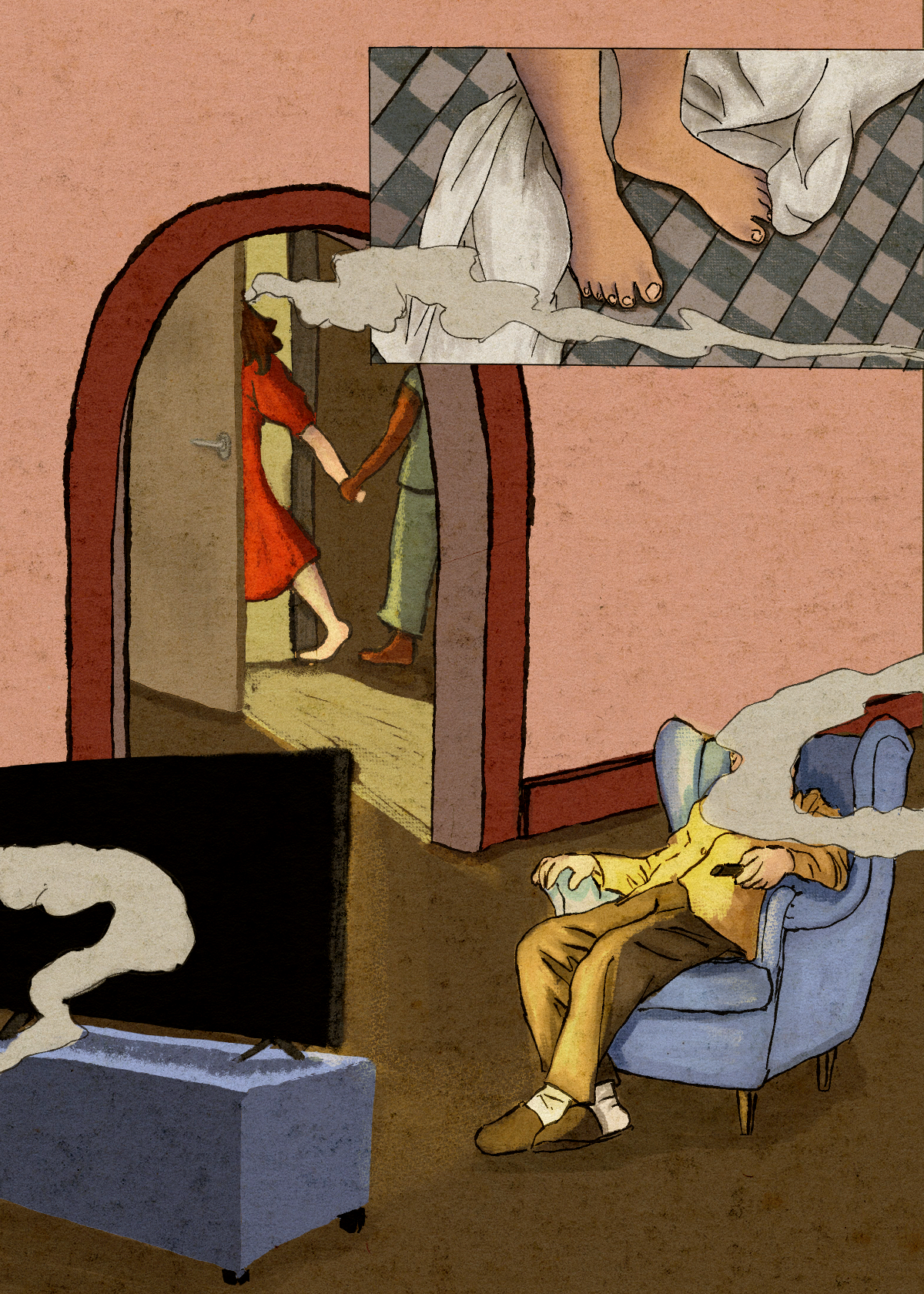
Illustration by Simone Khanyi Hadebe
This sonnet sequence appears in George Abraham's forthcoming book, When the Arab Apocalypse Comes to America, publishing on 16 March 2027 by Haymarket Books.


What shapes do solidarities take in these strange times we are living in? How can we find and forge solidarities when faced with genocides, human rights violations, and inexplicable injustices daily? Can storytelling play a role in liberation?
