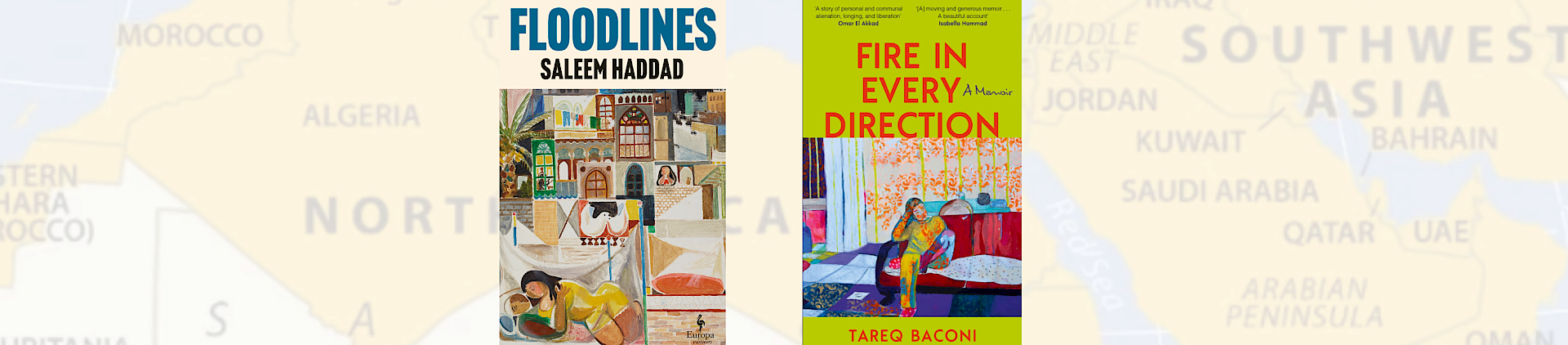
Intimacy as Futurity: A Conversation with Tareq Baconi and Saleem Haddad by George Abraham
Poet and Mizna editor George Abraham speaks with queer Arab writers Tareq Baconi and Saleem Haddad on their latest books – Baconi's memoir Fire in Every Direction and Haddad's new novel Floodlines – in this warm, generous interview from our latest issue, Wasafiri 127: Solidarities. Together, they discuss and explore narrative form, memory and archives, writing beyond a Western ethnographic gaze, imperial violence, art as a means of survival, and much more.
This is an extract from Wasafiri 127: Solidarities.
Download the full interview for free during October 2026.
Among my only sources of sanity and hope – living in the heart of the US empire as it continues to wage genocidal warfare against the South West Asia and North Africa (SWANA) region, and Global South more broadly – are the words and actions of my queer Palestinian community. Of the literary abundance that our community has always produced – not merely in times when our bodies are the spectacles of Western headlines – two recent books stand out as north stars: Tareq Baconi’s Fire in Every Direction and Saleem Haddad’s Floodlines. I first read Baconi’s memoir while visiting home, re-living the closeted landscape of my Palestinian Southern US upbringing, and fell in love with the book, not just as an extraordinary love story, but also as a fearless reckoning with our community’s most intimate silences and erasures: an empowering, life-affirming reminder that we will not be free until we confront, let alone liberate, the most abject among us. With this book, Baconi joined the likes of Randa Jarrar, Rabih Alameddine, and Saleem Haddad in my personal contemporary canon of queer Arab anglophone narrative writing. As a fan of his debut Guapa, Saleem Haddad’s latest, Floodlines, is an ambitious development of everything I loved about his first novel. With narration that is as sprawling, multigenerational, and poly-vocal as it is devastatingly intimate, urgent, and incisive, Haddad has painted us an unforgettable portrait of inter-familial grief and the after/lives of Iraqi artistic abundance in the face of imperial devastation. It is an honour to be in conversation with Baconi and Haddad, transcribed and edited for clarity and concision from a Zoom conversation in mid-March 2026, where the two spoke about their writing process, narrative form, and the interconnected futures of our global queer SWANA communities.
by George Abraham
George Abraham: As a writer myself, I’m always interested in hearing about the origin stories for other writers’ books; in this case, Tareq, your memoir, and Saleem, your second novel. Where did these projects begin, spiritually or emotionally, or cohere into a 'this has to be a book moment'? Was there such a moment for you?
Tareq Baconi: I always knew that I wanted to write something about the relationship that is at the centre of the book: the friendship, and then love, between myself and this boy called Ramzi from Amman. I always knew I would someday want to narrate that story; I just didn’t know what form the story would take. I explored different things, you know; first, I played with essays. I later thought about fictionalising it, and ultimately ended up deciding to write it as a non-fiction narrative book focused on that relationship. And that very quickly metastasised and became a memoir. So I think the origin was actually that teenage relationship. I knew I would somehow come back to it. The form wasn’t clear at first, but I knew it was something that would manifest in some kind of creative project.
Saleem Haddad: For me, I think it’s hard to point to a single originating image because the novel has been with me for more than a decade now, but what I recall from the early stages was a desire to write about Iraq and its extraordinary artistic legacy, especially at a time when Iraq was being framed almost exclusively through violence and collapse (this was in 2014, around the time of the rise of ISIS). I knew I wanted to write about Iraq, not only as the site of destruction, but also as a site of artistic and imaginative abundance. Given that this was during a period of rupture, I was really interested in exploring rupture, not just historical, but also familial rupture — and the question of what role art plays in such moments. When I began conceiving of all this, I was feeling a lot of grief. Grief about Iraq, about Syria, Lebanon, Palestine, but also just the Arab Spring in general, as well as the grief that comes with living outside of the region (I was living in London at the time). So the novel became a space to process all of these different things: art, rupture, grief. But I guess the earliest image, or the engine, so to speak, was this idea of the family argument. That was the thing that kept the car running for ten years: this image of a fractured family arguing over legacy and who owns what, and who decides what … and who gets to narrativise the past, and then beneath those sort of very administrative arguments, there were much larger questions around the legacy of the country, and the different relationships the family members have towards this country.
GA: At a formal level, both of your books are tethered to material objects: Tareq, with the letters, for example, and the photos you use to structure your memoir; whereas Saleem, it’s your use of art objects, and of course the endnote — disclosing that the novel parallels some real-life events even though it’s still solidly fiction. Saleem, what you said about art reminds me how Palestine, Iraq, and the entire region, despite Western colonial devastation, has always been a site of artistic, cultural, and historical abundance. I’m curious to hear more about – especially with these kind of object-tethered narratives that you’re both thinking about and working through – how the form for your novel, at maybe a level of process or ideation, crystallised for you? Floodlines has this amazing multiple points of view, Virgina Woolf-esque treatment of consciousness; meanwhile Fire in Every Direction has letters and photographs as a tether, taking the reader back in time, and ultimately showing us your whole family’s Nakba story before getting into the Ramzi relationship. This is my question to you as a literary scholar: how did these forms come about, especially given the objects of interest?
SH: It’s interesting to hear your perspective as a literary scholar because I think as a writer I don’t necessarily feel like I’m best equipped to analyse my own writing, oddly enough. But in terms of the art pieces, a lot of these are actually real-life artistic works — and not just from my own family. For example, the character of Nizar, who is a war journalist, dabbles in sketching and his sketches are very much inspired by the watercolour paintings of the Iraqi journalist Ghaith Abdul-Ahad. These Iraqi art pieces became the starting point to developing the characters. I used them to imagine: what kind of person might create these artworks, and what would this person’s position be vis-à-vis Iraq, vis-à-vis their own history? How might they think about the past?
For me, this novel is about estrangement, memory, and fracture — and the idea of multiple truths. So, a neat linear form wouldn’t really have worked, because no one in the book really has access to a stable or total truth. There were two broader structural forms that I was working towards: first, I wanted the book to function almost like a cubist painting, with overlapping, contradictory, partial perspectives that don’t necessarily align, and it’s only at the end that the reader can step back and see an emotional coherence to these multiple perspectives. The second was this idea of a river, where these different voices operate like separate currents. Sometimes they collide, sometimes they run in parallel, but they all move towards a shared end, which forms the final section of the book which, as you pointed out, was inspired by Virginia Woolf’s The Waves. It’s this kind of polyphonic, collective voice. And throughout the novel, I wanted memories and the past to rise the way floodwater rises: unpredictably, even forcibly at times.
GA: From the river to the sea, so to speak.
TB: Saleem, I think that’s beautiful. I remember, when reading earlier drafts, having conversations about water as a theme in your book and so I love that that was also part of the structure.
Thinking about how the objects shaped the writing, there’s really two sets of objects in the book: the letters that I have from Ramzi, and the diaries that I inherited from my grandmother after she passed away. And I think part of the way that I wanted to think about the book was really reconstructing the relationship that Ramzi and I had, and also understanding the futility of trying to do that from memory, understanding that memory is malleable and fleeting, and there’s no way that I would do justice to that relationship without something to guide me. And so I think the scholar in me went into the archive; the letters felt like an archive through which I could start to reconstruct our relationship ...
Read the full interview here, free to access during October 2026 only.


What shapes do solidarities take in these strange times we are living in? How can we find and forge solidarities when faced with genocides, human rights violations, and inexplicable injustices daily? Can storytelling play a role in liberation?
