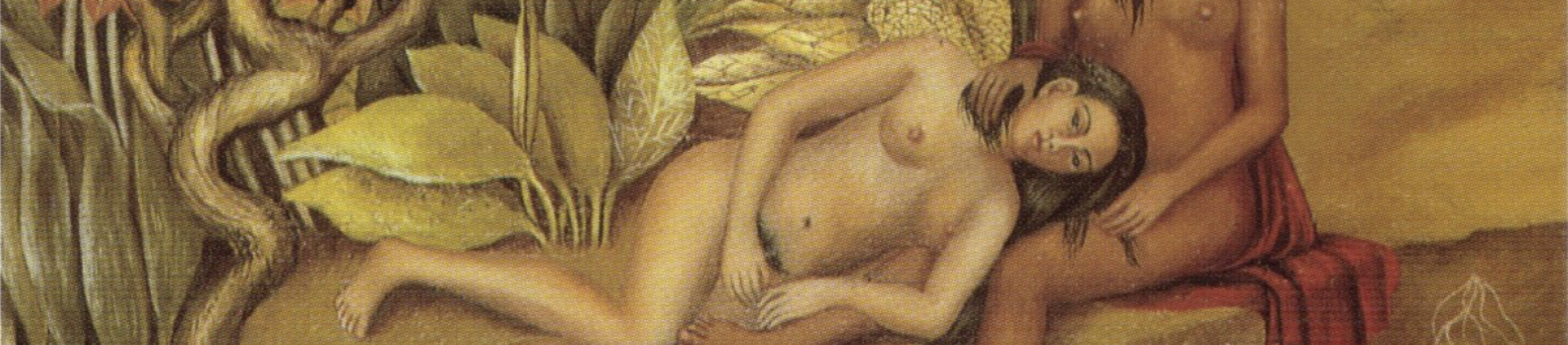
Towards an Embodied Resistance — Female Latinx Writers in Britain by Nathalie Teitler
Illustrated with her own personal experiences, Nathalie Teitler draws on the work of British Latinx writers Juana Adcock, Yara Rodrigues Fowler, Patrizia Longhitano, and Marina Sánchez to explore the physicality of women's writing, migration, (dis)embodiment, pain, and more. This is an extract from the Lead Feature essay in Wasafiri 124: Presencia y Resistencia – British Latinx Writing & Art.
Download the full piece for free during the month of December 2025 only, or read it in Wasafiri 124 in print.
Hombres necios que acusáis
a la mujer sin razón
sin ver que sois la ocasión
de lo mismo que culpáis:
si con ansia sin igual
solicitáis su desdén
¿por qué queréis que obren bien
si las incitáis al mal?
— Sor Juana de la Cruz, 1680s, Mexico
I am writing this to you from a body, a female body. I type these words with flesh and blood, tendons and muscles. And you, too, are reading this with a body. For the duration of this essay, I am going to ask you to read with your body, from your body — acknowledging your body. As we look at the work of several extraordinary British Latinx women writers – Juana Adcock, Yara Rodrigues Fowler, Patrizia Longhitano, and Marina Sánchez – I will keep asking you to focus on the body. To be present. I know this is difficult. For the next few pages, we will put aside the pact on which Western knowledge often sits: the pact that states implicitly that reader and writer are simply words and that knowledge meeting and reading/writing is a disembodied act. The problem with this pact is that it obscures the ways in which the knowledge transmitted in words acts on bodies. Real bodies — and women’s bodies most of all.
It also obscures the why and how of women’s writing, especially Latin American women’s writing. We have rendered the work safe and non-transformative. We have also taken the work away from the long history of Latin American women writing their resistance, a tradition that many would claim dates back to Sor Juana de la Cruz in the 1680s, writing poetry that is still as poignant today. By focusing on the body, we can see what happens to the (female) body in exile, or in a state of migration — a body that always holds cultural dissonance and lives in a permanent state of existing in-between: in between languages, in between countries. Carrying the burdens of being a woman in two cultures. Doubly embodied, or doubly disembodied.
If we are to truly read from the body, you and I, then I must tell you two stories. The first is my own history, and the second is the history of the British Latinx community and its writers — or, at least, my version of this history. The two are intertwined and far from simple. They are also stories about bodies. Stories of migration and exile, after all, are never simple, never disembodied.
I am born in a hospital in leafy Recoleta, Buenos Aires, at 7.30 in the morning on 26 September 1969. It is the same hospital where Eva Perón died many years before. I am my mother’s second baby and I am very small — so small that her friends gift her shoes made for porcelain dolls, an insult she will never forgive. She delivers me quickly, without difficulties. It is so quick that my father has not yet returned from his walk — a walk that includes an extensive breakfast. For a man, waiting is hungry work. For women, waiting has a different quality, perhaps because waiting is such a certainty for us. Since the dawn of time, or at least since Penelope, women have waited. Penelope filled her waiting by weaving a shroud: a funeral for her own life. If you really want to understand the essence of how women wait, look at your mother, your grandmother. If you identify as female, look in the mirror. Women are born waiting. Waiting and watching.
The nurses clean me, hand me to my mother. She orders herself food from the lengthy à la carte menu. They also bring champagne. It is a late September morning so we can assume that the sun is up, preparing for a fine day in the Southern hemisphere. There are several things about my identity that can already be said, even at this early stage. I am small, white, blue-eyed, and blonde. (My mother would probably say that I am already stubborn.) The nurses have assured her that I will be pretty, but that is probably to counteract any disappointment over my size. Neither of my parents are from Argentina. My father is a second-generation Romanian Jew from Brooklyn. My mother is Austrian and Catholic. They met in Madrid, speaking Spanish — my father’s second language, my mother’s third. (I did forewarn you that the story was complex.) I am both a Jew and a goy (the Jewish line passes through the mother). According to the law in Argentina, I am a citizen by right of birth. My passport states that I am British. Sometimes I think about all the ways in which bodies had to travel over hundreds of years just to bring my parents together. On my father’s side: a shtetl, escape, exile, migration. On my mother’s side: bombings, loss, migration. Generations upon generations of my ancestors who did not die where they were born. Perhaps it is this that keeps drawing me back to Argentina, a country built on immigrants (some willing, some forced), and on bodies who have to rewrite themselves in order to survive. In a short time, we will leave Buenos Aires.
1969. The political climate is troubled (a recurring theme). It is a climate in which those from Europe and North America – symbols of Western countries trying to siphon off natural wealth and resources – are to be immediately evicted. Soon we will arrive in London. My small body will have crossed continents, but something will have impacted my DNA. I will spend the rest of my life attempting to return. Or, perhaps, I will spend the rest of my life being two bodies: one continuing its life in Buenos Aires, the other forever challenged by the London winter, the soulless greys, the hiding of bodies under layers of clothes. The years of being taught to sit still, to not move. To contain emotion. To contain the body.
Read the full essay here, free to access and download for the month of December 2025 only.
Cover image: Adam and Eve by Fernand Léger


Our winter special issue, guest co-edited by Leo Boix and Karina Lickorish Quinn, critically explores the vibrancy and creativity of the British Latin American and Latinx communities which have been unjustly marginalised — both within Britain and beyond.
