Sand Under the Foundation: A Conversation with Joe Sacco
In this incisive interview, Zena Agha speaks to one of the world's greatest cartoonists and journalists, Joe Sacco. They talk about his 2003 book, Palestine, in the context of the ongoing genocide, his most recent release, The Once and Future Riot (2025), which investigates the 2013 Muzaffarnagar communal riots in India, and other work from across his decades-long career. Speaking openly about his positionality and experiences as a journalist and outsider to regions he covers, Sacco opens up about the brutality he has witnessed firsthand, the loss of hope, US foreign policy, settler logic, journalistic ethics, and more, in a conversation at once deeply personal and sharply political.
This is an extract from Wasafiri 127: Solidarities.
Download the full interview for free during September 2026.
I received Joe Sacco’s graphic novel, Palestine, as a gift. In the process of furnishing our flat through Freecycle during the long lockdown of 2021, I went to the house of an Irish sculptor living, at that time, in Wandsworth. He was slowly dismantling his home of thirty years and shedding his possessions in preparation for a move to Hastings. Though I was ostensibly there to collect some cookbooks, we walked through his house and talked about colonial formations in Ireland and Palestine and the predicament of living as an artist in unforgiving times. I saw Sacco’s Palestine perched on the windowsill of an upstairs bedroom, its iconic yellow title shining like a beacon. The sculptor said, 'Well, you should take it.’ I refused until he affirmed, ‘I really believe in giving. You’ll see how things will turn up in someone else’s life.’ He was correct, of course, as it was the same copy I took when I went to meet Joe Sacco at the Penguin offices in London on a cold Tuesday morning in November 2025. Sacco is a gracious presence; with attentive eyes and fedora I had seen in illustration form in his latest graphic book The Once and Future Riot (2025) — a sharp and harrowing investigation of the 2013 Muzaffarnagar riots in India’s Uttar Pradesh region. Our exchange over the course of an hour and a half is dynamic and, at times, feverishly urgent. Though Joe Sacco’s career is long, and his contribution to comic journalism is unmistakable, it was his first book, Palestine, first published in serialised form during the signing of the disastrous Oslo Accords in the early to mid-1990s that became the conversation’s fulcrum — particularly in light of the ongoing genocide in Gaza. That text, and what it reveals about Palestine – and, by extension, the world – was our point of departure and arrival.
by Zena Agha
Zena Agha: Can we start with Palestine? There are parts that are excruciating to read during genocide, particularly around the Zionist logic of maiming the Palestinian body. Often in the book, you come across children, men, women in all kinds of circumstances, who have been not only psychologically maimed, but physically too, and their bodies are fractured and broken. Every geography you’re in, you see this maimed body. So I’m curious about how you approach the body of Palestinians — the Palestinian body. Of course, you address the cause, the connection to the land and so on, but there’s also something so embodied in the book. And it’s excruciating to read in the context of today — with the most child amputees in the world now in Gaza. I’m curious about the connection between those two things, if there is one.
Joe Sacco: To be honest, I was astonished at the amount of people who had been injured in one way or the other when I was there. It goes back to [Yitzhak] Rabin’s policy of breaking of the bones. It seems to be an attitude of, if we let them live, we have to hurt them. They have to know that we’ve been here. You also realise that, especially with this genocide, the wounds seem to be deliberate and intended for certain areas. You can go back in the more recent period, to the Great March of Return in 2018, where people were shot in a way that probably led to an amputation. I imagine it’s to throw a problem onto society. And then, of course, with the genocide, there’s maiming from bombing and artillery fire, but also with gunfire and quadcopters. Clearly, they’re aiming for the head with children, which seems to indicate real intention. There’s nothing collateral about so many head wounds. So, I think, even the way people are killed, not just wounded, is meant to make the body into an object of … I almost want to say, a monument. A monument to the impunity of the Israelis. The way they’re able to mistreat bodies. There’s a lot of defilement of bodies, the way they’re run over by tanks or tractors, the way they’re buried and the way they’re returned, the way they’re held captive. People are returning from the Israeli prisons with grave injuries, and a lot of the bodies seem to be disfigured in some ways. And of course, the accusations, which seem to be adding up, to organ removal. So, it’s like you don’t even own your body. I don’t know much about this sort of philosophy, Foucauldian bio-politics, but there’s sort of a twistedness about it, from my point of view.
ZA: Early on in the book, you go to a hospital in Nablus, and suddenly they’re passing around the kuffiyeh and you’re taking these photos and then there’s one man who’s had his intestines shot, and his mother is beside him, and you ask if you can take a photo and he yells out. On that panel you write, ‘a private wound’. That simple clause – a private wound – has really stuck with me in the time since reading it. Our wounds aren’t private. In order for people to seem to care about Palestine, there has to be this expositional nature of our wounds, the expositional nature of our trauma. The justness of our position is not enough. There has to be this visual addendum that adds a sense of shock or gravitas. I’m not quite sure exactly what the purpose of it is — it’s not enough to say we deserve freedom. It has to be shown. And the people that you write about and draw in the book do that of their own volition. Thinking about today, the genocide is in such a visual register, there’s nothing private about these wounds. We see these families having very private moments of grief, but they’re public displays of grief as well, and they’re consumed by the world.
JS: You’re right. And the pictures of disfigurement, the pictures of burned bodies and maimed bodies have been streaming onto people’s phones. But I think it was the starvation that put people in a lot of countries in the West over the edge. Palestinians are spending their bodies – not with intention, they have no choice – but Palestinian bodies being spent is what eventually seems to have changed the American mind. It’s the same thing that happened to me when I saw the images of the Sabra and Shatila massacre in 1982 ...
Read the full article here, free to access and download for the month of September 2026 only.
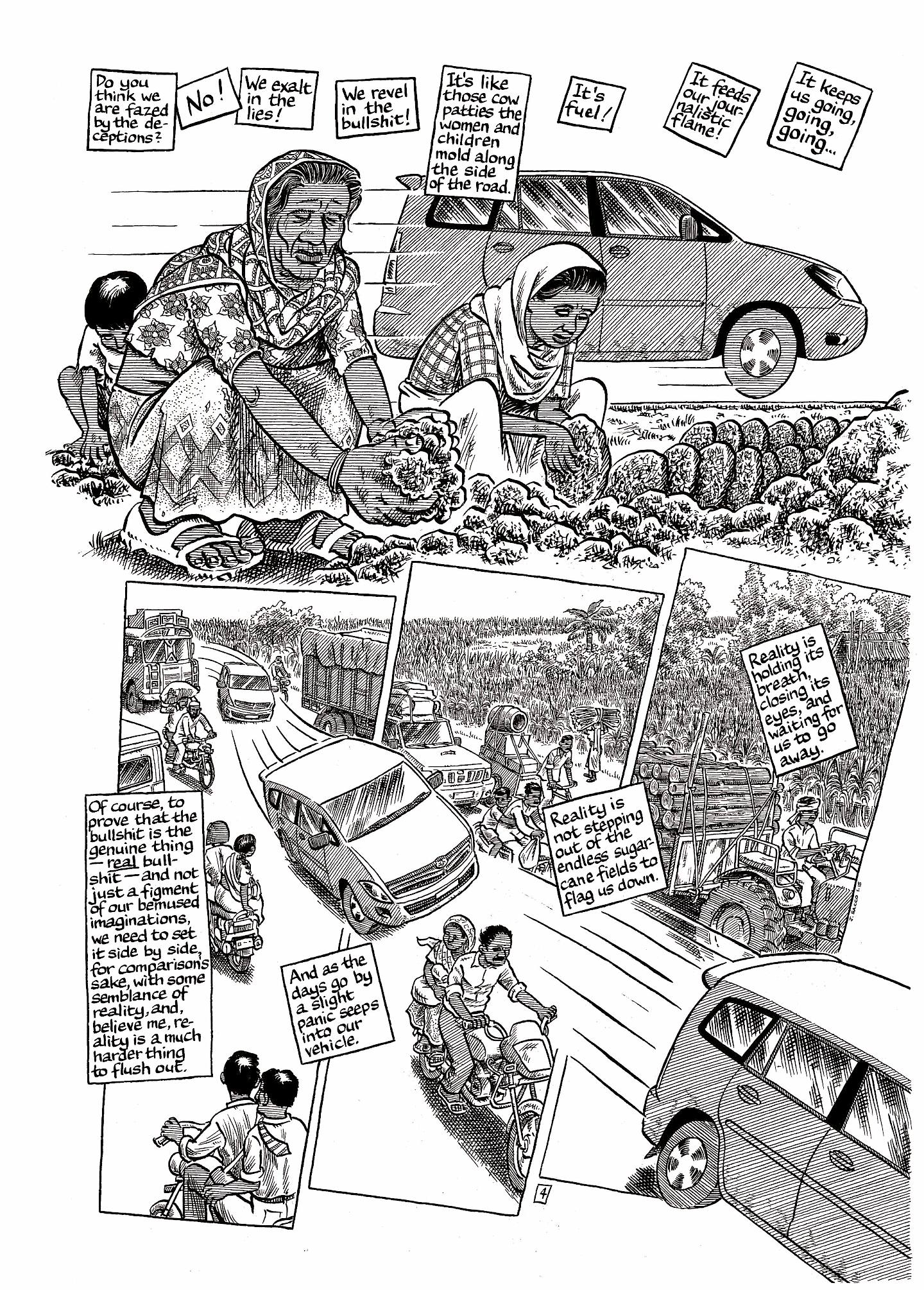
Image credit: Page from The Once and Future Riot by Joe Sacco (Jonathan Cape, 2025)


What shapes do solidarities take in these strange times we are living in? How can we find and forge solidarities when faced with genocides, human rights violations, and inexplicable injustices daily? Can storytelling play a role in liberation?
