Taring Padi in Venice and in Solidarity: Art and Autonomous Cooperation
What changes when activist artists are hosted by other activists, rather than by a conventional art institution in the Global North? In this essay, Marco Baravalle approaches this question through solidarity, a term that recurs throughout the work of Taring Padi, an Indonesian underground art collective formed in 1998 after the fall of the dictator Suharto. The group primarily makes large painted banners for public space. Baravalle examines their continued focus on intersectional solidarity – particularly along lines of class and shared anti-colonial struggles – analysing their previous exhibitions in Venice, Kassel, and beyond.
This piece is commissioned in tandem with Wasafiri 127: Solidarities.
Supported by a grant from the Open Society Foundations.
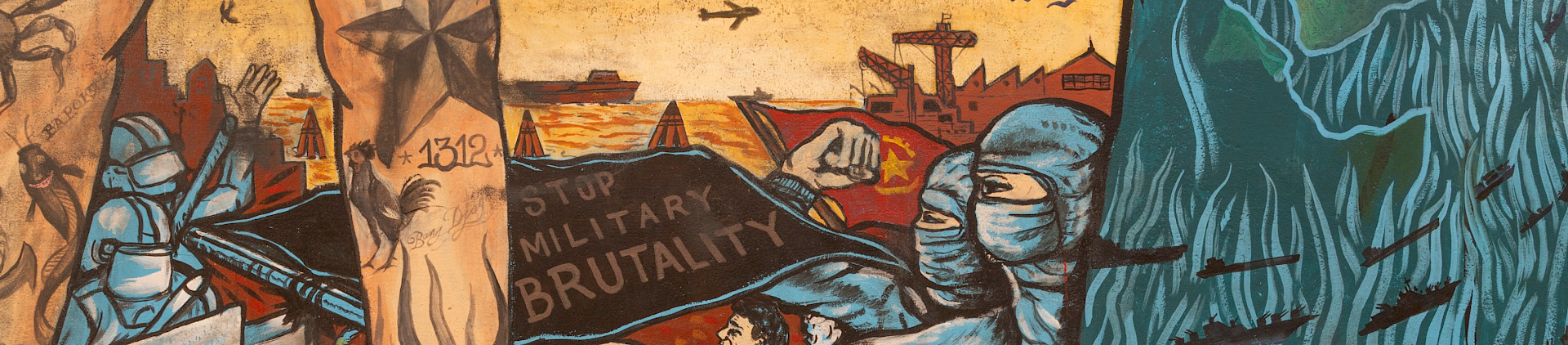
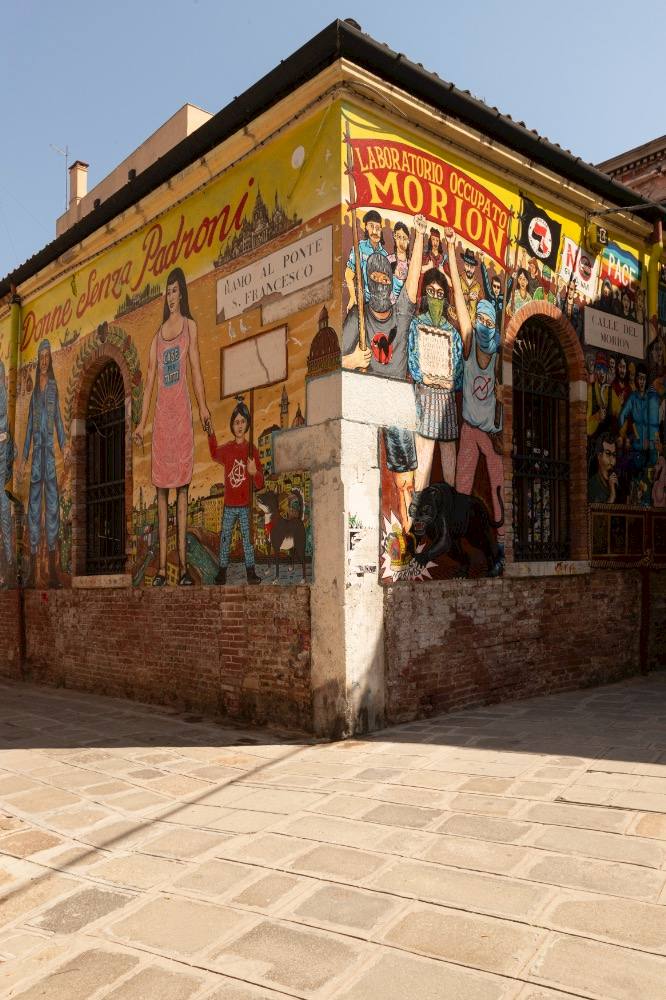
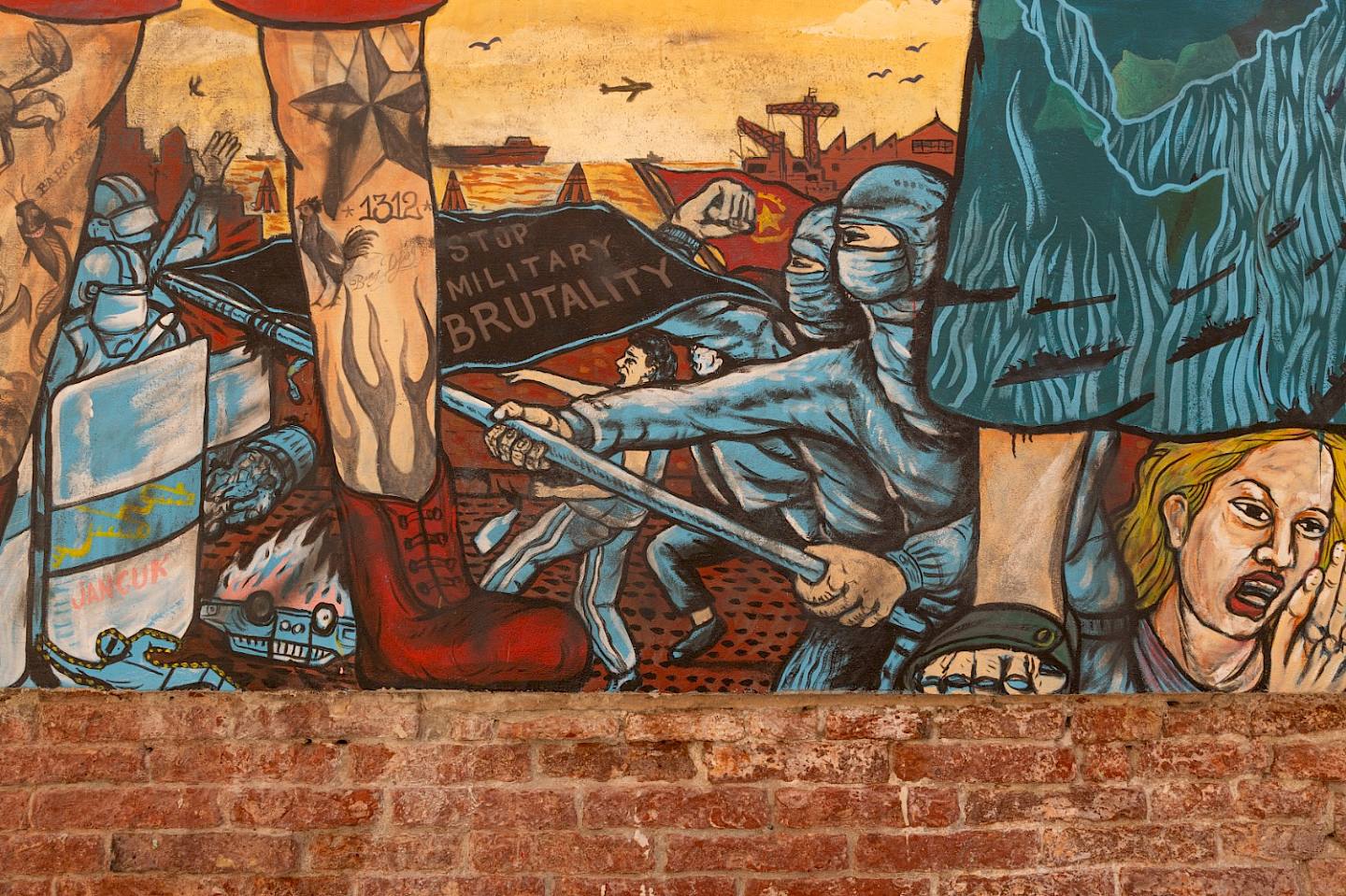
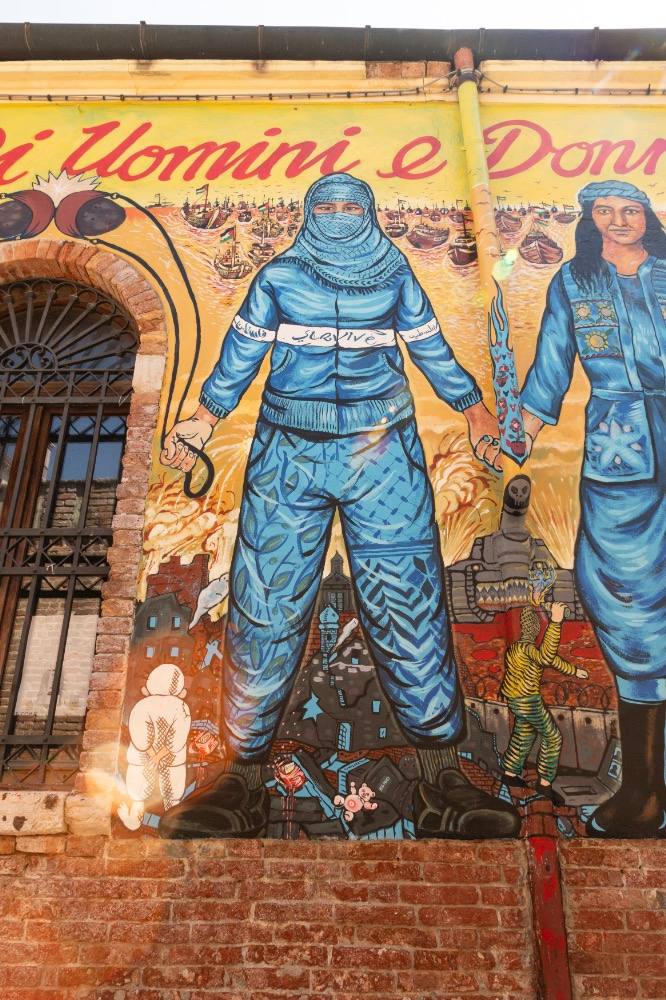
Like many Europeans, I encountered Taring Padi’s work late, at documenta fifteen in 2022. Like (perhaps) fewer Europeans, I was immediately captivated by the work of this underground art collective that first formed in Yogyakarta in 1998, after the fall of the dictator Suharto. Since its founding, Taring Padi has understood art as a form of social intervention oriented towards anti-militarism, anti-extractivism, and social justice. Its preferred media are large painted banners made for public space; the woodcut, a graphic technique favoured for its simplicity and for the way it allows images to be reproduced DIY; and wayang kardus, painted cardboard cut-out figures typically made to be carried in marches and demonstrations. I imagined bringing Taring Padi to Venice to paint the exterior walls of Morion, a squat and one of the few buildings in the city whose façade is entirely covered in contemporary graffiti. That plan became a reality four years later. Between early April and mid-May 2026, Morion hosted ten members of Taring Padi for a month and a half. They repainted the exterior of the building, unveiling the new murals on 25 April, during the celebrations marking Italy’s liberation from Nazi Fascism. On 3 May 2026, also in Venice, the collective opened a second project: Taring Padi: People’s Liberation, an exhibition featuring six large-scale banners painted between 2023 and 2026 in collaboration with collectives and individuals from different parts of the world: Brazil’s Landless Workers’ Movement (MST); Aboriginal artists in Australia; Palestinian activists; and the Institute of Radical Imagination, a collective of European, Palestinian, and Indonesian art workers. The exhibition was presented at Sale Docks, an activist art space that, like Morion, belongs not to the city’s network of art institutions but to the geography of its social movements. Collectively run through an assembly for almost twenty years, Sale Docks hosts artistic projects and organises for cultural workers’ rights; it is active in solidarity with Palestine and offers space to movements for housing, climate justice, and transfeminism.
Between the controversy at documenta, where Taring Padi’s large banner was first covered and then removed, and the Venetian residency, where the collective and the activist communities of Morion and Sale Docks lived and worked side by side for over a month, there is a chasm. This article examines what produced that difference. What changes when activist artists are hosted by other activists, rather than by a conventional art institution in the Global North, such as a museum, foundation, or biennial? I approach this question through solidarity, a term that recurs throughout Taring Padi’s work.
The collective titled its presentation at documenta fifteen ‘Bara Solidaritas’ (Flame of Solidarity). Solidarity also connects this article to Taring Padi’s first solo exhibition in London, on view at Ibraaz from 8 July to 22 November 2026. Its changing displays offer an almost anthological account of nearly thirty years of their work. Titled Rakyat Pasti Menang (The People United Will Never Be Defeated), the show presents the collective’s art as a vehicle for ‘international solidarity’. For a piece in ArtAsiaPacific, Kerstin Winking likewise analyses the collective’s works and actions as manifestations of ‘solidarity in public space’ (50), while Alessandro Kurniawan Ulung and Dadang Ilham Kurniawan Mujiono similarly argue that Taring Padi’s work fosters ‘cosmopolitan solidarity’ (118).
Historically, the concept of solidarity is inscribed in Indonesian politics and culture as a legacy of the anticolonial and anti-imperialist period. This international solidarity has roots stretching back to the 1920s and the work of ‘internationalist students abroad, such as the leaders of the Indonesian Society (PI) and provincial cosmopolitans at home, such as Sukarno’ (Utama 61). Considering the legacy inherited by Taring Padi, we should certainly add to these names the Marxist philosopher and leader Tan Malaka, who was executed by Indonesian republican troops in 1949. The work of forging these connections continued throughout the years of the Indonesian Revolution, from 1945 to 1949 (the year in which the Netherlands officially recognised Indonesia’s independence). After independence, the international solidarity built over the preceding decades took programmatic form at the 1955 Bandung Conference, drawing on earlier ties between Indonesia and the Arab world and extending them across sub-Saharan Africa. This sphere of Third World solidarity would extend to Latin America, particularly through the 1966 Tricontinental Conference in Cuba. This genealogy, alongside Indonesian Marxist nationalism, provides a historical context for the solidarity with contemporary movements in the Global South that animate Taring Padi’s iconography: from movements for the liberation of Palestine to the Sem Terra in Brazil and from Aboriginal Australians to the memory of anticolonial struggles in Africa.
One of the earliest occasions on which European audiences encountered Taring Padi’s work was in 2004. Some of the collective’s works were exhibited in Dresden in the group exhibition Unbekannte Schwester, unbekannter Bruder [Unknown Sister, Unknown Brother]. Curated by Christiane Mennicke, the exhibition sought to reflect on the aesthetic legacy of socialism. Yayak Yatmaka, an Indonesian artist and activist who was forced underground during the New Order years, took part in the exhibition alongside several members of Taring Padi, who presented the collective’s work. Yatmaka described one of the works on display: a large poster depicting a workers’ march printed using the linocut technique. The demonstrators march together as a compact group, fists raised in the air, their mouths open as they chant a slogan. Some figures in the foreground hold a banner, while others carry individual placards.
‘Taring Padi’s poster depicts prints carried by the protesters, with such slogans as “Develop Solidarity between the Oppressed Workers and the People”. These are, of course, expressions of hope, indicating another goal that they wish to achieve after the slogan of “Workers United” has found its manifestation in the form of true trade unions. As the workers foster the feeling of solidarity among themselves and with other oppressed members of society, the people’s victory might be within reach. That is the underlying message of the slogan’ (Yatmaka 149).
International solidarity thus intersects with class solidarity. One of the collective’s enduring commitments is to produce art for the people, among the people. Here, the term ‘people’ refers to the subaltern strata of Indonesian society: workers, peasants across the archipelago’s vast rural areas, and Indigenous communities.
Solidarity with the oppressed was one of the main principles articulated during the formative years of Lembaga Kebudayaan Rakyat, LEKRA (Institute for People’s Culture), an artistic and cultural movement close to the Indonesian Communist Party (PKI). During the 1950s, LEKRA developed a distinctively Indonesian form of socialist realism, departing in significant ways from its Soviet and Chinese variants. Founded in 1950, the movement formulated a method of artistic practice known as turba (‘going down below into society’) at its first congress in 1959. As Elly Kent writes:
‘At Lekra’s first National Congress in 1959, turba was formulated as a methodology to ensure artists could meet the ethical values set out in Lekra’s early manifestos. Lekra distilled its modernist, outward-looking and socialist-nationalist philosophies into the “1-5-1 Principles”. These firstly set “politics as the commander”, then defined five sub-principles pertaining to: “combining individual creativity with the wisdom of the many”, the wide distribution of high-quality art, the harmonic combination of content and form, wholesome traditions meeting revolutionary modernity and the combination of revolutionary realism with revolutionary romanticism. Lastly, 1-5-1 dictated: “1: Go Down Below, through interviews and in-depth investigation of the conditions and aspirations of the people”’ (99).
Six years later, Suharto’s seizure of power and the ensuing anti-communist purges killed hundreds of thousands of Indonesians. LEKRA was suppressed, but elements of its practice survived underground and resurfaced after the fall of the New Order in the late 1990s, including through Taring Padi, which was founded in 1998.
These historical and art-historical coordinates connect Taring Padi’s cosmopolitan and class solidarities to the differing institutional and political conditions of documenta, on the one hand, and Morion and Sale Docks, on the other. Hannah Arendt helps clarify that difference. For Arendt, solidarity belongs less to morality than to politics: it arises not from similarity or shared identity, but from the political choice to establish common ground across difference and act against injustice. As Pritika Nehra writes:
‘Within Arendt’s vision of solidarity, it is possible to resist in terms of an identity that is under attack without being a member of that group whose identity is under attack. Solidarity rests not on a shared identity, but it lies in the shared commitment of particular individuals to come together for the attainment of a common goal. We might glean from Arendt’s work that solidarity is based not on a community of feelings, but on a community of action’ (104).
In these terms, we can understand the documenta case as an instance of failed solidarity.
‘Death’ in Kassel
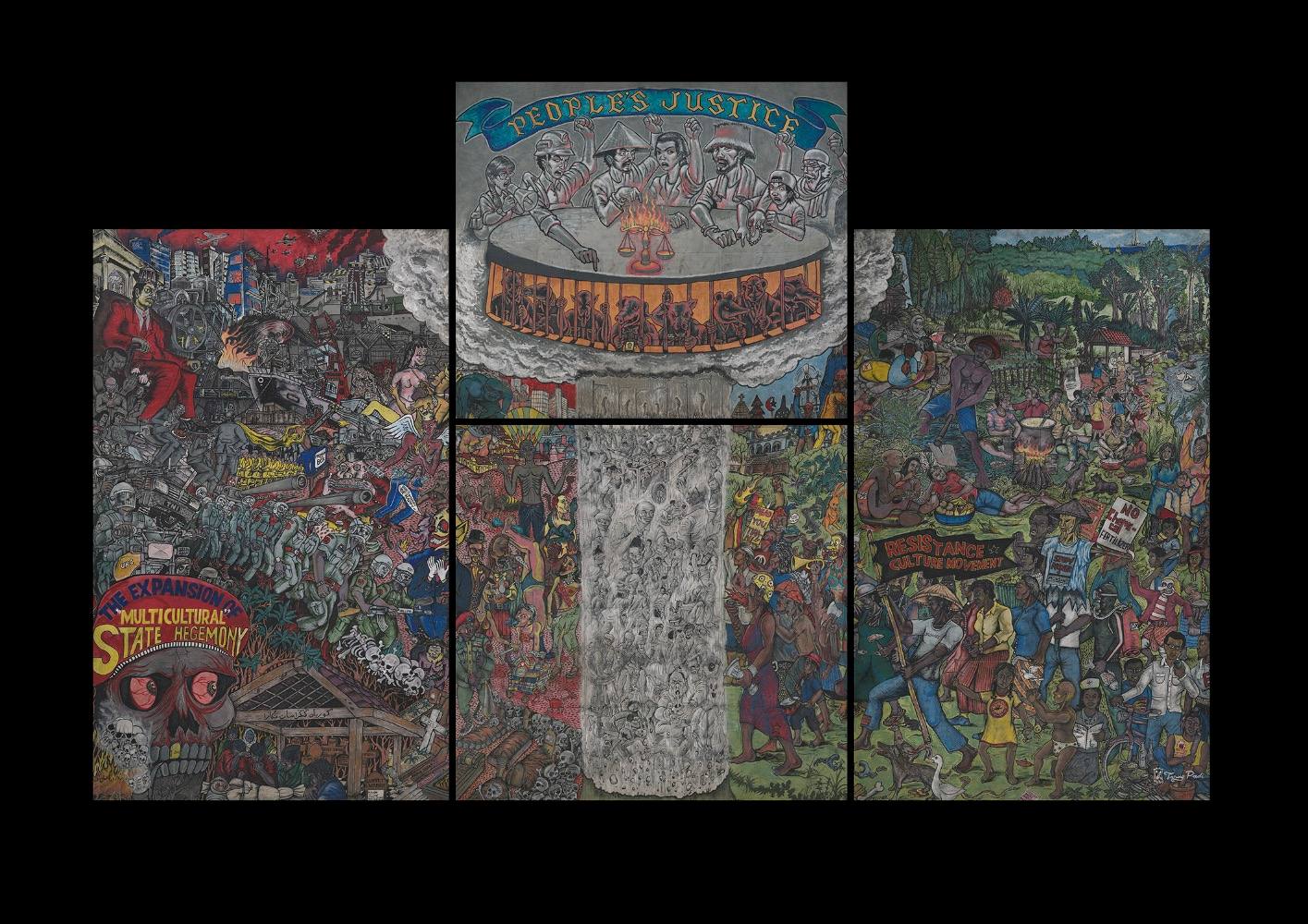
In Kassel, allegations of antisemitism against Taring Padi’s work focused on two figures that drew on antisemitic stereotypes in the large-scale banner (12 × 8 m) ‘People’s Justice’ (2002), installed in Friedrichsplatz. The first figure presumably depicts a fanged financier with pe’ot and a bowler hat marked with SS runes. The image unmistakably draws on antisemitic tropes. Taring Padi stated that its intention was political critique rather than racial or religious hatred; the collective nevertheless recognised the harm caused, apologised, and asked for public discussion. That request was denied. Documenta chose to deny any space for discussion, throwing Taring Padi to the wolves of public opinion; what followed instead was a trial by media. The initial institutional and media response gave little attention to the stereotype’s colonial transmission in Indonesia. Nor did it adequately consider the collective’s explanation that the second figure – a uniformed man with a pig’s head and a helmet marked ‘Mossad’ – referred to the Israeli state’s documented support for Suharto’s regime (Mack). The controversy also engulfed ruangrupa, the curatorial team, which was criticised for inviting Taring Padi and for not including Israeli Jewish artists in the exhibition.
One revealing aspect of the affair is the challenge directed at artists and curators from the Global South when they decline the institutional expectation that they perform legible identities. Taring Padi took a political position that included criticism of Israel. ruangrupa, for its part, sought to push against institutional boundaries by transforming the event from an exhibition into a common, replacing a gallery of essentialised identities with an experiment in redistribution organised through the metaphor of the lumbung (a collective rice barn in rural Indonesia). Both efforts generated friction: with Germany’s institutional politics of memory, which cannot be examined here in full, and with the hegemonic expectations that surround a major art exhibition. Neither Taring Padi’s contextual explanation of the banner as a critique of Suharto’s militarism and international alliances nor its apologies kept the banner on view or secured the kind of public dialogue the collective had sought.
In Kassel, the institution’s commitment to decoloniality reached a limit, one demarcated by introducing any critique addressing the State of Israel, and another that conceptualised lumbung, shifting attention from representation to economies and redistribution. The European art institution thus reasserted its authority over artists from formerly colonised societies.
Two days after this edition of documenta opened, mounting pressure led Taring Padi to cover – and therefore censor – the entire work with a large piece of black fabric, before removing it altogether the following day. After the banner’s removal at documenta, Taring Padi began travelling to work with activists and collectives around the world, using painting both to build solidarity and to investigate people’s justice and liberation. The other banners on display emerged from these encounters.
At Sale Docks, the image of the covered banner became the starting point for this later genealogy, transformed from a record of censorship into the announcement of potentiality. In a surprising short circuit, Taring Padi’s realist and pedagogical painting was thus transformed into a vast black monochrome, recalling Kazimir Malevich’s ‘Black Square’ (1915). Boris Groys identifies this Malevich piece as the revolutionary work par excellence — it ‘was like an open window through which the revolutionary spirits of radical destruction could enter the space of culture and reduce it to ashes’. Taring Padi’s vast black monochrome, an ephemeral and transitional object that lasted for a single day, briefly collapsed the opposition between revolutionary abstraction and realism. For an instant, two apparently irreconcilable traditions of materialism came together: the modernist negativity of the historical avant-gardes and the revolutionary articulation of art and militancy that characterises Taring Padi.i Could this have been a moment of healthy aesthetic destruction of the hypocrisies of neoliberal art?
Life in Venice
In Venice, Taring Padi’s invitation came from Sale Docks rather than from an institution such as the Venice Biennale. I have elsewhere described Sale Docks as an art alter-institution: an alternative, militant model of artistic organisation whose political, economic, and organisational principles oppose those of the conventional neoliberal institution.ii
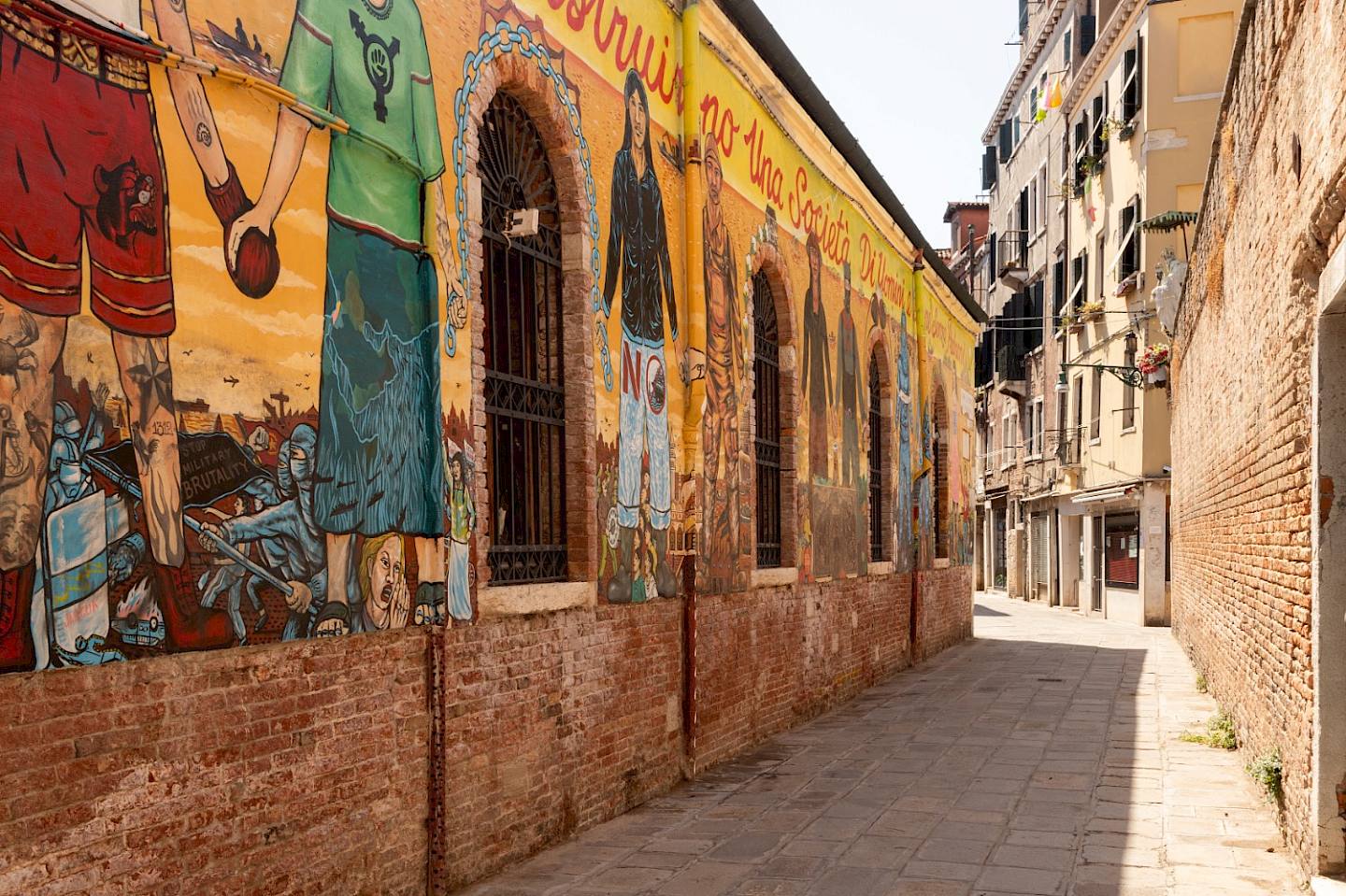
The encounter between Taring Padi and Sale Docks reveals a striking difference from Kassel. Sale Docks actually enabled criticism of Israel and support for Palestine, while distinguishing the political critique from antisemitism. Sale Docks is part of the Art Not Genocide Alliance (ANGA)iii and helped organise the large-scale strike at the Venice Biennale on 8 May 2026 against the presence of the Israeli pavilion and the choice of La Biennale to host it at the Arsenale. Taring Padi produced a series of linocut posters (which appeared on the walls of Venice) promoting the strike. Solidarity took shape in the work itself: Taring Padi, Sale Docks, and local pro-Palestine activists contributed materially to promoting the strike, including through the posters that appeared on the walls of Venice before the day of the strike. Solidarity was enacted through shared work and public action, rather than represented by artworks alone. After documenta’s ‘welcome’ into the ‘glamorous world’ of international art and the campaign of delegitimisation that followed, the Venetian stay allowed the two collectives to work together and, for Taring Padi, to rekindle the ‘flame of solidarity’ extinguished in Kassel.
What, then, does solidarity mean in this case? Returning to Arendt, we can say that solidarity between Taring Padi, Sale Docks, ANGA, and other groups of local activists did not depend on shared identity but formed through a community of action. I therefore propose a materialist account of solidarity as a relation formed through shared artistic practice, linking people across different geographies and identities. Steinar Stjernø, who has traced the history of solidarity in Europe, notes that Karl Marx used the term only occasionally, and more often criticised ‘brotherhood’ in favour of ‘workers’ unity’. For Stjernø, Marx understood working-class solidarity as arising from an increasingly uniform condition under capitalism and as ‘the result of specific forms of political practice’ (46–47).
If solidarity arises from a shared position within specific relations of production and from political practice, the conditions of the Taring Padi and Sale Docks project are telling: it received no institutional support and operated on a miniscule budget beside those of the Biennale, foundations, museums, and galleries in its ecosystem. The project’s material success rested on two elements that, in effect, define solidarity as an operating method as well as a feeling of closeness: first, reclaiming artistic cooperation from neoliberal capture; second, bringing turba and conricerca (co-research) together.
The first practice concerns a shared culture of the commons: cooperation pursued and enacted without expropriation by capital. In Capital, Marx is very clear: while cooperation does increase the power of labour, it is a historically specific condition set in motion by capitalism through the concentration of large numbers of workers in the same place (the factory), and through the way in which labour is industrially organised within it.iv More than a century later, postworkerist scholars proposed a different conception of cooperation, wresting it from the belly of capital and recognising its autonomous character. In this reading, capital is not the condition of cooperation; on the contrary, biopolitical production autonomously generates forms of cooperation that capital seeks to appropriate. Antonio Negri and Michael Hardt argue:
‘Cognitive labor and affective labor generally produce cooperation autonomously from capitalist command, […]. Intellectual, communicative, and affective means of cooperation are generally created in the productive encounters themselves and cannot be directed from the outside. In fact, rather than providing cooperation, we could even say that capital expropriates cooperation as a central element of exploiting biopolitical labor-power. This expropriation takes place not so much from the individual worker (because cooperation already implies a collectivity) but more clearly from the field of social labor, operating on the level of information flows, communication networks, social codes, linguistic innovations, and practices of affects and passions’ (140).
If this diagnosis holds for at least part of labour, institutional art’s expropriation of cooperation appears in the precarious conditions of artists, curators, and art workers; the reproduction of a financialised and elitist art world; the art market’s absorption of radical language; and the indebted and precarious art workers Greg Sholette calls ‘dark matter’ (41). In Venice, by contrast, the collaboration remained outside the Biennale and resisted what Sale Docks regards as the event’s role in artwashing authoritarian and genocidal regimes. The exhibition and mural resisted artwashing and gentrification, as well as the reduction of Venice to a real abstraction, a city organised around exchange value rather than everyday life. Our solidarity as self-organised collective practice produced a degree of autonomy within and against the neoliberal organisation of art and the city. In this sense, autonomous cooperation prefigured the liberated spaces and times it sought.
The second practice joins turba to conricerca, or co-research, rooted in the tradition of Italian workerism. Conricerca emerged in the late 1950s among intellectuals who went on to establish the journal Quaderni Rossi, first published in 1961. The method was developed over the following decades and theorised by Romano Alquati as conricerca. Workerist inquiry asked Marxist researchers to become militants: to reject the labour movement’s official theory and conduct research among and with workers in the new factories of Italy’s economic boom. The researcher forms an alliance with the people whose conditions are being studied. This partisan solidarity produces partisan knowledge — workers’ own experiential class knowledge, rather than knowledge produced about them. Research itself becomes part of political organisation, rather than a preliminary or separate activity. The joining of research and militancy brings inquiry closer to political conflict rather than keeping it at a distance. Co-research is accordingly conducted in factories and other places of social conflict, rather than in university classrooms, party headquarters or trade union offices.
Sale Docks also bears the legacy of workerism and adds artistic practice to the joining described above, producing an art-research-militancy. Sale Docks has combined performance, qualitative research, and organising; at other times, the collective has woven fiction together with the study of social movements and critical engagement with the city. Across this experiment, art can become a method of co-research joined to organising and activism.
Research itself becomes part of political organisation
Earlier, I described turba as an injunction for artists to ‘go down’ among the lowest strata of society. Its practice, however, exceeds that formulation: it invites artists to conduct research with subaltern groups. Drawing on accounts by members of LEKRA, Elly Kent describes turba ‘as a research method’ (99), a practice in which the artist seeks popular and proletarian knowledge, where art shifts from representation to participation.
Now, although not always codified, this articulation of art-research-organising is also present in Taring Padi’s work. The collective work underlying a workshop or the production of a large banner begins well before the painting stage. The co-authors of a banner are often invited to take part in extended collective sessions in which they share their histories and experiences, their organising methods, and the struggles in which they are currently engaged. This exchange unfolds over several weeks (even months in certain cases) and culminates in the collective choice of the subject to be painted. Indeed, each banner incorporates a process of co-research, even when the outcome is not an essay published in a militant journal.
As Alexander Supartono writes of Taring Padi’s trajectory: ‘The real problem lies in protecting and sustaining radicalism, that is, making art that does not just stand as a mirror reflecting social relations, but which is an organic part of these relations’ (7). Unexpropriated cooperation and co-research therefore work within and against social relations organised by capital. In Venice, they enabled Sale Docks and Taring Padi to turn solidarity into a sustained community of action.
Endnotes
i In the same essay, Groys argues that Malevich was a radical materialist, convinced that all art of the past, like every society of the past, was destined for the destruction and transformation wrought by historical time. Nevertheless, ‘Black Square’ offers a line of flight as an image of destruction, since ‘the image that survives the work of destruction is the image of destruction’. Boris Groys, ‘Becoming Revolutionary: On Kazimir Malevich’, e-flux journal, no. 47, September 2013.
ii For a more detailed discussion of alter-institutionality in art, see Marco Baravalle, The Battleground of Art: Radical Curating in the Crisis of Neoliberalism, Verso Books, 2026.
iii ANGA is a coalition of art workers that, under the umbrella of BDS and PACBI, calls for the exclusion of the Israeli pavilion from the Biennale and an end to artwashing.
iv Marx addresses the notion of cooperation in Volume 1 of Capital. Karl Marx, Capital: A Critique of Political Economy, vol. 1, trans. Ben Fowkes, Penguin Books, 1976, Chapter 13, ‘Co-operation’, pp. 439–54.
Works Cited
Baravalle, Marco. The Battleground of Art: Radical Curating in the Crisis of Neoliberalism. Verso Books, 2026.
Groys, Boris. ‘Becoming Revolutionary: On Kazimir Malevich’. e-flux journal, no. 47, Sept. 2013.
Hardt, Michael, and Antonio Negri. Commonwealth. Harvard UP, 2009.
Kent, Elly. ‘Artistic Ideologies: Individual and Society in Indonesian Art’. Living Art: Indonesian Artists Engage Politics, Society and History, edited by Elly Kent, Virginia Hooker, and Caroline Turner, ANU Press, 2022, pp. 83–108.
Mack, Eitay. ‘How Israel Helped Whitewash Indonesia’s Anti-Leftist Massacres’. +972 Magazine, 9 Sept. 2019.
Marx, Karl. Capital: A Critique of Political Economy. Translated by Ben Fowkes, vol. 1, Penguin Books, 1976.
Nehra, Pritika. ‘Cosmopolitan Solidarities of Difference in a Broken World’. HannahArendt.net, vol. 12, no. 1, 2022, pp. 94–106.
Sholette, Gregory. Dark Matter: Art and Politics in the Age of Enterprise Culture. Pluto Press, 2011.
Stjernø, Steinar. Solidarity in Europe: The History of an Idea. Cambridge UP, 2005.
Supartono, Alexander. ‘Introduction’. Taring Padi: Seni Membongkar Tirani / Art Smashing Tyranny, Lumbung Press, 2011, pp. 7–18.
Ulung, Alessandro Kurniawan, and Dadang Ilham Kurniawan Mujiono. ‘Activist Cosmopolitanism in Taring Padi’s Art: Fostering Cosmopolitan Solidarity for Human Security in Indonesia’. Mudra Jurnal Seni Budaya, vol. 41, no. 2, 2026, pp. 116–31.
Utama, Wildan Sena. ‘From Pan-Asian to Afro-Asian Solidarity: History of the Bandung Conference from the Indonesian Perspective’. Bandung-Belgrade-Havana in Global History and Perspective: The Deployment of Bandung Constellation towards a Global Future, edited by Darwis Khudori, Diah Ariani Arimbi, and Isaac Bazié, Airlangga UP, 2023, pp. 59–71.
Winking, Kerstin. ‘Taring Padi: Solidarity in Public Space’. ArtAsiaPacific, no. 128, 2022, pp. 50–57.
Yatmaka, Yayak. ‘Workers United, Will Never Be Defeated’. Taring Padi: Seni Membongkar Tirani / Art Smashing Tyranny, Lumbung Press, 2011, pp. 147–59.


What shapes do solidarities take in these strange times we are living in? How can we find and forge solidarities when faced with genocides, human rights violations, and inexplicable injustices daily? Can storytelling play a role in liberation?
