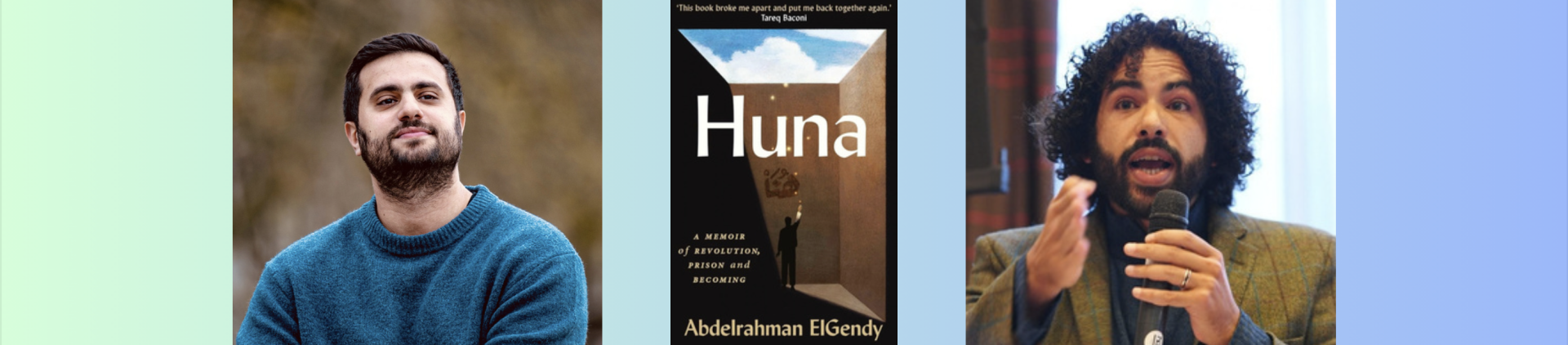
Book Launch: Abdelrahman ElGendy in conversation with Hazem Jamjoum
What does it mean to remain 'here' when here is not a physical space?
In Huna: A Memoir of Revolution, Prison, and Becoming, Abdelrahman ElGendy begins from that word, 'huna', 'here', inspired by the popular protest song 'Sawfa Nabqa Huna'. Huna emerges from six years of political imprisonment in Egypt and grapples with revolutionary hereness and withness inside a revolution, prison cells, and exile, reckoning with what it means to inhabit a space designed to erase you and find ways to be.
In conversation with historian and award-winning translator Hazem Jamjoum, we begin with Huna and open outward: toward prison literature, cross-prison solidarity, and the resonances between prison movements in Egypt and Palestine, as well as the ways in which they may refuse easy comparison. What can prisoners teach us when we stop treating them as mere spectacles and begin listening to them as theorists and meaning-makers? Can well-intentioned superhumanisation of political prisoners be as harmful as dehumanisation?
Join Elgendy and Jamjoum for a conversation co-hosted in partnership with Wasafiri that engages with how the book asks questions of its own form. What does it mean to write an Arab prison memoir in English? How can opacity and untranslatability become tools of literary dissent? Who is the reader being asked to stand beside? What is the role of language in a time of genocide?
When: Tuesday, 3 November, 7-9pm (Doors open 6.30pm)
Where: Mosaic Rooms, London
Tickets: Free
Abdelrahman ElGendy is an author and translator from Cairo. His memoir Huna: A Memoir of Revolution, Prison, and Becoming is a finalist for the National Book Award. A winner of the Samir Kassir Press Freedom Award, ElGendy holds an MFA in Nonfiction Writing from the University of Pittsburgh and an MSc in Human Rights and Politics from the London School of Economics and Political Science. His work appears in The Washington Post, The Nation, The Baffler, The Los Angeles Review of Books, and elsewhere.
Hazem Jamjoum is an educator and lead editor at Safarjal Press. He is also a curator of the British Library’s early twentieth-century audio recordings of relevance to Arab and Gulf History. His work aims at digitising, cataloguing, and contextualising this part of Arab communities’ audio heritage. He has also co-led a project aimed at identifying similar at-risk audiovisual collections in the region with the longer-term aim of fostering such preservation and curatorial work on a wider scale. His doctoral research in history at NYU traces the connections between the production of 'Arabic music' as a concept and a commodity, and the implications of these production processes on supra-state collective identifications, pan-Arabism in particular. He recently translated Ghassan Kanafani’s The Revolution of 1936–1939 in Palestine and Maya Abu Al-Hayyat’s No One Knows Their Blood Type.

What shapes do solidarities take in these strange times we are living in? How can we find and forge solidarities when faced with genocides, human rights violations, and inexplicable injustices daily? Can storytelling play a role in liberation?
