‘A Beginning of Love Stored in Time’: Abdelrahman ElGendy in Conversation with Fady Joudah
Upon the release of his seventh collection, Exhibit G, the prolific Palestinian American poet and translator Fady Joudah speaks to Egyptian author and translator Abdelrahman ElGendy – both longlisted for the National Book Awards this year – about the collection’s porous formal boundaries, the politics of the image in Gaza, practising versus performing solidarity, what it means to inherit land and language while both are in the midst of being incinerated, and much more in this rich, extensive interview.
This piece is commissioned in tandem with Wasafiri 127: Solidarities.
Supported by a grant from the Open Society Foundations.
For the Palestinian American poet and translator Fady Joudah, to write about Palestine in English is to be forced to grapple with the mirage of ‘originality’ — where the condition of entrance requires, indeed, a performance of the self, often erasing the very interiority one is trying to protect.
In his seventh collection, Exhibit G (Milkweed Editions, 2026), Joudah writes from the impossible position of enduring the genocide of his own people – including members of his own family – through a language and literary tradition that the West only receives through the narrow aperture of its own claimed universality. A Palestinian poet in the West is often only registered as an advocate, a translator of the ‘Other’, or a martyr in the waiting. Joudah views this as a ‘parody’ of existence that caters to a listener demanding legibility as the price of solidarity. Like its predecessors, Exhibit G arrives with Joudah’s signature precision: this is a poet who knows that his interior life belongs to a reality that English fails to grasp.
I spoke with Joudah about the collection’s porous formal boundaries and how the poem leaks into the photograph into the essay into the fragment. We discussed the politics of the image in Gaza, the ethical divide between a solidarity that views the victim as an abstraction as opposed to one that loves them as kin, and what it means to inherit land and language while both are in the midst of being incinerated.
by Abdelrahman ElGendy
Abdelrahman ElGendy: I have been thinking a great deal about the relationship between the matn and the ḥāshiya in classical Arabic scholarly works. Radwa Ashour writes beautifully about this in Li Kulli al-maqhurin Ajniha, describing how the main text, the matn, is often confined to a few lines on the page while the ḥāshiya, its marginal commentary, comes to occupy most of the page. Sometimes that commentary even becomes its own separate text, overtaking the matn in scope, citation, and intellectual life.
You have often said that Palestine will be liberated in Arabic. Your poem ‘Baby Moses & Khalas or Notes on Palestinian Interiority’ from Exhibit G confronts us with a similar burning question: what becomes of Palestinian interiority when it passes from Arabic to English, and why does genocide become the price of that passage? Could you speak more about what it means for Palestine to exist in English as a ‘marginalised identity’ versus in Arabic as a ḥāshiya, where the margin carries a different relationship to authority, theorisation, and citability?
Fady Joudah: The history of marginalia in Arabic literature has been quite developed for at least a thousand years. Epistolary art, science writing, poetry collections ... everything was accompanied by poetic marginalia or interjective prose, so much so that the marginalia sometimes became more text than the text, in volume or substance. Alongside this art of marginalia, hybridity formed. I have engaged these forms throughout my poetry collections as my own private conversation with an ancient literary tradition. Modernity freed the named (poetry, in this case) from the forms that name it. But one gets past the mirage of renaming (or the adolescent game of antecedence): ‘Who shall be true to us / when we are so unsecret to ourselves?’
Palestine in Arabic has a much more organic relationship with imagination than it does in English, if only because Palestinians do not have to repeat themselves ad nauseum in the circus of limited movement and false advertisement. Take the word ‘organic’ above. If you are a Palestinian chicken or egg, what exactly makes you ‘organic’ in English?
At least in Arabic, the masses from Morocco to Iraq will sing love songs for Palestine. If there is a similar thing in English, it is nascent, still cultivating a deep heart. Talking too much about Palestine in English risks turning oneself into a parody. Instead, one must endeavour to honour the sovereignty of those who live Palestine in Arabic. We have not even begun this process in English. It has not taken root. Or the mycelia and the rhizomes have not connected with it yet.
Exhibit G attempts an imaginative Palestinian return to Arabic. But it cannot escape being an exhibit in English: that Western tradition that turns its vanquished into a museum, with all that entails.
In 1974, Mahmoud Darwish published a long poem for Gaza that not many know about. In ‘Exiting the Mediterranean Coast’, Darwish writes: ‘You need a miracle to understand me / because your languages are so understood: / Clarity is the crime / but the mystery of those you kill is the truth.’ It was a time of Palestinian revolution. Now, Gaza has exited the Mediterranean coast and spread itself all over the world. The world still needs a miracle to understand Palestinians.
AE: ‘Baby Moses & Khalas or Notes on Palestinian Interiority’ strikes me as a ḥāshiya itself, perhaps the core ḥāshiya of this collection, written to one of the foundational stories of sacred scripture, the story of Baby Moses. Formally too, it unfolds through proliferating ḥāshiya-like fragments, linked by recurring ‘OR’ and ‘&’. Baby Moses is an epic of mothers and miracles, genocide and grammar, prophets and checkpoints, and etymologies, photographs, and revolutions.
This piece made me think about form more broadly across Exhibit G. The book is presented as poems, essays, and photographs, yet these categories seem to continually leak into one another. How do you think about the relationship between form and thought in this collection? Are these distinctions meaningful to you in any way?
FJ: Perhaps a digression here is informative or more entertaining. Take the wide circulation of Darwish’s excerpt ‘the mask has fallen’. It comes from a book-long poem, In Praise of the High Shadow. I imagine the title is in conversation with Jun'ichirō Tanizaki’s 1933 essay on Japanese aesthetics and Western modernisation, In Praise of Shadows? Tanizaki’s essay is corrupted in English to support an apolitical intimacy that affirms the Western ideation of negative liberty toward a positive one: a freedom from the political toward a freedom to live the apolitical. But the essay is intensely, albeit quietly, political. In his own poem, Darwish engages the most intimate aspects of Palestinian interiority while reflecting, in 1983, on the barbaric Israeli destruction of Beirut in 1982. He claims kinship with the Japanese through Hiroshima and Nagasaki, two acts of unfathomable annihilation. The epic poem does not depict the Arab self as infallible or monolithic. But it honours and celebrates the Palestinian (and Lebanese) shadow that is forced to rise high above the incinerated ground made uninhabitable by oppressively progressive light.
In Tanizaki’s words, Western lights violate Japan. The Palestinian shadow, one of several metaphors of Palestinian interiority, achieves ascension not to achieve holiness or abstraction, but to secure a space for living until it can return to walk on earth, attached to a body that is not in constant flight or perpetual revolution. These are lived realities for a Palestinian.
AE: ‘Baby Moses’ also relentlessly interrogates the many faces of ‘khalas’: redemption, enough, done, agreed, arriving at. ‘There is no spectacle in redemption. And no redemption in spectacle.’ But this sits alongside another insistence: ‘It is not your fault that your love was not the love this place could love you with.’ This love seems to me the collection’s core recurring preoccupation. I find myself haunted by it most sharply through the horses in Exhibit G. You invoke Antara ibn Shaddad’s epic mu’allaqa poem, where his horse, pierced with spears and lances in battle, turns to him to plead ‘with a tear and a neigh’, as the mu’allaqa puts it. In your reimagining, he comes to realise that ‘The love he thought he had for his horse / had not been the love.’
‘Another Horse’ offers us a different love. Here, the horse is not an instrument of war but a companion of ordinary life, standing before the family home and then slaughtered amid genocide. It is mourned and blessed as kin: ‘our horse’, ‘our bolide’, even its unbearable stench is claimed with tenderness. It feels, in my reading, like a horse loved with the love that is the love.
Could you speak to these two horses, and to the distinction between the love that is and isn’t the love, and what kind of love might make khalas possible?
FJ: We all perform or attain the love that is the love and the love that is not. Perhaps the latter imperfect love is much more available to us than the former, and sometimes we find the former in it, as marginalia. The survival of Antara’s verse about his horse reflects his true love for his horse, Al-Abjar. But Antara loved himself more than he loved his horse. This indicates the separation between human and animal while still acknowledging a great degree of kinship between them. This also parallels human love for other humans, no? What separates humans from animals begins with alphabetical language. But there is a threshold after which (or before which) no distinction exists between human and animal. Love marks it. It is an incomplete love, but it is love, nonetheless.
As I say in ‘Exhibit G: Apple of Carthage’, redemption is attainable only when you recognise that you will lose it again, and you must restart your search to reattain it, not retain it. Redemption cannot be retained once attained. The labour of retention is a capitalist morality. Reattainment is a labour of love, which can only be attained with the foreknowledge that what one seeks, one will lose once they attain it. No fee for service works with redemption.
Redemption refuses complicity in the dark arts of human affairs that seek to rein it in, to employ it. Attaining redemption is an awareness of the impending loss that demands the honest labour of proximity to what you will lose but cannot retain. Redemption is a metaphysical state inseparable from the physical, and retention of redemption insists only on the physical. Spectacle is nothing but material — material that can perform the metaphysical and deceive it. Art can be an example of this, especially during a time of genocide. But performing redemption is not redemption. Attaining redemption is possible only when there is no performance in it.
Antara, at the moment he realises he has let down his horse (because he brought suffering upon him in the name of war, a pain that brings the horse to the cusp of human speech), touches redemption. He is not performing it in the poem; he is devastated by his imperfect love. He remains far more honourable than Israeli soldiers shooting a horse dead in the head, in the middle of a genocide, to destroy the human lives that coexist with the horse.
Also, Palestinians are not horses other Westerners love and disabuse. Palestinians are not horses at the cusp of human speech about to become a miracle: ‘You won’t understand me / without a miracle / because your languages are so understood. / Clarity is your crime / when the mystery of those you kill is the truth.’
Attaining redemption is possible only when there is no performance in it
AE: For the first time in your work, you include photographs in this collection. Most are from the Gaza Soup Kitchen collective. Many of the images show Palestinian children and adults in relation to what should otherwise be mundane (food, drink, pets, classrooms), but whose horror lives in the details of their context: standing in long, death-trap food lines; hauling containers of drinking water that become scarcer with each passing day; huddling in tents to knead dough for bread and to cook mulukhiyah.
Yet the people in these images are not marked only by desolation. Often, they meet the camera with smiles, radiating joy, sometimes posing, sometimes unaware of the lens. I found myself thinking about the fraught politics of the image, a tension you engage directly in the collection, writing, ‘I’m not a window, / I said, I’m the view.’ In ‘A Glass of Water, a Burning Boy’, you write: ‘A Pulitzer for a vulture objectively giving a moribund child his space to die of starvation.’
We know that no camera lens is neutral, that there is always a tension between bearing witness and voyeurism, testimony and extraction, exposing horrors and producing genocide gore.
But again, another lens of love emerges:
‘To pose for a photograph during extermination and look like the love of life, laissez-faire still within reach. What free fall and what ascension. What accrues in the kids’ memories is stored in their bodies. What’s stored in their bodies is a beginning of love stored in time.
Too many Palestinians are a beginning of love stored in time.’
I am curious how you consider the politics of the image and what guided you in curating the visual elements of this book as ‘a beginning of love stored in time.’
FJ: ‘Palestinian faces. Acapella or minstrel. But the kids, the kids, they just want a word with time.’ In the repetition of faces and bodies, so many details arise — in the eyes or mouth, in hands or feet, in dress and other paraphernalia. There’s what a T-shirt says, for example, whether the names of superheroes or fake Western brands. The irony and the horror. The heart of darkness is invisible in these colourful photos because it belongs to the onlooker. But the photos are not about gore or pity. Perhaps the photos ask us what sickness has possessed us that we have become so worshipping of scales of suffering? A sui generis narrative unfolds. Let’s not pretend the images do not stir feelings of unexamined racism, even if through the mask of pity. What is a Palestinian in English besides a runner along the spectrum, the spread, of pity and indignation?
‘I am a victim. No, I am not, and I spit in your face.’ Each is taken in by the performative retention of a different grace. The former grace is common decency; the latter is democratic. In both cases, the Palestinian in English is a parody.
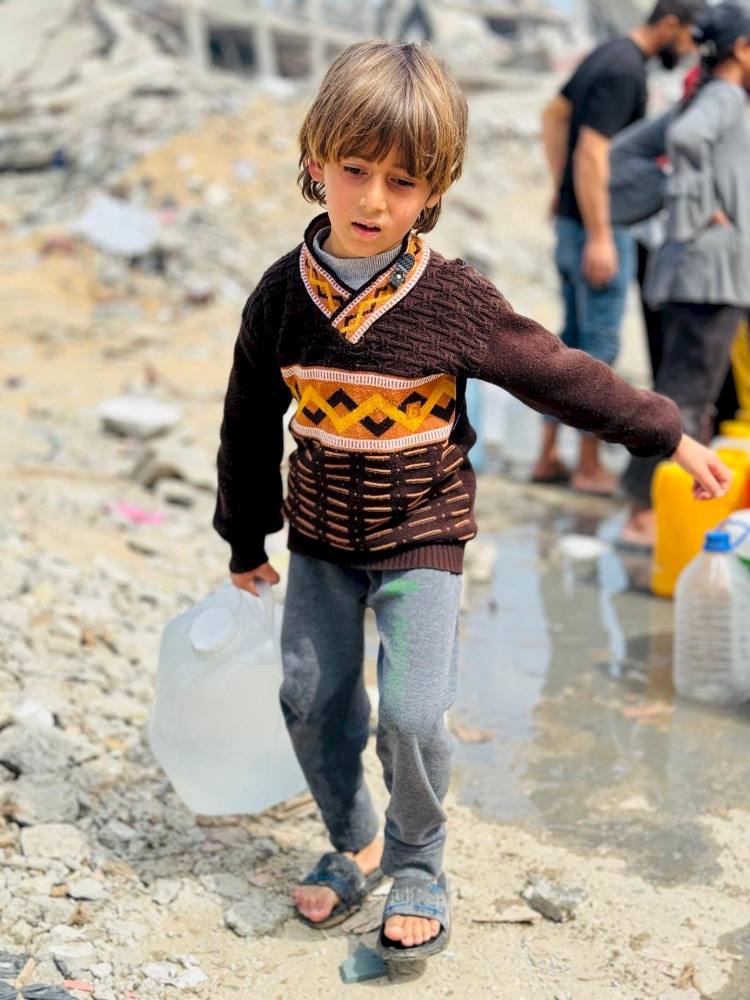
In Exhibit G, I did not feel responsible for representing genocide ‘accurately’ to those who produce it and then resist it. But I did not deliberately seek to ‘mask’ or sugarcoat horror either. If someone focuses on the joy or sunshine in these children, they have to ask themselves, why use these terms of endearment? What happens after the camera turns away from the children, now or much later? Palestinians are not ghosts or books. The children don’t see themselves that way. Some portraits in Exhibit G also seem to mock the art of the portrait itself, both in quality and content. But that is another conversation for an art critic or historian.
I want to offer a word about Naji Al-Ali, and Handala, his cartoon creation. Handala, the Palestinian refugee or besieged child, stands with his back to the world. He didn’t start this way in 1969, but by 1974 he reached full maturity and refused us his face. We have never seen his face after that (except in one instance, I think, in 1982, holding the Palestinian and the Lebanese flags). Handala is faceless not because he lives in a world that has lost its common decency to see a child’s face, but because the world has not earned the right to see his face. It’s an agency quite removed from the ethics of victimhood.
Handala knows this: to recognise that a child has a face, your heart must see that face before your eyes do. When we see Handala – if we see him – we see him with our hearts. You notice how the adult Palestinians in Al-Ali’s cartoons all have faces? But each one of them was Handala at one point, a Palestinian child with the right of return. They developed faces only after they became adults. The faceless faces of those Palestinian adults are quite emotive and span all generations in Al-Ali’s art — parents, grandparents, and their lost childhoods. But also, they are saying that Palestinians acquire faces without meaning.
Handala refuses us his face because he knows what the liberal agents' intent to preserve the security of their tribe can do to adult Palestinian bodies. These agents never acknowledged the existence of Palestinian childhood in child or adult bodies. Handala knows we have never acknowledged his face, because he knows what continues to be done to Palestinians whose faces we see. And so, the many children in Exhibit G are not here to perform for English, [and the worlds English signifies and encompasses.] It is not their fault that English thinks the entire world is always performing for its capitalist morality.
What happens after the camera turns away from the children, now or much later?
AE: Reading ‘The Land Has Hands’, I was struck by your invocation of Darwish’s refrain – ‘And land, like language, is inherited’ – from ‘The Tragedy of Narcissus, The Comedy of Silver’, which you yourself translated. This line appears four times in Darwish’s poem, each instance following moments of near-mythic closure that attempt to reconcile violence by rendering it meaningful within the experience of a collective Palestinian ‘we’, whose continuity persists across time.
In ‘The Land Has Hands’, however, the refrain is triggered by the witnessing of an external, colonising ‘they’ – soldiers, killers, occupiers – whose crimes rupture rather than resolve. For example, the soldiers claiming a land where they are unable to speak to its olive trees, their consuming of ‘the flesh of the flesh’, or the question ‘Who uproots, severs, burns a thousand-year-old life?’
One of the sharpest depictions of this inheritance arrives in the scene where soldiers pose with a stolen makdos jar and giggle. They appear to be colonising the jar and the delicacy itself, but not the embodied inheritance of land and language that these hold. Later in the collection, you describe these soldiers as: ‘They who bomb hospitals to inherit the earth.’
How does this triad of inheritance, land, and language function in Exhibit G, and what is it meant to hold open?
FJ: One of the poem’s other refrains is ‘A stone scratching the sun’, which commemorates the First Intifada, and ‘the children of the stone’, who, in an act of non-deadly resistance, threw stones at the Israeli army machine. I also refer to this in ‘Baby Moses’ when I mention Yitzhak Rabin, the former Israeli prime minister and ‘prince of peace’. It was him who gave the orders to use those non-deadly weapons, the stones, against captured Palestinian youth in order to break their arms and crush their hands. It is amazing how in Western narrative constructions, Rabin was made into a martyr of peace when he was hardly as decent as FW de Klerk. Perhaps it was because he was not as yet defeated.
The First Intifada’s initial spark was ignited in the Jabalia refugee camp in Gaza. It’s hard not to see the Israeli spite in wanting to raze Jabalia to the ground during the genocide, purportedly to avenge that historical uprising of Palestinian revolutionary existence in December 1987, which was eventually subdued through the failed Oslo Accords and a changing world order, as it were. Palestinians recognise the good life in a stone, how they can embody its thick skin toward liberation. But the refrain you mention, ‘And land, like language, is inherited’, had vexed me for a while. On the surface of it, it seemed to say that whoever owns the language of the place inherits the land. If brute and totalising force transforms the language of a place, it gets to transfer land to itself and pass it down. If so, then coexistence is still an option so long as this new language does not annihilate other languages of that land. The violence of the nation-state model always tussles with the matter of recognising official state languages. Arabic is no longer an official language in Israel. Coexistence was never really a foundational stone for Zionism, only a mask.
But there is clearly something else in the refrain. Land itself has the right to language, and indeed it speaks it. Stone, earth, the air above, the water, on the land, around it, from the river to the sea ... all speak. And what the land speaks, the people have the option to embody. The land ventriloquises the people who keep the land that keeps them. The land that gives you olive trees for centuries or millennia is the same land that gives you sesame and garlic and a cuisine that is not for cannibalisation. Even the code of honour in conquest no longer exists in the settler-colonial state. To cannibalise your vanquished by stealing their foods – without adopting their dialogue with the land – is a losing proposition in time. To eat the flesh of the flesh is not a language the land wants to bequeath. In the West, too many talk about nature and ecology but avoid registering how Palestinian liberation is a preservation of a decent human relationship with the nonhuman world.
What we are sold in the West is Israel as a mirror image of us: we mow lawns and establish ecotourism. In 1992, Darwish further expanded this language of the land in 'The “Red Indian’s” Penultimate Speech to the White Man’. Even water is part of a body. If 60 per cent of the human body is water, then stealing water from Palestinian artesian wells is a murderous act. Israel steals Palestinian water to sustain the Israeli body and desiccate the Palestinian’s — to drink the water of the Palestinian flesh.
Land has and is a language. To inherit it, you must speak its language as best you can. It will teach you coexistence, no matter how imperfect, and this imperfection will now and again illuminate a path for redemption. Palestinian insistence that a part of their language is the language that the ancient land has taught them to speak is an indomitable, ineradicable mode of inheritance. Those of us who think this kind of language is for the weak, poetic, romantic, etc think they can own time. But time, when employed as a weapon by the oppressed, terrifies oppressors. There will come a moment when Israeli society cannot pass down the land because the language that its society speaks is only a language of death. You can only bequeath death for so long. It’s a self-limiting process. It kills its beholder, too. Yes, there is no life without death, etc. But the beholder of death dies when they are no longer able to honour life for themselves or for others. In […] (Out-Spoken Press, 2024; Milkweed Editions, 2024), I echoed Al-Buhturi: ‘Destruction runs its business to the ground.’ All destruction does. The original Arabic goes something like: ‘Destruction’s conduct destroys itself.’ Incidentally, I ran across that line in a commentary on Al-Mutanabbi’s line that I then used as the epigraph of […].
At best, the Western diligence to rehabilitate Zionism and fascism can be seen as a reaction toward preserving life. The argument is that restoring the oppressors’ relationship with life, instead of death, ensures more of the oppressor and the oppressed get to live. Yet a sense of supremacy still drives this thinking. It cannot imagine or accept that Palestinians know more of how to honour life, including that of their enemy, than their enemy does.
AE: Love has always been a preoccupation across your body of work, and I often return to something you said in an interview for The New Inquiry around your previous collection, [...]:
‘There is a solidarity whose horizon is assimilation, and there is a solidarity whose horizon is liberation. The former is hierarchical to those it is in solidarity with. The latter is in community with them. The former treats them as abstraction. The latter is citational. It names those it loves.’
In Exhibit G, poems by the Gazan poets Rawan Hussein and Nima Hasan appear throughout the collection, including one co-written with Nima. I couldn’t help but think again about citation as an act of love, and of naming those that one loves, especially as citation itself can be read as a form of ḥāshiya. Looking across your work, and especially at Exhibit G and the many forms of love it (be)holds, could you speak more about citation as method? What does it mean to cite, whether from so-called allies, across struggles, or within our own communities?
FJ: In times of extremity, citation is about giving power back to where it should reside. Palestinians need to cite each other much more than we do. It is a question of imagination. We need to think through and with Arabic, even if the expression of this thinking is done in English. A greater courage or sense of liberation is required for this engagement. We need to love ourselves more and be mindful of the inferiority complex we carry in English, and which English practises on us in myriad forms. Even in forming solidarity in the West, we perform ourselves, as if Hamlet has reached the epiphany of turning words into action: ‘The play’s the thing / Wherein I’ll catch the conscience of the king’. The latter needs no catching. We get consumed by ‘the play’.
Palestinians in English struggle to be themselves without constantly selling themselves to some aspect of Western culture, in which they are forced to experience erasure again. A kinder, gentler erasure. Palestine in Arabic holds on to a relationship with time that is more liberated from imperial time. Not all time in Arabic is liberated, and much of it is colonised, but being aware of the existence of and experiencing this non-imperial time is significant in Arabic. It is more real and accessible than the slogans shouted in English.
To what extent is solidarity with Palestine in the West an evolved echo of Zionist mantras? Early Zionists said Palestine is ‘a land without a people for a people without a land.’ To what extent does Western solidarity now say: ‘Solidarity for a people without those people. Solidarity for Palestine without Palestinians’? To what extent is solidarity with Palestine in English evangelical, in that it abstracts its subject? ‘Palestine yes, Palestinians no,’ Edward Said said in his much-referenced ‘Permission to Narrate’ in 1984. Some of the ‘heroes’ of solidarity achieve bizarre commercial success through legacy, industry, or the more ‘socialist’ digital platforms. The experience is surreal. To the extent that solidarity with Palestine in English is a product of the culture and system that oppresses and erases Palestinians, this solidarity is more loyal to the rehabilitation of that system-culture than it is to the liberation of Palestine or Palestinians.
In any case, on the aesthetic level, including the poems of Rawan Husein and Nima Hasan is about the contrast and plurality of language from within Gaza now. They offer two different styles and subjectivities. Nima is much more outwardly. She has a disarming simplicity in capturing macro conditions through the most intimate details. Rawan is deeply introverted. Her imagination captures an entirely different lexicon. I was honoured to be in correspondence with them. I felt, yet again, how artificial much of the writing within empire is, intensely geared toward a domesticated reader and viewer, regardless of diction and register. It was liberating to work with them on texts they wrote in hand, out of hand. I am aware how writers from Gaza are considered ‘more authentic’, and are sought after for purposes of bona fide solidarity that must converse with the market in English. We also have to address the extent to which this preys on their despair. In other words, the genocide creates its own economy and machinery.
Still, I open the book with my own epigraph: ‘I turned my love for you into art, / that I may triumph over death.’ And in the penultimate poem, I return to ask: ‘How did we convince ourselves / we had learned all we needed / to learn from love? To begin again. That’s how beginnings end.’
Listen to a short audio clip from the interview here.
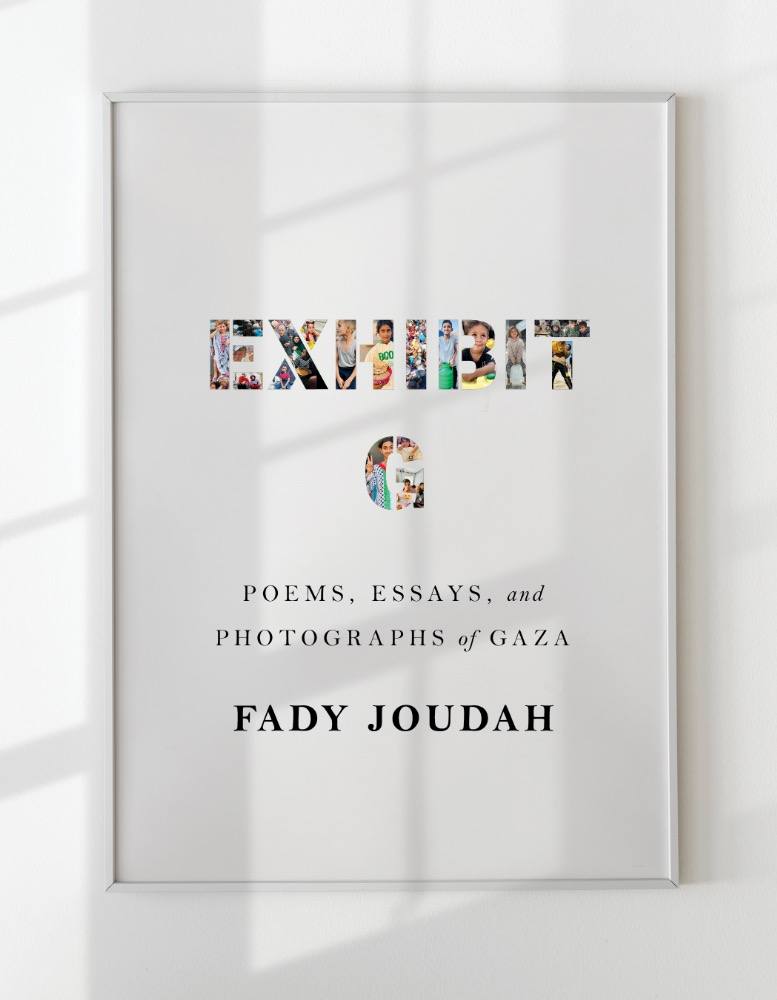
Exhibit G by Fady Joudah is out now with Milkweed Editions.
Fady will also be delivering the Edward W. Said London Lecture 2026, titled 'Notes on Solidarity', at Mosaic Rooms, London on 15 October.
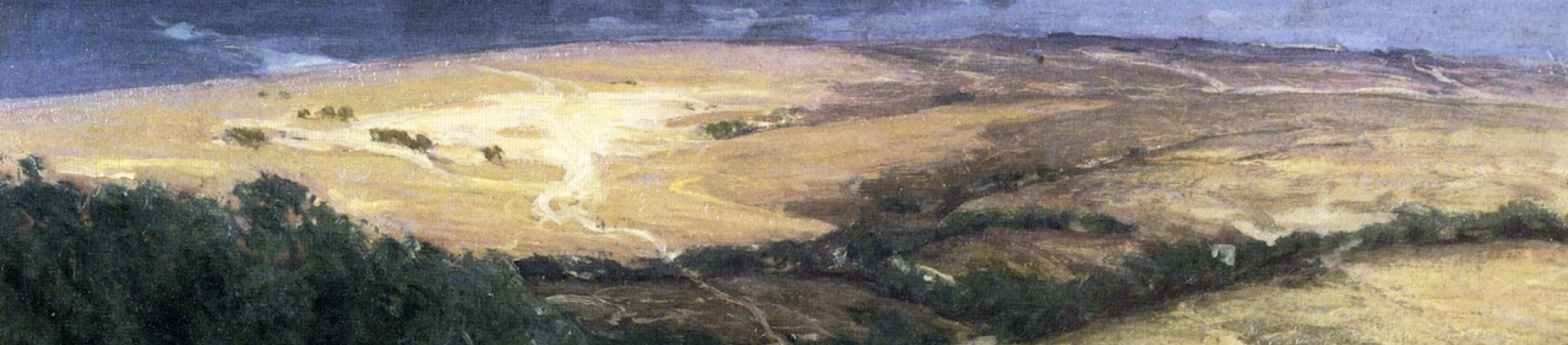
Cover image: Henry Ossawa Tanner, A View in Palestine, 1899


What shapes do solidarities take in these strange times we are living in? How can we find and forge solidarities when faced with genocides, human rights violations, and inexplicable injustices daily? Can storytelling play a role in liberation?
