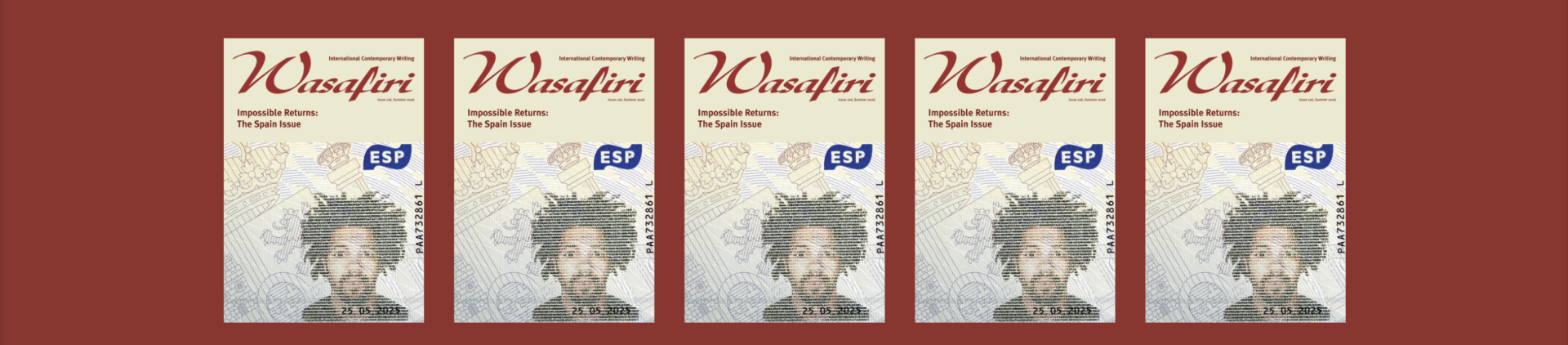
Impossible Returns: Online Launch for Wasafiri 126 – Spain Issue
Join us as we celebrate the launch of Wasafiri 126: Impossible Returns – The Spain Issue! Guest editors Marta Fernández Campa and María del Pilar Kaladeen will lead a wide-ranging online event drawing out key themes from the issue, including national memory, colonial history, nationality, and identity in the context of Spain.
There will be readings from issue contributors Salma Bechar, Noelia Cortés, and Lola Ortiz Vargas; a conversation between translators Layla Benitez-James and Julia Conner; a guest reading from Wasafiri's Translator in Residence (Endangered Languages) Juana Adcock, and an artist presentation by Sol Mussa, with time for audience questions.
Please note: this event will be bilingual in English and Spanish.
When: Tuesday, 15 September, 7–8.30pm BST
Where: Online via Zoom
Tickets: £5 (A discount code for buying the Spain issue will be shared at the event)
Juana Adcock is a poet, translator, and editor. Her poetry collection I Sugar the Bones (Out-Spoken Press, 2024) was shortlisted for the Forward Prize and for The Saltires, Scotland's National Book Awards. She is co-editor of the anthology Temporary Archives: Poetry by Women of Latin America (Arc, 2022) and has judged the Premio Valle Inclán prize for translation from Spanish. Her translation of Laura Wittner’s Translation of the Route (Bloodaxe/PTC, 2024) was longlisted for the Warwick Prize for Women in Translation and received a PEN Translates award, as did her translations of the Me'phàà language poet, Hubert Matiúwàa. In Mexico, she has published in Spanish her poetry collections Manca (Tierra Adentro, 2014), Dolly Parton y la traducción imposible (UANL, 2025), and Barraca del bisonte (UNAM, 2025), and she has performed her poetry at over fifty literary festivals across Europe, Asia, and Latin America. She is currently completing a CHASE-funded PhD in Translation Studies at the University of East Anglia, focusing on poetry in Indigenous languages of Mexico.
Salma Bechar is a poet and multidisciplinary artist. Her book of poetry Agharas, a collaboration with fellow writer Sanae El Mokaddim, was published in 2024 by La Parcería Edita. Her work additionally features in the anthology Matria Poética: Una Antología de Poetas Migrantes (La Imprenta). Salma has performed her poetry widely and has participated in several literary and artistic festivals in Spain.
Layla Benitez-James is the author of the award-winning God Suspected My Heart Was a Geode, but He Had to Make Sure. Recent work can be found at Poetry Foundation and in the anthology Violent Phenomena: 21 Essays on Translation. An NEA literary fellow in translation and a past NBCC emerging critics fellow, Layla is currently the managing editor of publishing at Apartamento magazine.
Julia Conner is a Chinese American language educator and translator from the US South with a degree in Modern Languages and Literatures from Kenyon College. Her previous translations and interviews have appeared in Action Books Blog, Asymptote Blog, Poetry Northwest, ANMLY, MAYDAY, among others.
Noelia Cortés is a Spanish Roma writer and activist. Her debut poetry collection, Del mar y la muerte, first appeared in 2021, with an expanded edition released by Cicely in 2024. It was followed by her essay collection La higuera de las gitanas (En el Mar, 2022). Noelia has published widely on anti-Roma racism, literature, culture, and society in outlets such as A Flamenco Catharsis, Pikara Magazine, El Salto, Vogue, and the anthology Flores para Lola. Her work has been highlighted by the magazine Mujer Hoy in its Generation Next selection and she has been shortlisted for awards such as the Lince Moradas for her anti-racist activism. In 2025, she was awarded by the Premios Gitanos Andaluces (Romaní Andalusian Awards) for her contribution to Romaní culture.
Marta Fernández Campa has previously worked as an editor in the journal Anthurium and is currently editor at Caribbean InTransit and Postcolonial Text. She has taught and been involved in research projects at Goldsmiths University and the University of East Anglia, with a focus on literary archives, Caribbean literature, and colonial memory. Her articles feature in journals such as Arc Magazine, Anthurium, Callaloo, Small Axe, and sx salon. She has published a monograph titled Memory and the Archival Turn in Caribbean Literature and Culture.
Sol Mussa was born in Vigo in 1996 and moved to London to work and complete her studies. In London, she has worked in a museum, an art gallery, as a nanny, in a Lebanese restaurant, and at a cinema. These experiences have allowed her to deeply connect with the world around her and meet people from diverse backgrounds, which has in turn informed her art practice. She holds an MA in Fine Art from Saint Martins where she was awarded grants from the Mona Hatoum Foundation. Part of her artwork has been acquired by the Fundación María Cristina Masaveu Peterson and Sirvent Mobiliario Contemporáneo. Her work has been exhibited at the Urvanity Art Fair in Madrid with the gallery Arniches ’26; at Subtitle Labs, London; in the Museo Provincial de Pontevedra; Curtocircuíto, Santiago; Sala Manuel Moldes, Pontevedra; and at Lux in London.
María del Pilar Kaladeen specialises in the history of Indian indentured labour in the Caribbean. She is the co-editor of the Journal for the Study of Indentureship and its Legacies and has collaborated in the production of two anthologies of writing on this subject. Her non-fiction has appeared in The Conversation, The Funambulist, and Wasafiri and she has worked with a number of institutions in the UK to promote a wider understanding of the use of Indian indentured labour in the British Empire.
Lola Ortiz Vargas (Madrid, 1989) published her first short stories in the digital magazines Narratorio and Barcelona Review. She published her first novel, Una loba en Santiago Rodríguez, in 2023 with Ediciones en el mar. Lola is currently working on El Maizal, her second novel.

Edited by Marta Fernández Campa and María del Pilar Kaladeen, Wasafiri 126: Impossible Returns – The Spain Issue is a compilation of work by racialised Spanish writers and artists. The contributions, ranging from short stories, interviews, poems, critical essays and art, feature poignant and powerful pieces that ask questions about national memory, colonial history, nationality, and identity.
