A Lone Hunger by Isabella Peralta
Isabella Peralta, who is part Filipino and Spanish, grew up in the Philippines on a former US naval base, consuming delightful varieties of Filipino foods and American media. In this evocative piece of life writing, she reminisces about her year working in Madrid, finding a sense of familiarity in instant ramen and an East Asian supermarket — a common, comforting presence for Asians living in global metropolitan cities. In the face of homesickness, dislocation, and growing anti-Asian sentiment, Peralta's experiences as an ethnically ambiguous, hybrid Filipino woman in Spain reflect how foods, objects, memories, smells, and tastes can furnish a sense of home across racial, linguistic, and geographical barriers.
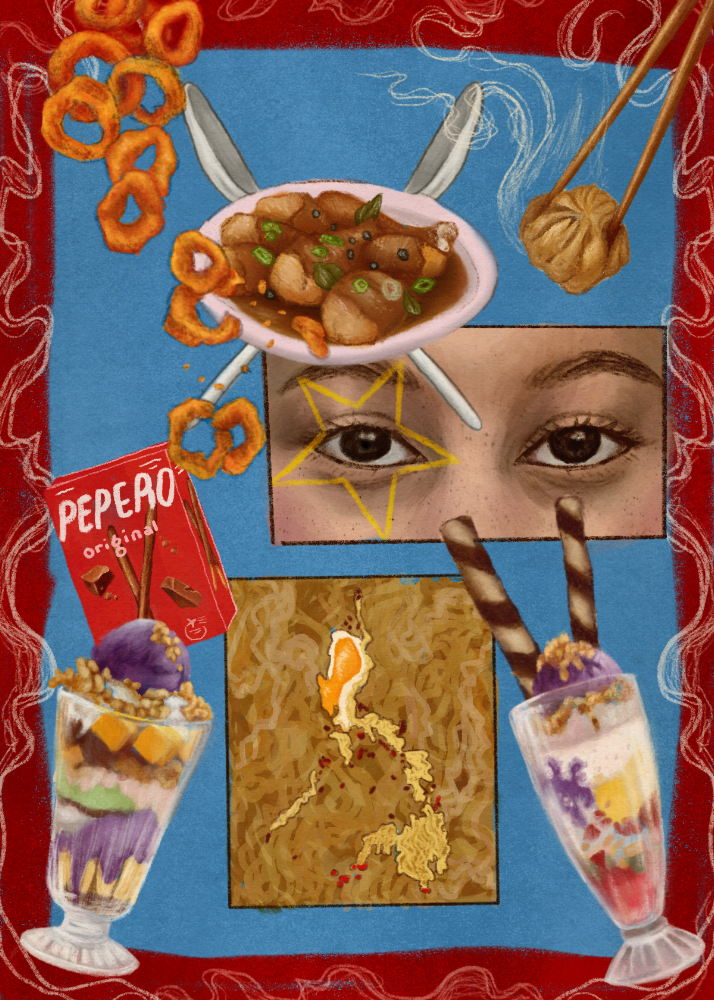
This piece is commissioned in tandem with Wasafiri 126: Impossible Returns – The Spain Issue. With an illustration by Simone Khanyi Hadebe.
Supported by a grant from the Open Society Foundations.
Whenever I yearn for home, I look for an East Asian supermarket. Whether I’m in New York for a semester abroad or staying with family in Dubai for the holidays, my hunger is never satiated until I find one. As I push the heavy glass doors open, my eyes instantly shut at the low hum of the freezers, each brimming with plump dumplings and pillowy buns and crispy, flaky pancakes. I amble down the aisles and can almost feel the coarse crumbs of corn and honey butter chips on my fingertips, their shiny bags adorned with words I cannot comprehend. Stacked instant noodles tower over me, their multicoloured wrappers gleaming under fluorescent lights. The canned milk tea and sweetened soy milk compete with shelves of sugary snacks for my attention, while the prawn and rice crackers wait for me patiently, packets crinkling at the slightest touch.
In Spain, there is a minimart I used to visit often. I’d moved to Madrid after Dubai’s final COVID lockdown ended in the spring of 2020, leaving my family behind to work at a bilingual school. Every time I missed home, I would take a short bus ride from where I lived to this cramped shop. There, I realised I didn’t even need to speak. What mattered was what I remembered: bright red boxes of pretzel sticks dipped in glistening chocolate; cream-filled biscuits adorned with a smiling cartoon panda. Upon seeing them, I’d journey to the past without warning, rekindling my childhood memories of the Philippines.
MYM is unassuming. Nestled between a kebab shop and a bank on the outskirts of Madrid, it looks like a typical family-run Spanish grocery from the outside. The word AUTOSERVICIO is splayed above its entrance, with sun-bleached posters of tropical fruit and €1 ice lollies plastered across the shopfront. If you step closer, however, you’ll see faded Han characters on the windows. Someone has taped flyers in English and Mandarin on the glass doors, advertising piano lessons and after-school tutorials and rooms for sublet.
The first person I always noticed there was the cashier. Mr Zhao, a stout Chinese man in his late forties or fifties, would perch on a beige plastic chair by the till every single day, even on weekends. The longest conversation we ever had was sometime during the last week of 2020, when, in tentative Spanish, I asked for his name. The only times I heard him utter more than three sentences in Mandarin were when a certain middle-aged woman dropped by the shop. In my head, she and Mr Zhao are married. They left China for Spain in search of better opportunities abroad, much like my parents when they left the Philippines for the UAE over a decade ago, when I was eighteen.
After I became a weekend regular, Mr Zhao no longer kept a watchful eye on my every move. As I inspected his shop’s shelves, his gaze stayed fixed on the blurry videos of Chinese opera singers on his phone. He’d only look up as I approached him, coins jangling in my pockets.
‘¿Una bolsa?’ he always asked, reaching for a plastic bag as bright green and flimsy as pandan jelly.
‘No, gracias,’ I’d say, pointing at my rucksack.
Sometimes, while leaving the minimart, I would realise Mr Zhao was the only person I had spoken to all day.
*
Throughout my adolescence, my siblings and I would accompany our mother to the supermarket, where we’d sneak Filipino treats into the shopping cart while she pretended not to notice. At home, we munched on Chiz Curls, a puffy, melt-in-your-mouth corn snack. Regent Cheese Rings dangled from our powder-coated fingers while salty Clover Chips stained our skin a traffic cone orange. When we craved sugar, we unwrapped Choc Nut – a peanut chocolate candy bar that crumbles like sand in your hands – and drank sweetened glasses of milk using Stik-O wafer sticks as straws.
But despite growing up in the Philippines, and despite being part Spanish on my mother’s side and part English on my father’s, I’ve always been mistaken for other nationalities: Japanese, Chinese, Thai, Korean. People stare at my pale, freckled skin and ask me where I’m from. But you don’t look Filipino, they declare, as if diasporic and mixed-race Filipinos don’t exist. As if all Filipinos are supposed to look the same.
I never ruminated on my Filipino-ness the way I do now
My appearance, as well as my upbringing in a secluded former US naval base, led me to often feel disconnected from my motherland. I watched American TV shows and sang along to American pop stars and collected imported teen magazines about American heartthrobs. I never needed to know any Filipino languages — my parents spoke to me solely in English, concerned that I’d never become fluent in it if I spoke Filipino, Tagalog, or any other language of my country. The international school I attended from the ages of three to eighteen had an American curriculum, and everyone there communicated in English.
Back then, I never ruminated on my Filipino-ness the way I do now. I had always seen myself as different — during family reunions at my maternal grandmother’s province, distant relatives would dramatically complain about ‘getting a nosebleed’ from having to speak in English with me and my siblings. My uncles would tease me for my pronunciations of words like sinigang and adobo at the dinner table. I took my inability to speak my grandparents’ mother tongue as proof that I wasn’t Filipino enough. My birthplace of Manila, my secret stash of Lucky Me! pancit canton, my inevitable craving for a glass of sweet, creamy halo-halo on a scorching summer day — to ‘real’ Filipinos, none of that mattered.
*
I thought Spain would make me happy.
Post-graduation life had teemed with disillusion — two years after completing my undergraduate studies in Abu Dhabi, I found myself back under my parents’ roof in Dubai, unemployed and sharing a room with my sister. While struggling to find a job during lockdown, I looked for opportunities abroad and eventually received an offer to work in Madrid.
My first months in Spain were coloured by confusion and uncertainty. I was part Spanish and could converse in the language, but I didn’t end up feeling as connected to the country as I thought I would. At least 100,000 Filipinos reportedly live in Spain, many of them employed in restaurants, hotels, and schools. However, much like in the Philippines, random encounters with strangers would still remind me of how different I was. Chinese tourists would approach me without a hello and ask for directions in rapid-fire Mandarin before I could even explain I wasn’t Chinese. Bus drivers would greet me in English, one of them even complimenting the shape of my eyes before I stepped off his bus. I scarcely slept during my first week in Madrid, homesickness rooting itself in my stomach, my chest. I’d stare at my ceiling for hours and wonder if I’d made a mistake.
When I walked into MYM for the first time, I almost cried. I had no idea what MYM stood for (I still don’t), but thanks to a desperate late-night search on Google Maps, I discovered a small piece of home. Outside of the Philippines, I rarely see Filipino supermarkets. Most often, I encounter shops under the basic umbrella of ‘East Asian’, with a tiny section dedicated to Pinoy goods. But whether it’s a family-run business in London’s Chinatown or a multi-million-pound chain like Oseyo in the heart of Cambridge, there’s always something I can pinpoint from my childhood, back when I’d trade snacks with my Korean and Japanese classmates by the playground.
On that first visit, with the crisp November air rushing in with every push of MYM’s doors, I could breathe again. Relief washed over me as I browsed the shelves: this wasn’t some multinational retailer with a single aisle labelled ETHNIC FOODS. Instead, MYM boasted a whole wall dedicated to various kinds of instant ramen, ranging from veggie and seafood to cheese and ‘hot chicken’. Different types of noodles and tofu and rice, more than I even knew existed, beckoned to me at the back. Near the entrance, Asian condiments reigned supreme, with countless kinds of fish sauce crammed between bottles of banana ketchup and kecap manis. I fought the urge to buy everything I could recognise – Hello Panda biscuits, Pepero sticks, Choco Pie – now that I’d found this safe haven, a temporary home that would always be there, waiting for my return.
*
I first read Chinese Malaysian writer Tash Aw’s 2016 memoir, The Face: Strangers on a Pier, during my final year of university. The text explores migration and adaptation, beginning with strangers mistaking Aw for other nationalities, such as Nepali and Thai. ‘It has to do with my face,’ he writes. ‘My features are neutral, unpronounced … My face blends into the cultural landscape of Asia’ (Aw 11).
To read Aw’s writing was to look into a mirror. Finally, I had stumbled upon the words of someone who could understand me, someone whose past encounters, in a way, reflected my own: tourists approaching me at a shop in Bangkok, asking how much the fridge magnets cost; waiters greeting me in Korean at a KBBQ restaurant in Seoul, unable to hide their shock as I replied in another language. When you’re ethnically ambiguous, belonging can feel like a battle. The first thing most people see – your face – is something you cannot easily change or control. Your face can hold you back from being accepted by your own people, regardless of all the local slang and inside jokes and traditional recipes you learn.
A face can also become a guessing game. At late-night parties, friends of friends often ask where I’m from: No, wait. Chinese? Korean? Japanese? After three tries, they usually give up and wait for the same well-worn speech I’ve delivered countless times over the years. They see my face as a source of amusement; after I clarify my background, no other questions follow. Their curiosity satiated, they simply move on to another topic. I can understand: when meeting other ethnically ambiguous Asians, I always find myself wondering about their families, the places they call home. But rarely, if ever, does anyone ask for more than a simple answer, a category, like a label on a packet. I’ve accepted that most people will never know my mother’s paternal side is from the Spanish city of Galicia. They will never hear about the serendipitous threads woven into the tapestry of my family lineage, such as the story of my father’s great-grandmother, Alice Inwood, who left her entire life in London behind in 1909 to move to a brand-new world, the Philippines, for the man she loved.
When you’re ethnically ambiguous, belonging can feel like a battle
*
On my way back from MYM in late December 2020, stomach grumbling at the thought of dinner, a man drove towards me. I cannot recall his voice or his face, but I will always remember the five-letter word he yelled over and over and over out his open window:
‘China! China!’
As his car sped closer, headlines from the past year – about reported hate crimes, about attacks on people who looked like me – flashed in my mind. In London, a Chinese Singaporean student sustained facial fractures after being punched and told, ‘I don't want your coronavirus in my country.’ In New York, a woman was injured on the subway after fellow commuters repeatedly hit her and hurled anti-Asian, COVID-related statements. In Madrid, a Chinese American man was attacked near a metro station, only regaining consciousness later in the hospital.
My heart thrashed in my chest. I couldn’t move or speak. My body shut down, but my mind kept racing: Will this guy hit me with his car? Throw something at me? Get out and strangle me to death?
He drove past in a blur, laughing to himself. Instead of shouting back or doing something, anything, I stood still.
Shame has a bitter aftertaste. By doing nothing, I let him win.
Somehow, I returned to my studio apartment intact. I threw my winter coat aside and stared at my rucksack, my purchases from MYM peeking through. Intent on distracting myself, I reached for my groceries. I wanted to fill my stomach until it threatened to burst like a ripe, swollen melon. I wanted to gnaw on shards of brittle corn chips. Stab a bag of biscuits with a kitchen knife. Gorge on noodles coated with black bean sauce, dark and gloopy as tar.
I no longer wanted to eat for pleasure or memories — a different hunger consumed me.
*
When asked why she writes about eating and drinking and not ‘the struggle for power and security, and about love, the way others do,’ American food writer M F K Fisher posits that our basic needs for food, security, and love are ‘so mixed and mingled and entwined that we cannot straightly think of one without the others. So it happens that when I write of hunger, I am really writing about love and the hunger for it … and then the warmth and richness and fine reality of hunger satisfied … it is all one’ (xv).
I remind myself of these words whenever I’m asked why I write about food; why, to me, food is more than a form of sustenance or temporary joy. When placed beside investigative pieces on rising inflation in the Philippines and the current political climate in the UK, a food essay may seem trivial or frivolous in comparison. But a piece about hunger isn’t really just about food, is it? When we peel back the layers and look beyond the poetic descriptions and endless synonyms for the word ‘delicious,’ what do we see?
Food is my inherited tongue
In her 2021 memoir Crying in H Mart, Korean American musician and writer Michelle Zauner ruminates on her identity following the death of her mother: ‘Am I even Korean anymore if there’s no one left in my life to call and ask which brand of seaweed we used to buy?’ (4). Like me, Zauner is mixed-race, or more specifically, white and Asian. Like me, she is not fluent in the non-English languages her mother’s family speaks. But she knows there are other ways to show one’s love beyond words: ‘I could always feel [my mother’s] affection radiating from the lunches she packed and the meals she prepared for me just the way I liked them’ (Zauner 4).
As a Filipino who can’t speak the languages of her ancestors besides English, food is my inherited tongue. It has been passed down from generation to generation, our family recipes and condiment preferences and snack brand loyalties what I think of whenever my Filipino-ness is questioned. Ask me to decipher an idiom or translate a tongue twister or name a dozen famous local celebrities, and I will fail spectacularly. But ask me about my favourite Pinoy street food or the origins of banana ketchup or the ingredients of my mother’s adobong manok, and I will answer without fail.
*
In every East Asian supermarket I’ve stepped foot in, there has always been Jin Ramen, along with Kewpie mayo, S&B golden curry mix, and Huy Fond Food’s iconic ruby red sriracha. They’re ever-familiar to me, the tastes consistent whether I’m in Spain or England or the UAE. During my time in Madrid, Jin Ramen became my preferred ramen brand: I found its salty, rich broth and soft, chewy noodles uncomplicated, offering edible bliss with minimal effort. Steam would curl up with every bowl, painting my lips red. I would slurp the savoury soup, shovel the slippery noodles into my mouth, bite down into the glistening yolk of a soft-boiled egg. Liquid warmth would spread throughout my stomach, like an embrace on a harsh winter evening. In January 2021, when Storm Filomena brought the city to a standstill, I cooked bowl after bowl of Jin Ramen. I found the process of preparing this packaged food therapeutic — I measured and assembled ingredients with a clear end result in mind. Outside my kitchen, life was messy, unpredictable. But inside, with a set of never-changing instructions, I was in control.
What is it like to state your origins with confidence?
Five months before I left Madrid, as I rummaged through my kitchen cupboards for a snack, my mother called. She asked how I was (‘Tired, but okay’) and if I’d met anyone interesting (‘Unfortunately, no’), then questioned my decision to return to my family in August. I placed a pot on my tiny stove and waited for the water inside to bubble up. Doubt briefly seeped into my mind: if I could survive this long here, surely I could last another school year? I no longer needed a map to navigate my neighbourhood. I’d formed friendships with a few colleagues. I’d started a decent list of my favourite places in the city — restaurants, museums, parks, and, of course, MYM.
I tore open a Jin Ramen packet, the sound of rustling plastic a small comfort. I told my mother what we both knew: I needed to leave. As I placed a dry noodle block into the scalding water, I thought of nights in my college dorm’s shared kitchen in Abu Dhabi, chatting with friends and chewing on crunchy, stray noodle bits; of sunny afternoons in Dubai with my mother, sharing a single pack of ramen between us. What I wanted was not another year abroad. I craved home, where there is always someone to say ‘good night’ to. Where everyone is too polite to claim the last piece of food at dinner. Where asking if you’ve eaten yet is a display of love. Where no meal is finished in solitude.
*
There’s a line from Strangers on a Pier I think about often: ‘Maybe it isn’t to do with our faces, but with our wish for everyone to be like us. We want the stranger to be one of our own, someone we can understand’ (Aw 11). When most strangers presume I am from an East or Southeast Asian country that isn’t my own, I remind myself about our common threads. Perhaps they themselves are from these countries, or perhaps a loved one is. Perhaps they seek a connection with me, and so search, in my face, for something familiar, the way I myself turn to their restaurants and markets and food.
Sometimes, I imagine having a different face altogether. What is it like to have your own people always accept you by default? What is it like to state your origins with confidence? To never allow space for even a sliver of doubt? There are times, I admit, when I am tempted to lie. If I say that I am what they presume me to be, there will be no more looks of disbelief, no more endless interrogations. No more strangers seeking loose threads to unravel my own history.
But being Filipino has always been a central part of my identity, shaping how I live and perceive the world. I’ve heard my people described as generous and resilient, showing kindness while persevering in the face of hardship. Yet I’ve realised, while living abroad and alone over the past few years, that there are smaller ways in which Filipino-ness shines through in my everyday life too: leaving the last piece of food on a shared plate at the dinner table; giving little snacks or gifts as pasalubong to loved ones after spending time abroad; asking someone if they’ve eaten yet, or ‘Kumain ka na ba?’, as an act of care.
I cannot – and will not – deny who I am: a westernised Filipino with an Asian snack obsession; a mixed Filipino with the pale, freckled skin of her Spanish and British ancestors; a Filipino unable to speak anything but English to her grandparents.
A Filipino who doesn’t have to be anything but herself.
*
On my final visit to MYM in the summer of 2021, I remembered my first encounter with its wall of instant ramen and its shelves overflowing with grains, condiments, and bottled drinks. My trips to this place had become integral to my weekly routine; the thought of going somewhere else seemed strange now. I felt a longing for the shop before even stepping outside, like I’d already begun to miss it.
While purchasing my final packs of instant noodles, I smiled at Mr Zhao. He asked, as always, if I’d like a plastic bag. At that moment, I wished I could communicate to him what MYM meant to me. I imagined saying I had found belonging there, and many East and Southeast Asians have probably found a temporary home in MYM over the years too.
‘¿Una bolsa?’ Mr Zhao asked me again.
Instead of pointing at my rucksack, I spoke. ‘No, está bien. Pero muchísimas gracias — por todo.’
I hoped, somehow, he would understand.
Works Cited
Aw, Tash. The Face: Strangers on a Pier. Restless Books, 2016.
'Coronavirus: Student from Singapore hurt in Oxford Street attack'. BBC News, 3 Mar. 2020.
Fisher, M F K. The Gastronomical Me. Daunt Books, 2017.
Guerra, Julio. 'Agreden en Madrid a un hombre de 29 años a grito de "chino" y "coronavirus"'. Cadena SER, 10 Mar. 2020.
Jaymalin, Mayen, and Rudy Santos. 'More Pinoys opting to work in Spain'. The Philippine Star. 9 Oct. 2023.
Pereira, Sydney. 'Woman Beaten In Anti-Asian Attack On A Train In Manhattan'. Gothamist. 27 Dec. 2020.
Zauner, Michelle. Crying in H Mart. Picador, 2021.


Edited by Marta Fernández Campa and María del Pilar Kaladeen, Wasafiri 126: Impossible Returns – The Spain Issue is a compilation of work by racialised Spanish writers and artists. The contributions, ranging from short stories, interviews, poems, critical essays and art, feature poignant and powerful pieces that ask questions about national memory, colonial history, nationality, and identity.
