Befriending the Forest by Selina Nwulu
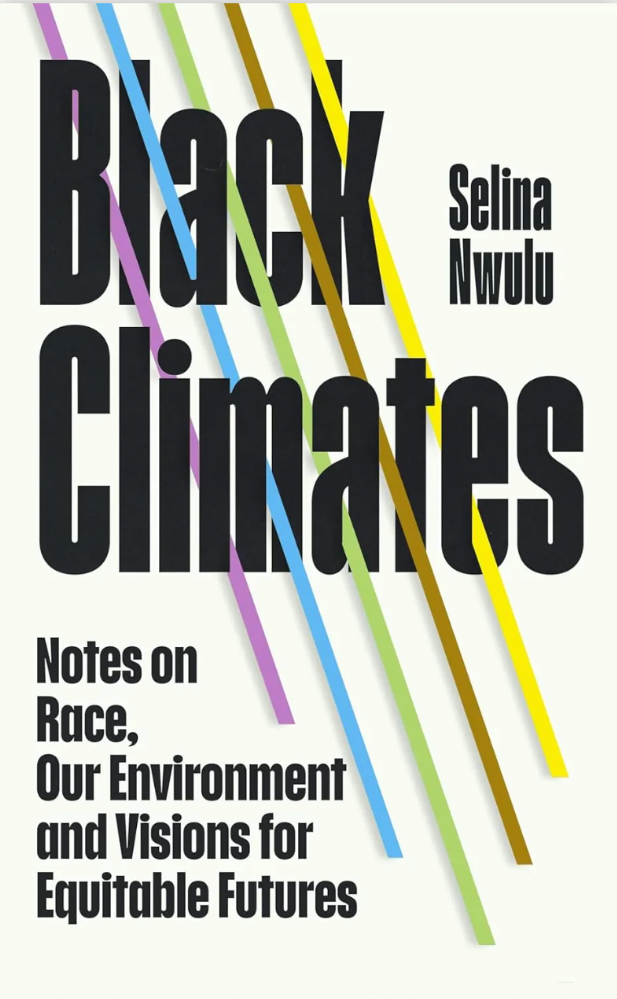
Selina Nwulu unpacks the impetus behind her debut essay collection, Black Climates – 'an exploration of climate breakdown through the lens of the Black experience' – where mainstream discourse has inadequately addressed how marginalised peoples are affected by the climate crisis.
My debut essay collection, Black Climates (Chatto & Windus, 2025), started from a feeling of absence. It came and went for over a decade, during which time I would often feel discomfort during the talks and conferences I attended around the climate crisis — an inner bristling that would leave me looking for clues, like when you suspect you’ve left something behind but can’t figure out what. Looking back, I was struggling with mainstream climate change narratives, dominated by the thinking of the academic and scientific community, that spoke of greenhouse gases and carbon emissions, but rarely of people. I was especially grappling with how concerns of lost ecosystems and dwindling wildlife were too often prioritised over social injustices sometimes happening in those very same places, without any consideration of how these issues were deeply intertwined.
What does the climate crisis mean if we can’t be in solidarity with those in our more immediate environments — on our streets, in our local areas, regions, and beyond? What is an environment if not a space that is created and nurtured between us? Over time, I began to search for other truths: what does the climate crisis mean to marginalised communities who are already constantly navigating crises of all kinds, from transphobia to racial hatred, a cost of living crisis, a pandemic, and more?
As a slow thinker, my thoughts took shape gradually, buried within the sediments of my mind; they developed like a fossil, concretising slowly and silently. Then, off the back of the Black Lives Matter uprisings of 2020, the mainstream began to make room for more conversations around race and, by extension, race and climate justice. The landscape moved in a more intersectional direction, while I carried on questioning, listening, and thinking. By the time I came to write Black Climates from 2022 onwards, it felt like I was standing in front of the full scale of the questions and truths I’d been holding onto for the first time. I began to see them as I would an unwieldy forest — dense tree life and flora entwined with one another, shifting and growing alongside both my ideas and those of the wider collective. I came to liken the process of writing this book to hacking a path through thick woodland, with no clear sense of an ultimate destination, at times both thankful and bewildered by the messiness.
What does the climate crisis mean if we can’t be in solidarity with those in our more immediate environments — on our streets, in our local areas, regions, and beyond? What is an environment if not a space that is created and nurtured between us?
Black Climates is an exploration of climate breakdown through the lens of the Black experience. It’s a work of creative nonfiction in which I explore a range of topics, from what eco-anxiety means to a Black collective, to prisons, land, disability, and migration. Many of the subjects covered are both familiar and unfamiliar to mainstream climate narratives, and intentionally so. While historically the climate movement has often required marginalised peoples to overlook their worries for that of the climate crisis, I wanted to prioritise issues that are of pressing concern to Black communities, and to bring a climate dimension to them.
Writing this book gave me the opportunity to consider what an understanding of the crisis through a more intersectional lens could truly look like. To go beyond ‘making a case’ for the climate movement to consider race, and rather offer deep reflection and insight into how race is a core dimension of the climate crisis, therefore painting a fuller picture.
This was also my first book-length prose publication. Approaching this primarily as a poet helped guide me. How could I bring lyricism and beauty to a book discussing the ugly truths of how the historical oppressions of colonial violence shape the world we live in today? Could I find a way to interrogate these topics from several different perspectives as I would in a poem? What else could I notice this way? It was in maintaining a poetic curiosity that writing Black Climates felt familiar, even in another genre; the book consequently possesses a poetic sensibility that I hope connects it to my other works.
Still, it felt important to move both with, and beyond, poetry to open myself up to the potential of another genre. I looked to other writers who have also worked across different literary forms: Kei Miller, Christina Sharpe, Aria Aber, Maggie Nelson, and Claudia Rankine. I took inspiration from writers and artists who have also looked at the living world from expansive racialised perspectives, such as Alexis Pauline Gumbs’ Undrowned: Black Feminist Lessons from Marine Mammals and her Harper’s Bazaar article ‘Heat is a not Metaphor’, and Britton Smith’s reflections on the divine nature of water in them magazine. These are people who understand the natural world as a multifaceted source of guidance and connection.
Writing this book gave me the opportunity to consider what an understanding of the crisis through a more intersectional lens could truly look like.
I found myself surprised by how far my ideas stretched. This was, in large part, due to my decision to centre Black diasporic experiences of the climate crisis as a way to more intentionally explore the intricacies of our experiences and concerns. What I found in doing this were textured worlds that contained multitudes. That wayward comment I plucked the courage to say at a past event or a five-minute talk on a panel became pages, chapters, a whole book. That initial feeling of absence was much bigger than I’d imagined — neglected realms, histories, and emotions buried beneath the surface, within me.
As marginalised communities, we need to develop our own links to the climate crisis, and explore our complicated relationships to it, contradictions and all. We need to name our discomfort with specificity and, at times, with disinterest in the climate crisis as it is narrativised, finding ways to make visible overlooked connections between race and climate. Especially given these connections have been historically ignored within the climate movement.
For instance: in one of the book’s chapters, I write about slowing down. I name the necessity for us to move beyond grind culture, where hyper-urgency is a toxic force that drives a culture of endless resource extraction, which in turn fuels the climate crisis at large. But I also problematise how much hard work and hyperproductivity are deeply instilled in us as Black people — from legacies of enslavement to the ‘You have to work twice as hard to succeed’ ethos to hustling for more work as a means to survive. What does slowing down look like for a world that inherently expects so much from Black communities? How can we as Black people realistically nurture a personal stance towards slowing down, too?
Forming a connection to the planet can be hard for people whose lives are consistently undermined and made uncomfortable by it — particularly for those who are being told in headlines, political discussions, and by acts of violence that they do not belong safely in this world. These include people who fear going into work due to the threat of deportation, who fear harassment when walking down the street, or who cannot keep up with rising bills to even afford a roof over their heads. What is a meaningful climate story for those of us experiencing these realities? As I additionally make clear in Black Climates, our disconnection with the natural living world around us is also part of our oppression. We are left isolated and out of sync with the world, rather than in deeper connection with it. We are being taken further away from the reality that there is more than enough food and land for everyone, and rest and meaningful community should be freedoms widely available to us all.
As marginalised communities, we need to develop our own links to the climate crisis
In writing this book, I have found myself now in better alignment with the messaging and ideas of the mainstream climate movement at large — albeit fresh out of the forest, dishevelled, and with a few more scratches. We should care about our environment, but this care must integrally include wildlife, non-human ecosystems, and people holistically as a site of messy – yet essential – interconnection.
As I maintain throughout Black Climates, the climate crisis is one of disconnection — the ways we often consider ourselves as separate from the natural world, rather than as an extension of it. The crisis is us. The harmful habits we have normalised – the extractive behaviours we engage in, treating one another as disposable – mirror the way we treat the planet at large.
My time in the ‘forest’ was sacred, leading me towards more unexpected pathways and questions. Through writing this book, I have come to realise that while the climate crisis presents us with worrying uncertainties over the future, it also offers us possibilities for our collective consideration. What would a world in which we live in deep respect and connection with the land and each other look like? If we can listen to the questions the crisis is asking of us on how to return to our humanity, and find better balance and synchronicity with the natural living world, it may lead to deep transformation and, ultimately, our liberation.

