Dugout by Emma Oldham
In this short story by Emma Oldham, the Australian sun is its own overbearing, brutal character, beating down especially on poorer and Aboriginal communities. The story follows the narrator's relationship to the heat and her complicated, uneven entanglement with a richer white man, who offers both 'pleasure and climactic relief' in his air-conditioned home.
This piece was shortlisted for the 2025 Queen Mary Wasafiri New Writing Prize.
I spread my legs, drawing up my sarong, the colour of burnt dust, past my thigh. The fabric clings to my skin, wet with sweat. Every Friday, Nikola takes the long way home, circling the brittle edge of our camp in Coober Pedy like a dingo sniffing heat. Nothing’s pretty in this part of Australia. But underneath this stained cotton, between my thick hips, something glows. He enjoys his weekly tease. And I enjoy giving it.
Or I used to.
The heat is horrendous.
Ngunytju, mother, says heat like this used to be a season. Now, it’s a sentence. It’s 5.4 degrees hotter now than when she wed beneath the same red sky. She tells me, voice gone soft, like she’s speaking to old people in the dust, that it could warm another seven degrees by the time my babies I bring into this world are old enough to marry. Her voice goes dry when she says it, like the thought has scorched her tongue.
Nikola loves it when I sweat like this, dark clumps of moisture pooling under my breasts and around my collarbone. He lingers by the door frame, now ripped off its hinges, yawning to let whatever stale breeze that exists wander through our shack of tin and crumbling cement. It does little. But it gives him a good view.
My bedroom runs parallel to the door — a theatre box. I pull off my top, slow like melted sugar, and let my breasts breathe, still full and round. In their prime, they still defy the world’s attempts to flatten them. I lick a finger and draw it down between them, a slow, deliberate line. Nikola licks his lips. He thinks this is all for him.
I never let him cross the threshold. The illusion would shatter. A rich white boy like him, stepping inside a tin shed left to bake by policy and history? There are eyes everywhere, whispering, condemning. We keep our distance. That’s what makes this last. This ritual. We’ve been maturing together, a private theatre of watching, imagining, blossoming, evolving, aching. The tease gives me enough dopamine to forget the clay oven I’m dying in.
I used to wonder — if I let him in, across this threshold, would he finally see it? My history, sweating from the walls? The mattress sagging in the centre, as weary and breathless as my lungs?
When it’s his turn to perform, he gives me the signal. A stone kicked just so against the wall of my shack. An invitation. The roles reverse. When I walk to him, it’s only when the sun has dipped far enough to let my skin survive the journey.
His family lives below. A ‘dugout’, he calls it, slow and soft in that syrup-thick accent of his. His parents’ home is a luxury tomb, cold and carved to forget the sun. Always the same temperature. Perfect. His father, a miner with an artistic streak, has carved out entire rooms in the rock. Bathrooms echo with marble, there is a games room and a cinema den. This is the kind of space that doesn’t just shelter, it forgets. Forgets the heat. Forgets hardship. Forgets us.
Nikola once said, half-laughing, 'It’s like living in the future down here.' He didn’t see me flinch. His future doesn’t include melting skin.
The first time I stepped inside, I thought I was falling into a castle. Door after door after door. And there he was, my Nikola, framed in an arched doorway, trousers dropped to the floor, boxers slipping with teasing grace. His hands around himself, moaning my name like a prayer. His nipples hardened in the cool air. And I revelled in it. I fantasised about the day I would finally feel him inside me. Take me here, I thought, in this dugout, where my body can surrender to your cold walls and floor. I imagined the moans, a potent mix of pleasure and climactic relief.
But to step forward would be to admit the imbalance. That his hunger comes from desire, and mine from distraction. Because in his underground world, heat is a fantasy. But for me, it is death.
Above ground, the sun kills us in slow punishment. An older woman, Nyangka, died just last week. Her heart gone wrong. Heat’s cruel kiss. The health worker said it was 'linked to ongoing extreme temperature exposure.' But we already knew. We've known for years.
Up here, we’re not on the grid. We rely on diesel generators and intermittent solar. Air-con exists. Sure. But it’s for the rich, or the lucky, or the ones with money from opals or tourists. Not for ones like us.
Nikola’s visits stretch longer between each now. My Ngunytju spends more time at the Umoona Tjutagku Health Service too, where the air-con never dies and the water is free. She goes there most days. Breathing too hard now, this late in the day. My worry dries me out. And I think: if I stay too long in this limbo, watching the man I can’t touch while my mother wilts in silence, what will be left of me?
I appreciate when Nikola still comes to linger at my doorway, not tiring of my body as it softens and shifts. Hair curling where skin once gleamed. My hips, widening with the quiet readiness to carry life. The clay I paint my body with – ochre from the old riverbed, mixed with moisture and meaning – dried fast in this heat. Across my back, legs, and chest, the clay has broken into ancient lines, sacred and defiant. Like this country.
Nikola doesn’t see it. Never the suffering beneath the shimmer. He sees the shape of my breasts, not the politics in my sweat. Nor the resistance in my thighs.
He sees a show. An escape from his air-conditioned guilt. And I drank it in. I watch him watching me, and weigh his gaze like gold dust in a prospector’s pan. Will it ever be enough?
Because I, too, need escape.
I go inward. Dig deeper than his dugout.
Into a place where heat can’t destroy me.
Where the sweat and ache and pulse of me are not symptoms, but power.
So, I sink my fingers into myself, feeling the wet bloom beneath my digits, never looking away from Nikola’s dark, hungry eyes.
And in that moment, I am not forgotten. I am fire.
I am my old people’s dreaming.
I am Country, still burning.
Still alive. I am not done yet.
For more like this, check out our summer 2016 issue, Wasafiri 86: Unsettled Poetics – Contemporary Australian and South African Poetry
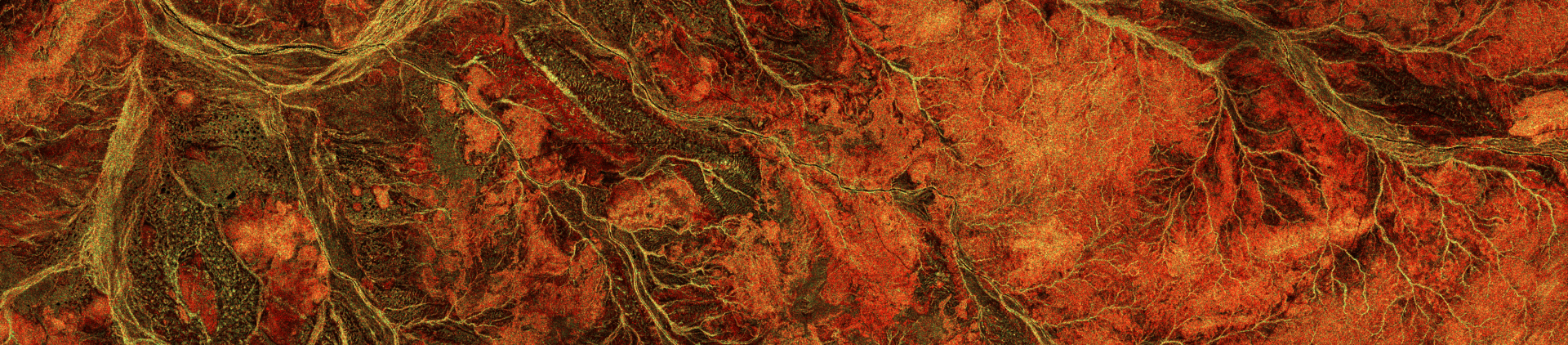
Cover image: Landscape of Western Australia

