Meditations: Sunnah Khan on The Hajar Book of Rage
Sunnah Khan weaves in her reading of Hajar Press' first anthology in their Elements series, Rage, with her conversations this summer with political prisoner Kamran Ahmed, who is one of the 'longest hunger strikers in UK history'. Ahmed's trial began in September 2026 alongside his fellow hunger striker, Heba Muraisi, and comrades Qesser Zuhrah, Zahra Farooque, Moiz Ibrahim, and Liam Mullany from the Filton 25 (follow the case here). As Sunnah's fragmented text progresses, it often splinters and soars into poetry.
Wasafiri’s Meditations series features creative and personal responses to literature, asking writers to seek connections with themselves, their own work, and any texts they may be reading. Lying between criticism and life writing, each Meditation offers a unique angle to view the writer and the reader, and the world around them.
This piece is commissioned in tandem with Wasafiri 127: Solidarities.
Supported by a grant from the Open Society Foundations.
'If you think the night ends when the sun rises,
then you’ve never known war.
Remain in your peace —
Someone pays for it here, every day.'
— Ruba Khalid, 22, Gaza
*
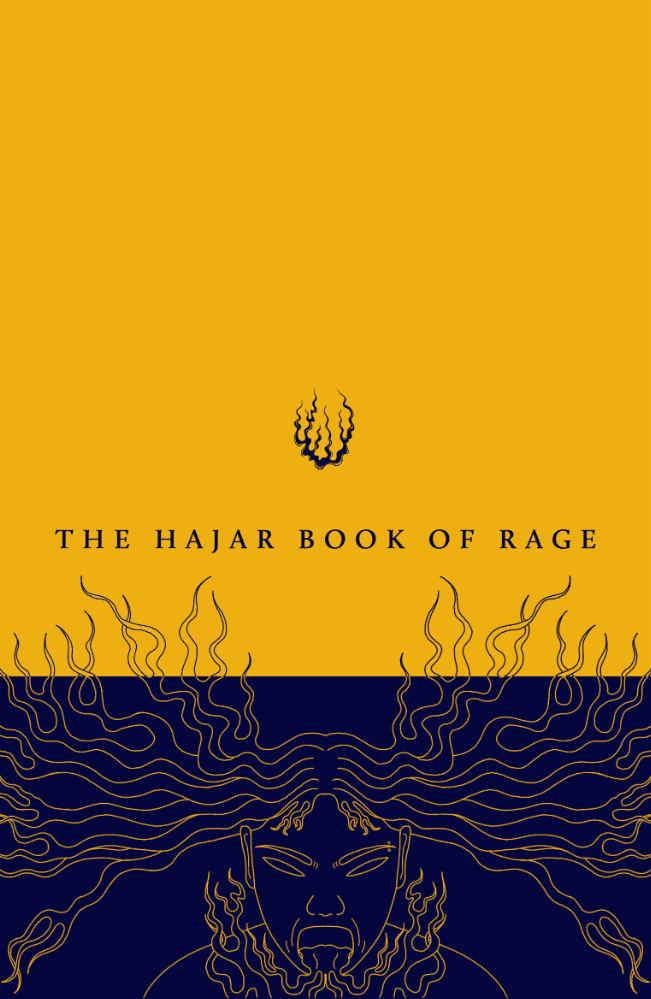
I carry this slender anthology around with me all summer, the hottest summer on record, according to the Met office. I think about the rising temperature as moral consequence, earth's visceral response, the ecological repercussion of sustained military destruction ongoing elsewhere. It companions me on the train, on my journeying, on my way now to meet this man, as if it were a friend or a comrade, which in a way is what it is, holding community in its pages through a constellation of poems and stories that build around a metaphorical heat.
The Hajar Book of Rage is a prescription for these burning times, a necessary reminder of what must rise forth and rise up collectively: that rage holds an alchemy, a potential to see from within and beyond the destruction.
*
In the poem ‘Two Stones’ by Aria Danaparamita, parallel realities meet in one fist.
Across time and place, there is the echo of colonial imprints, the promise that rage solidifies, the long-sightedness of refusing violence, whether in a cell or on the frontline.
A refusal that echoes:
‘trust in god in time our rage will engulf
all’ (4)
*
We almost walk into a graveyard before he turns back, refusing to go further. We find a patch of burnt grass near the entrance of Abney Park and sit with the sounds of the road behind us, the trees above reaching for the barely breathing air.
There is nothing extraordinary about this man other than the light emanating from his face and a slight breathlessness, a tightness in the chest, as if his lungs are learning to breathe again.
He is sincere and humble in word and gesture. I hand him the mic to hold, and he talks, partly answering my questions, partly responding to what knocks on the door of his memory, asking to be released.
‘I want to talk to you about faith and hunger,’ I say, realising I am not sure what I am asking for.
*
Kamran Ahmed is one of the longest hunger strikers in UK history, having spent 65 days of his fifteen months in remand without charge refusing to eat.
At the time of writing, he is on bail, awaiting trial alongside his Filton 25 comrades, four of whom were sentenced earlier this summer.
We don’t talk about the facts around his case.
We don’t say this ongoing atrocity has stretched past its 1,000th day.
We don’t speak of the genocide he took direct action against, the arms factory that provides Israel with drones.
We don’t talk about what those drones do or how they mimic the sound of a crying child to lure people out of their homes.
Or how the genocide continues like some theatrical backdrop; how we sit in a country that refuses to speak openly about its deeply entrenched Zionist connections that permeate the justice system. To stand against it – and to defend those who stand against it – has led to accusations of contempt of court and resulted in a reframing of language and legal consequence.
*
In the short story ‘Sequence from a Dream’ (15), Jiaqi Kang reflects on a dreamlike series of memories, the intimate specificities of comradeship of activists on the frontline: its intensity, opacity, its boundaryless boundaries. The encounter reminds me of what authors Laura Foster and Joel White called ‘friendships of breadth’ in their book Friends in Common: Radical Friendship and Everyday Solidarities (2025).
In meeting the other at a juncture of shared principle and risk, a depth of bond is formed. Through the widening of a shared moment, its heightened quality, social norms, and expectations are dislocated — friendships of solidarity become a wide field of encounter, then, not an endless distance sustained by biography or relational claim. It’s a precarious yet deeply principled place.
The Hajar Book of Rage is a prescription for these burning times
*
The first time I come across Kamran is on my Instagram stories, alongside Heba Muraisi, who has gone 72 days without food, Kamran at 65 days, and Lewis Chiaramello, who has been fasting for 44 days [at time of writing]. All at serious risk of death.
I learn the current length of their incarceration in remand – fourteen months – without any conviction under high-security conditions. I learn of their demands, including:
A right to a fair trial
To shut down Israeli arms firms’ factories in the UK
In the same breath, the next story I watch on social media is of a child in the rubble. I learn the acronym WCNSF — wounded child no remaining family. In the next story, aid trucks are at a standstill at the border of Gaza. NEXT: an advert for face contouring. October 2023 feels like a distant date, but this landscape, this time, the length of violence, its normalisation, its insatiable hunger, all keep extending beyond belief. I feel my pulse quicken, heat rush to my cheeks.
*
At first, I was against it. When I decided to go on hunger strike, I prayed Istikhara for many days in prison. Our case kept coming up for trial, then being pushed back. I was told there was going to be a protest outside the prison. I had begun to read up about the political value and history of hunger strikes and it felt like it was the right time and the right thing to do: to stand with my comrades who were already hunger striking and to raise the profile of our case.
*
In ‘American Sonnet, After Terrance Hayes’ (35), Malika McKenney offers a visceral encounter: ‘I restrain the beast, then try my hardest to hold it.' There is a sense of attempting to grapple with two possibilities at once in the same body, opposing forces fighting against each other — one still holding prayer and possibility, the other an enveloping darkness, the ‘white lie’ mixing, polluting, that makes me think of the structural dichotomies of holding on to truth whilst being dependent on violent structures of power for safety. How the body in the absence of justice, in refusing fear or state coercion, becomes its own geography, the final site of autonomy.
*
I kept asking God the whole time if I was doing the right thing.
I kept doing my remand work, moving and talking, and I was drinking water. I felt fine, better than fine. I felt clear in the mind except I was told my vitals were dropping dangerously. I was confusing the medical staff and remand officers because I was presenting as normal, although medical examinations were proving otherwise. I took it as an unspoken sign to keep going.
By the sixty-fifth day I couldn’t walk in a straight line. I began to feel weak, my head felt like someone was electrocuting it, and the doctors told me it was likely mini seizures from not getting enough blood to the brain. I decided to stop then because I was also worried about the implications for my comrade Heba’s health. We were keeping each other going.
I ask about his breathing and he says he doesn’t notice it. The doctors told him the starvation had shrunk his lung cavities, and the pressure required for his lungs to take in air at full capacity again will take work and effort.
‘Did you ever lose hope?’ I ask him.
Only once in solitary, when I thought no one cared and we were doing all this for nothing.
*
A United Nations analysis of the Filton case found that the original ten held unlawfully incommunicado by the state possibly amounted to enforced disappearance. This was established in a letter written by UN special rapporteurs to the UK Government condemning the ‘unjustified use’ of UK counter-terrorism laws against them.
*
The last time I meet Kamran, he is on bail, and we are gathered on the grass outside the court in Woolwich awaiting the sentencing of the first four of his comrades up for trial.
From a distance, you might think it was a festival — flags and drums and speakers, all of us old and young, parents feeding children, students holding hands. A doctor who has worked in Gaza stands in the centre of our makeshift circle. He tells us that the damage done through the direct action of those awaiting sentence equates to the single lifesaving act carried out by the UK since this second Nakba began.
Later the judge sentences them as terrorists.
*
In ‘In the Absence of Fire’ (39) by Malak Hijazi, language unravels and erects fences as the protagonist pieces together their identity from ‘other people’s metaphors’ (43), having been fenced into the word ‘refugee’ (40).
‘rage didn’t come from missiles or the daily news of killings. not at first. it came quietly slowly - when i began to understand the world’s order’ (41).
*
What does language do to the parameters of our psyche?
how can it be used against us, these seemingly arbitrary strings of letters swung with a force that disrupts the course
REFUGEE, IMMIGRANT, FOREIGNER, CRIMINAL, TERRORIST
people are not words to be unearthed and removed from a sentence
killing and displacing people should not be inevitable words in our language
how does a body digest all this language that holds no sustenance or substance?
*
In ‘Broken Parrot Warrior Tongue’ (49) by Simran Kaur Johal, a surreal, dreamlike interiority unfolds as the protagonist finds herself in a new city. The people there don’t look like her, they stare at her with disgust. Language and words appear out of reach. A kind of magical realism enters in the form of a parrot, or perhaps it is the shape of the psyche, still undefined by any hostile gaze, the unoccupied imagination rising up.
*
When I ask him what got him through the time he spent incarcerated, Kamran tells me it was knowing that there was always something to be done, whatever the circumstances.
Fellow remand prisoners, repeat offenders, became friends. Conversations moved from prison jokes to what he was doing here — to talking about Palestine. One man who had lost all sense of direction was so angry at the system and had no sense of what to do with it. Kamran told him to channel his energy into making someone else’s life better. He saw him months later in another block. The man told Kamran, ‘I’ll never forget our conversation. When I get out of here, I’m going to go volunteer, help people in poorer countries.’
I came to ask him about faith and hunger. What we end up talking about is the borderless place found within confinement and restriction, the edge of rational hope and reason, and the endless possibility of what lies beyond it.
*
In ‘Preliminary Flame Before A Kiss’, Yasmin Alrabiei insists that beauty is ‘far from being extinguished by catastrophe, it persists as a mode of endurance a counter archive, a way of insisting on life when so much conspires to erase it’ (7).
She takes the primal force and anticipation of a kiss as a springboard to move through thoughts on art, attachment, and encounter. Drawing us to the archive of the kiss of the captor – the counternarrative that shocked the world – the Israeli hostage who kissed his Hamas captor as he left, showing no signs of hurt or distress
*
There was one night I’ll never forget.
I had just been moved to Pentonville. I remember it was Ramadan, and I was put in the hottest cell. It was so hot that when they brought me food, it would go off the same day. I remember thinking I don’t know if I can handle this. I was missing home, missing being together in this holy month. Then from another cell a man began reciting his prayers so loudly we must have all been able to hear it. He went on like that for an hour, and I prayed with him. I never met that man, never knew who he was. But in that moment, I knew I might not have a key to this door or know a way out, but I was not alone.
Kamran recites a surah to me then, one of the shortest surahs in the Quran:
وَالْعَصْرِ
إِنَّ الْإِنْسَانَ لَفِي خُسْرٍ
إِلَّا الَّذِينَ آمَنُوا وَعَمِلُوا الصَّالِحَاتِ وَتَوَاصَوْا بِالْحَقِّ وَتَوَاصَوْا بِالصَّبْرِ
I swear by time
surely man is in loss
except those who believe and do good
and encourage each other to truth
and enjoin on one another patience
I know this surah. My mother taught it to me when I was a child. But when Kamran recites it, I hear the distant echo of prison bars, both from his memory and from what might come next for him. His heart holding on, despite his slowed pulse from the hunger he endured — a certainty in his refusal overriding man-made notions of justice. I hear it anew. It sounds like an anthem of resistance. Both a private reminder and revolutionary force.
*
The root word for ‘genocide’ is very different from the root word for ‘holocaust’.
The word ‘genocide’ was coined in 1944 by Polish Jewish lawyer Raphael Lemkin to describe the systematic destruction of an ethnic, racial, or religious group, combining the Greek word genos (meaning race, tribe, family) with the Latin suffix ‘-cide’ (meaning killer, from caedere).
The word ‘holocaust’ on the other hand is an ancient term first used in early Greek translations of the bible, from the ancient Greek holokauston, holos meaning ‘whole’ and kaustos meaning ‘burned’. Historically, it referred to a religious sacrificial offering completely consumed by fire –– a burnt offering.
By the mid-twentieth century, the capitalised ‘Holocaust’ was used to specifically denote the genocide by Nazi Germany.
To burn whole encapsulates the psychic, physical, emotional, and environmental impact of what we have been witnessing for three years.
Perhaps we should call it a holocaust. A flaming sacrifice. See what it feels like in the body. See what happens to the weight of the word in the air. In our mouths.
*
‘Where do birds fly after the last sky?’
‘I no longer want to create. Teach me how to destroy.’ (67)
The poem ‘October for Another Century’ by Nur Turkmani invites a particular clarity, a fixed point, a way through unflinching, the necessity to break apart what no longer functions.
*
Proscription of language has taken the UK further into its Orwellian dystopia. To say you support direct action, just to speak or write the words now warrants arrest.
I wonder what would happen if instead of pensioners, all the children sat in Trafalgar Square holding up their signs of support for ACTION. I wonder what would happen then.
would we watch police officers carrying children away as we have watched old women and men, how far is the British government willing to unmask its own madness how deep in the belly of the beast how far from the realm of sacred have we wandered
*
In her book From the Clinic to the Streets: Seizing Psychoanalysis for Revolutionary Futures, Lara Sheehi references Frantz Fanon, argues that true decolonisation requires psychological and cultural liberation, not just physical or political independence. She takes this further. To decolonise the psyche, we must first recognise how power acts upon it. How despair is psychological warfare. The repetition of violence a pathological psychic attack reminding and reinforcing upon us that nothing will change. That this is all inevitable. Except it is not.
THOUGHT EXPERIMENT: REPEAT AFTER ME
THERE IS NO GOD BUT GOD NO
WORDS TO MAKE ME BELIEVE
THIS WRONG INTO RIGHT NO
WAY TO PUSH AGAINST MY MIND
ALREADY DECOLONISED. NO GOD
BUT GOD NOTHING YOU CAN STEAL
THAT’S REAL NONE OF IT BELONGS
TO YOU
REPEAT AFTER ME
THERE IS NO POWER HIGHER THAN
THE TRUTH THAT SUPERSEDES
THE PRETENCE OF FALSE JUSTICE
THAT THROWS RHETORIC AT THE WIND
CRUSHES FALSE MEANING UNDER ITS FEET
If repetition is a warfare it is also psychological intervention.
A necessary defence.
REPEAT AFTER ME
PALESTINE WILL BE FREE
*
I remind Kamran to drink something. We have been talking for over an hour. There is a certainty in his calm presence, in the face of such clear injustice and constriction.
I used to think faith was about humility but, in practice, sitting here watching the people passing by, listening to Kamran’s words about the harsh conditions of remand prison and the intentional humiliation that comes with incarceration, I realise it’s about dignity. It was always about dignity. A refusal to bow, bend, or break for anything other than truth.
There is a necessity in its repetitions.
It makes me think of dhikr, the prayer beads I roll between my fingers in my pocket, repetitions of gratitude, requests of forgiveness, prayers for relief and strength said under the breath, to keep the mind focused, the tongue wet.
Kamran highlights conditions of sweltering confinement, rats, cockroaches. Only to then emphasise the indignities others continue to face, not to make a point of his own suffering.
It’s nothing compared to what the Palestinians have endured.
*
‘We have been here before in 2023, 1948, 1916, 1830, 1619, 1492
Our bones keep score where our teeth have gone soft’
– ‘Labour Day’ by Nicole Morris (77)
*
We walk to the station and realise it’s later than intended. Ordinarily, this would be a minor inconvenience, but for Kamran it could mean a return to remand for breaking bail conditions.
We continue talking in the taxi as we are thrust through the London night, the heat receding, our windows down.
I want to be a person who can look myself in the eye, to not just speak against a thing but act against it.
The landscape animates with football fans and children on wheelie bikes playing freedom, shouting and blowing horns in delight, as the whole city spills out flags, British pride, and the belief in great possibility. England is set to play the World Cup quarter final tonight. I count the minutes on the drivers’ route map as we stand in traffic at a roundabout.
The contradiction of the image keeps returning to me. This young man, and a handful of others, a singular symbol of fighting for freedom, acting for true British democracy and justice, and the funfair of fans of nationalism, of the cheer and pride surrounding us, the false freedom, the theatrics of false freedom, all built on burning and massacre, the cheap thrill, the quick win, the illusion of freedom, the ignorant confinement of comfort and conformity.
*
I remember visiting the Venice Architecture Biennale a few years ago. I was singularly fascinated by a projection of a prayer space in the absence of a building to denote a mosque that had been attacked and destroyed. The sound and the projection of prayer mats in the space without walls created its own borders, and my imagination understood. I felt reverence, I fell quiet, wanting to take my shoes off. I stood back and walked around it, then watched a family move through the same projection without thinking twice, their children jumping on and between the prayer mats, the parents laughing, unaware of the invisible walls they had just demolished walking right through, no sense of what was being held or the sacred.
*
The strangeness of occupying the same space with entirely paradoxical realities is a symptom of this genocidal time.
*
In the absence, fire.
‘You are not safe in your forgetting. And we are not gone’ (Hijazi 44)
*
In the first trial that led to historic terrorism convictions, as the judge delivered his shocking sentence in her final statement, 30-year-old Ellie Kamio chose to reframe the words of the Palestinian poet Marwan Makhoul:
‘In order for me to hear the birds the drones must be silent.’
*
That night in bed, I edit the manuscript of my friend, a 22-year-old poet still in Gaza, trying to reach out beyond her circumstances with the only tool she has left.
She writes in English, tells me her language is covered in blood, and there is no space left for imagination to speak. The foreign language offers some possibility of escape.
I do not speak of the ones whose deaths made noise —
whose bodies made it to the headlines,
whose names became chants and posters on broken walls.
I speak of us. the ones who die slowly,
quietly, bit by bit, every minute, without farewell,
without a name etched in stone.
I want to wash her language clean of the horror enacted upon it. Instead, I promise to keep raising her words.
The foreign language offers some possibility of escape.
*
Words are weapons. Let the right ones pierce your heart. Let them mobilise you to sustained action. As the editor of The Hajar Book of Rage, Farhaana Arefin, says in her galvanising foreword. ‘Anger is instructive [… let us] clear the ground for something better. To give our rage somewhere to go.’ (vii-x)
Endnotes
Follow the case, raise their voices, show up at the court, and find out more here.
Further resources:
Support/Reach out to the Gazan poet Ruba Khalid on Substack: @rubakhalid
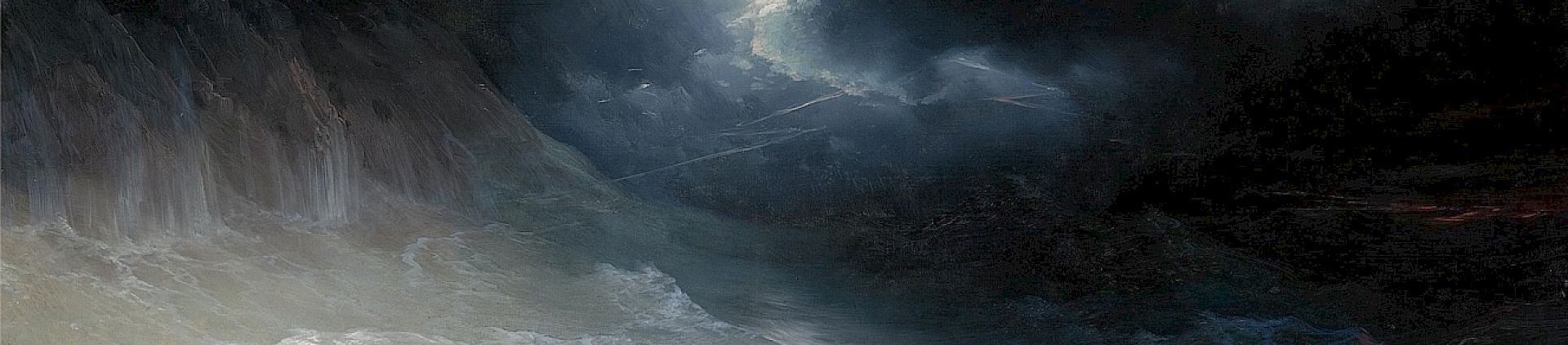
Cover image: 'The Wrath of the Seas' by Ivan Aivazovsky


What shapes do solidarities take in these strange times we are living in? How can we find and forge solidarities when faced with genocides, human rights violations, and inexplicable injustices daily? Can storytelling play a role in liberation?
