The Day Palestine Was Liberated
What will it feel like on the day Palestine is liberated? Our New Writing Prize judge for poetry this year, Mona Kareem, imagines the ecstatic, utopian feeling of experiencing Palestine's liberation at last. At once breathless, hysterical, and raw, the story is both speculative and fantastical, as well as an evocatively mapped future for Palestinian freedom.
This piece is commissioned in tandem with Wasafiri 127: Solidarities.
The day Palestine was liberated was like no other: I lay awake in bed the night before, electrified, clenching all my bones, releasing them for a few seconds to let the warm waves of dream wash over me. I couldn’t keep my eyes shut, they kept opening in long, intense blinks the way a cat’s does when it wants to say ‘I love you’. I held and held to the waves so the day Palestine was liberated would not slip away before sunrise. I laid out my outfit on the armchair, painted my grey hair with henna, chose the right earrings, colored my nails red red red red and green. The day Palestine was liberated, my heart couldn’t stop pounding. My heart was a whole planet erupting. My heart was drums and trumpets marching. I woke up without having slept at all, and I flung the curtains wide open, and jumped jumped and jumped till the earth began to shake and the windows shattered. I prayed and wore my special outfit, wore a giant Palestinian flag, and I went to the job and smiled and grinned at sour faces, waved at and laughed with sweet faces, roared like a lunatic with brand new laughter.
The day Palestine was liberated, sound changed forever: The humming drones were attacked by the sunbirds and the hoopoes, the storks and the eagles, the houbara and the sandgrouse, till all the humming disappeared. And once the feathered birds defeated the metal birds, we realised that Palestine was liberated, and mothers filled the newly-quiet air with ululations.1 The sun was powerful and gentle. No trees were set on fire that day, no dogs were beaten, no homes were demolished. No earthquakes or tornados or wildfires. The humming of engines disappeared. The mountain tops were visible from wherever one looked, the fish darted through the waters, the sea turtles came out onto the shore to lay their eggs, and we all enjoyed the singing of the whales.
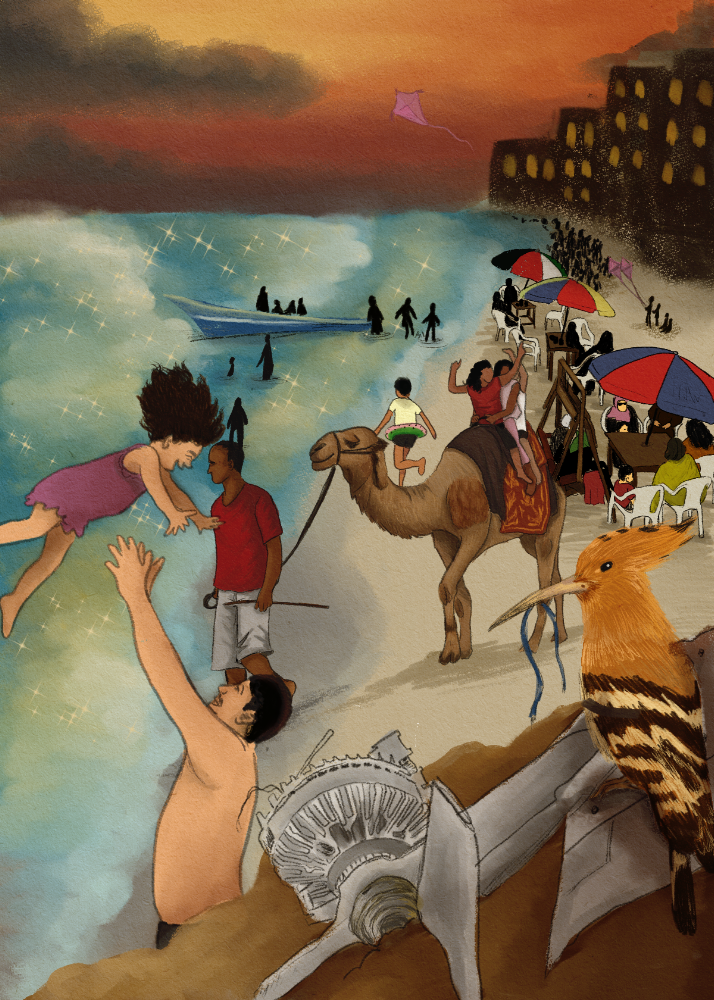
The day Palestine was liberated, all the soldiers disappeared along with their talkies and vehicles, and on the roads – the big roads and the small alleys, the fluid and the solid roads – the earth became carpeted with uniforms and boots and helmets, so much so that the earth appeared khaki green and mustard yellow!2 We found ourselves with so much time and so much freedom and we stood on the hills drinking tea and iced milk coffee and pumpkin soup, and we sang and sang, falling asleep whenever and wherever.3
The day Palestine was liberated, we swarmed through Qalandiya and swung through its corridors giggling, slamming our bodies against the metal bars, over and over till our stomachs hurt and all our pain evaporated, drop by drop by drop from every pore. We sat in the parking lot overlooking Qalandiya checkpoint, holding hands, watching the rest of us cross over and go back and cross over and go back just for the hell of it.4 And from the crossing that was no longer a crossing, we went to Qalandiya Airport and we woke it back from the dead, and we said, ‘Qalandiya! You are free, Qalandiya, you are free, man, I swear! You can now fly again, Qalandiya , you are an airport again!’ And Qalandiya carried us all and we flew, like pink kites in the totally free sky, totally free, all the way to Lod airport.
The day Palestine was liberated, nations of Palestinians crawled back to it from every corner of the world — from Lebanon, from Jordan, from Syria, from Egypt, from Iraq, Arabia, and North Africa, from Bay Ridge, from Dearborn, from Chicago, from Chile, Argentina, Brazil. From every continent, a nation of Palestinians returned, waving their flag, waving their hearts, crying rivers and seas, a whole Mediterranean of tears, tears they never tasted before. They came back and they were some spectacle and we all felt one with them, and we also felt so jealous, so jealous, so jealous, yet so one with them. The heart of the world was finally free and now it could ring and pulse nonstop.
They returned by cars and ships and boats and parachutes. Some just walked and those who couldn’t walk limped; some literally crawled on their stomachs, and some rolled down the hills, rolled and rolled cackling. And the Gazans too came back, all 100,000 of them. 200,000 Gazans reemerged from the rubble; 300,000 Gazans sprouted and bloomed, filling the air with their aroma and petals. They came holding nothing but their dead and their amputated, nothing but their elderly and their foetuses, nothing, not even their tents. And once they were all there, they danced and danced for days and weeks, for months even. They slid their rusty keys into their rusty doors, and CLICK the doors opened, and they sat in their limestone houses again. They sat in the groves, and by the Tiberias lake, and in the green and yellow of the Naqab, everyone pledged to rest and be happy and do nothing till the day they died.
The day Palestine was liberated, we flung the prison doors wide open and found a whole country inside. We found Marwan Barghouti and Shatila Abu Ayyad and Hussam Abu Safiya and Adnan al Bursh, and they asked us, ‘Where were you and what the fuck took you so long?’ They walked out into the sunlight and shivered, their faces unfurled the years, and their wounds mended as if touched by Jesus. Their voices fell under the spell of all the singing, and they hugged the prison walls because now the walls were friendly, were theirs, and could be broken down brick by brick.5 No more speech, no more discourse, the once-caged birds can now only sing. And they marched, this nation of prisoners, they marched with the shackles around their feet and wrists, and so we had to break the shackles with our bare teeth and nails.6
And Marwan sang, ‘First thing first’ and led us to the prisons of Ketziot and Megiddo and Ofer and Nafha and Ramon and Gilboa and Shatta and Ashkelon and Eshel and Ohalei Kedar and Damon and HaSharon and Hadarim and Rimonim and Ayalon and Nitzan and Rakefet and Sde Teiman and Anatot and Etzion and Huwwara and Salem and Al-Maskubiya and Kishon and Petah Tikva, and all the rest of them, until everyone inside was free, literally EVE/RY/ONE. And the prisons were declared to be nests; they were left to the birds to do with them as they wished, and freedom became something that NO ONE could take away from you!
Endnotes
- The Algerian Independence Day (5 July 1962) is often remembered by the sound of tens of thousands of women who stood on the roofs of their homes and released their ululations across the harbour city.
- When the tanks of the People's Army finally crashed through the gates of the Independence Palace on 30 April 1975, the people of Saigon experienced a brand-new quiet, no humming and no curfews. Their roads were carpeted with the abandoned gear of the defeated South Vietnamese soldiers.
- 'Iced milk coffee' is what they drank on the liberation eve of Saigon. 'Pumpkin soup' is what they drank on the liberation eve of Haiti, which was a luxury forbidden to enslaved peoples on the island.
- In Elia Suleiman’s film Divine Intervention (2002), a man from Nazareth meets his lover from the West Bank at the parking lot of al-Ram checkpoint, which was later replaced by Qalandiya.
- After storming the Bastille in 1789, a symbol of monarchical power, the French revolutionaries set the buildings on fire.
- In the February revolution of 1917, the prison guards and locksmiths went on strike. Prisoners broke out of the Siberian prisons and walked in the freezing snow, burdened with iron shackles, hoping to catch the final trains out. Many died in this march.


What shapes do solidarities take in these strange times we are living in? How can we find and forge solidarities when faced with genocides, human rights violations, and inexplicable injustices daily? Can storytelling play a role in liberation?
