Two Short Stories by Ibtisam Azem, trans. by Mayada Ibrahim
In these two short stories by Palestinian writer Ibtisam Azem, things are not quite as they seem. In 'Nashwa', a woman wakes up in the aftermath of a street protest with no recollection of her actions. In 'The Old Woman and the Poppies', Nada learns why the poppies surrounding her home are so significant and what they represent for her people and land. Translated from Arabic by Mayada Ibrahim, this fiction is simultaneously disconcerting and grounding — unfolding in medias res, with scenes and imagery that linger long in the reader's mind.
This piece is commissioned in tandem with Wasafiri 127: Solidarities.
Supported by a grant from the Open Society Foundations.
Nashwa
The sunrays snuck under the curtains into the room. She struggled to open her eyes. Her head ached as though someone had taken to it with a hammer and her body was heavy with exhaustion. She forced herself out of bed, removing the covers before inertia could overtake her. She walked to the window, as was her habit in the mornings, and drew back the curtains to let the rays enter freely into the bedroom. She noticed a large stain on her white shirt and felt dread at the sight of blood. Removing the shirt, she checked her body for the wound but didn’t find any. In the bathroom she washed her face and was puzzled by its extreme pallor. She glanced at her wristwatch, then removed it and set it by the sink. It was broken. Its hands had stopped at seven o’clock.
The last thing she remembered about the previous day was its evening. Security personnel had surrounded them and started firing tear gas before unleashing a hail of bullets. Someone must have been shot. The blood must be theirs. She removed the rest of her clothes and stood under the shower, lifting her head to let the water pour over her face. It terrified her that she could not recall what had happened or how she had gotten home. She remained under the shower for a few minutes or more, trying to remember, but to no avail. Then she closed the tap and stood looking around for her towel, then realised she had forgotten to bring one into the bathroom. She walked to the bedroom, water dripping off her naked body. Her delicate fingers pulled a white towel from the cupboard, which she used to dry herself quickly, forgetting her back. She took a smaller towel and wrapped it around her hair, then put on black knickers and a black embellished bra, before grabbing a blue shirt and jeans. Her hair looked thin that day. She tried to remedy that by piling on styling cream, then face lotion and sunscreen, and sprayed on her light daytime perfume. She glanced around and found her trainers by the bed and slipped them on. She looked for her phone everywhere but couldn’t find it. Maybe she had lost it at the square. She noticed that her wallet, too, was nowhere to be seen, nor were her keys. Another wave of anxiety. She would go to the square and her friends would certainly be there. They would know what happened, she thought, soothing the mounting fear inside her. She took some cash and the spare keys from the nightstand before rushing to the square.
Something had shifted since the previous night. People were celebrating. She overheard children saying the president has resigned. She could not believe it. She hastened to the café, where she would no doubt find people she knew. Her mind drifted to martyrs’ families, and she was reminded she needed to call her own to let them know she was okay. She walked three blocks and grabbed a newspaper from Abu Ali’s kiosk, leaving the money by the window after greeting him but not waiting for his response. Al-Amir Café was less than a three-minute walk from the kiosk. Her eyes slowly rid themselves of fatigue as she made her way through the jubilant crowd. She felt as though she had slept an eternity, and it was the reason she could not understand what was happening. She asked more than one person, and they kept repeating: ‘The regime has fallen. We’re free!’ She was in disbelief.
She entered Al-Amir Café and took a seat at her usual spot by the window to look out at the street. Opening the newspaper, she was stunned to see, on the main page, a photo of her leading one of the demonstrations, chanting with the crowd. She smiled and decided to take a copy for her mother. Turning to the person sitting at the table to her right, she said, ‘This is me at the square.’ The man with the thick glasses did not look at her and she chalked this up to his poor vision. She called Samir the waiter, but he was busy flirting with a foreign customer. She got up with the newspaper in hand. She needed her coffee quickly and did not want to wait. She went to the bar hoping someone would explain what had happened, and stood waiting for Samir to finish talking. ‘Double espresso, Samir,’ she said. He looked in her direction but did not reply, and continued his conversation. Every morning he greeted her with expressions such as, ‘Good morning to the loveliest of them all’ and ‘You’ve come to light up my day’, — so why was he ignoring her now? Perhaps something terrible had happened to his family and he did not want to talk about it. Maybe he really had not noticed her. She opened the newspaper again and noticed the caption below the photo, ‘Nashwa Khoury, psychology student, the last to be martyred before the president’s resignation.’ She reread it. ‘Nashwa Khoury, psychology student, the last to be martyred before the president’s resignation.’
She was dumbfounded. There must be a mistake. She called out to Samir, who had stopped talking now. He came over with a cup of espresso and placed it on the tray next to her. He did not look at her, even though she was standing right beside him. Perplexed, she called his name again, but he did not hear her. She raised her voice and extended her hand to touch his shoulder, but it was all in vain.
She thought of her family and felt a deep sorrow; she had not called them so they could hear her voice one last time before she was martyred before she was martyred.
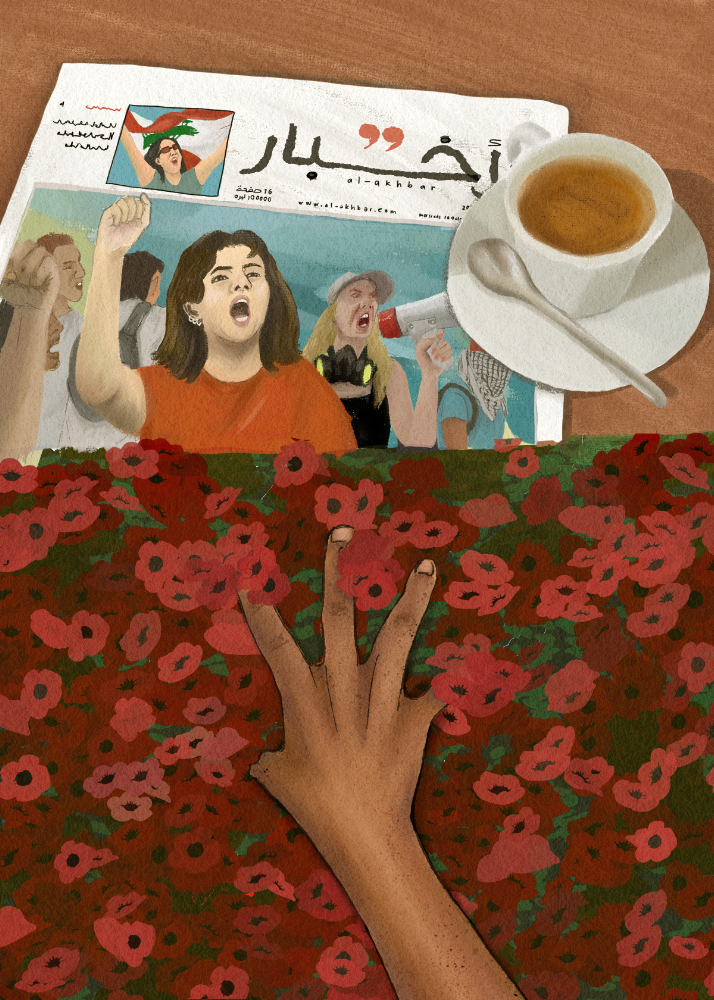
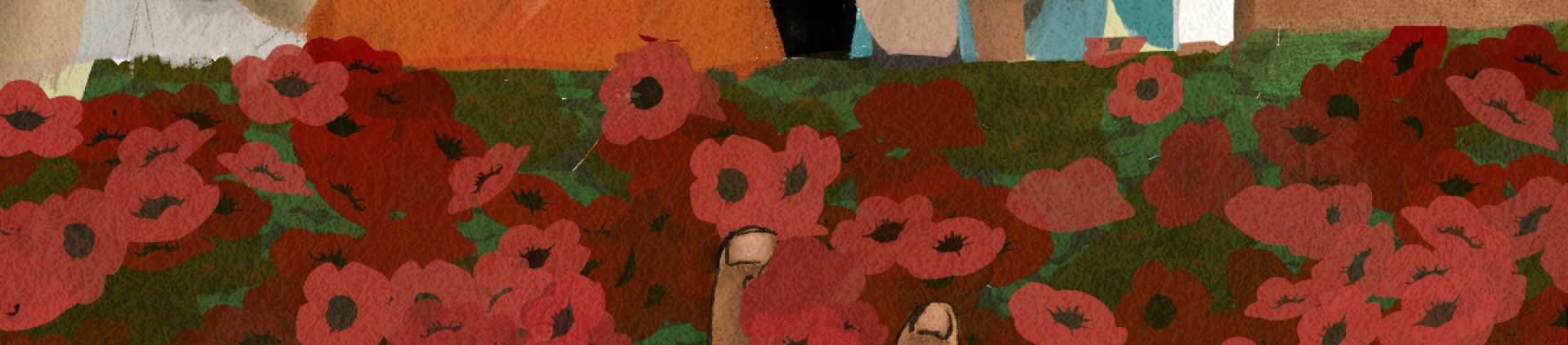
The Old Woman and the Poppies
1
Comrades, they bid the lover of poppies farewell
And death was a friend
All living beings bear witness to the truth when dignity awakens1
It dawned on us only later that that had been the last year we saw the poppies. Their redness had reached a level that made their heads droop, like elderly people with curved backs. The flowers were scarcely able to lift their heads from the ground. Two years have passed now since that spring when the poppies stretched like a crimson sea across our slopes. In the year that followed, fires burned everything in sight, and the poppies disappeared from our country. It was said they would be gone for a hundred years.
2
I walked out of my house, which was built in the old Ottoman style, to make my way to work. In the neighbourhood, my house stood out amid the concrete jungle growing around it. I pulled the old iron gate shut and hurried off. I had painted the gate a colour that was unusual for the neighbourhood, an indigo that made my heart joyful. I walked a hundred steps along the sidewalk until I reached the street corner — I knew the number of steps because I counted them often. The sidewalk was not well-built. Scattered across it were bottles, teacups, empty plastic bags. People discarded plastic as if planting seeds on the street. The plastic grew and multiplied by the day.
I reached the corner where the old woman’s house was. She smiled at me as I approached her, which surprised me because she usually did not even return a greeting, and if she did it was not with a smile. I looked closely at her face. The tattoo under her lip looked bigger than before. ‘The dahnun2 is not coming this year. That’s it. It’s not coming. God will provide a way. Last year was the last year.’ She looked at me meaningfully and spoke in a loud voice so I would not miss a word. Still, I did not understand. And I preferred not to ask further; she was sharp-tongued and quick-tempered. She could hurl rocks at me from the pile she placed next to her, in case one of the children crossed her or allowed their shadow to linger in her presence longer than she could tolerate. Everyone, whether young or old, avoided the old woman, but still listened intently to every word she said.
They say she was clairvoyant like Zarqat al-Yamama.3 They say she was born the year the earth shook beneath her family’s feet and war became their home. They say that the old woman turned one hundred this year, the year 2048. They say that her mother birthed her at the beginning of 1948 on a Galilean hillside, where she hid from gangs of settlers who descended upon her village. They say when she came out of her mother’s womb, there were no hands to catch her, so she slipped down her mother’s supple thighs and fell onto a bed of poppies. And when her mother then stood upright to check whether the road was safe, she was shot in the head by a sniper, while her daughter, Maryam, wailed between her thighs.
It was hard for me to imagine that the old woman Maryam was once a child wailing between her mother’s thighs.
They said she had never wailed or cried since. Later that same day, she lay silently next to her mother’s body, fallen from the sniper’s bullet, until she was found by runaways from a neighbouring village who took her in. She grew up among them. No one in our neighbourhood even remembered that her name was Maryam. Everyone called her ‘the old woman’. Only the elders remembered that she had once been a child, but most of them had died now, except Maryam, who was turning one hundred from loneliness.
We had left the month of March behind, but the poppies were still missing from our hill slopes. I attributed this to climate change and the cold wave that had hit the town and delayed spring. The poppies would surely reappear. They might take a while, but they would return. I smiled back at the old woman, quickening my step as though chasing my own shadow. I kept turning back to make sure she was not following me with a stick or something of the sort. Only her self-assured voice caught up to me and said, ‘The dahnun is not coming this year. That’s it. It’s not coming. God will provide a way.’ I did not reply. I did not understand what I assumed to be incoherent babbling.
I reached the end of the road. Before taking a left, I turned to look at her again, not knowing that it would be the last time. She was still looking in my direction with a smile on her face. I resumed walking before suddenly running into Hamoudi, the kiosk owner. His face was like a prickly pear; his beard was light, his hair short, soft, and ruffled, eyes bulging. He was hosing down the street, as he often did, with water stolen from the municipal line — all the while praising the prophet and asking God for forgiveness. Sometimes he went on hosing for half an hour or more, chasing papers and plastic away with the water instead of sweeping first.
‘Did you hear the news, Nada?’ Hamoudi asked without saying good morning.
I shook my head.
‘They say the dahnun will never grow in this country again … Last year was the last time.’
‘Who said?’
‘The old woman. She knows what she is talking about. Relief has come’
‘I don’t know what you mean.’
‘You don’t know the story of the dahnun?’
‘No.’
3
Only much later did I learn why it was a good omen for the poppies to stop growing for the first time in our country’s history. Since childhood, I had loved poppies. I loved their crimson colour and the pearlescent black balls scattered at their centre. I picked and shaped them into small bouquets. I would curl my fingers around the bouquets like bracelets. Sometimes I would mix the poppies with other mountain flowers to create wreaths.
But I stopped picking them while I was still a child, after the old woman Maryam dragged me away by the arm, almost detaching it from my shoulder. I had been returning from the nearby hillside, strutting with my bouquet of poppies. Suddenly she was standing in front of me. Then she forcefully pulled me towards her and said, ‘I'll kill you if you don't stop pulling out the dahnun or trampling them with your feet.’ She insisted I would have to salute them and bow my head every time I passed by. I thought she was a lunatic. Why else would she demand I bow my head to greet poppies? I did notice afterwards that the other elders in town did that. They walked reverently until they were a suitable distance away from the flowers. I never dared ask why. The old woman appeared stern, and when she demanded something, you had to obey without arguing. She got what she wanted. I did not find out until later what the secret of our poppies was, a secret we told no one, that we shut away in our hearts ...
Our story goes: whenever one of us is martyred, their soul comes back in the form of a poppy. As our fallen grow in numbers, the more crimson our hillsides become. They said that the black dots inside the flowers were the women’s kohl that seeped as they cried over their children and the martyrs. They said the most intensely red poppies are those carrying the souls of children.
As for the tourists and those who had colonised our country as though they had fallen from the sky — they did not know our story or what the poppies truly meant to us. We keep these stories hidden inside our chests so that no one could steal them and lock them up like they did us. The closer we guarded our secret, the redder our hillsides became. So the colonisers grew more infatuated with the poppies, and picked them for decorating their vases and homes.
On the day she announced to every passerby that the poppies would not appear on our hillsides again, the old woman disappeared. She had been right.
They said she died. Some said she went back to the village she had been expelled from, and that she now lived there among the cacti like a ghost, only coming out at night. No one could see her but her people. Only the family can see its ghosts.
4
Many mornings passed, and then a whole year went by since the old woman disappeared. This morning now is only beginning its journey. I am sitting on the roof of a building waiting for the contractor, looking at the sky above the Shaykh Muwannis area where I work. Buildings are spread out before me like stacked domino pieces. I think about the three floors we still have to finish before the building can begin to put on its attire. Some buildings are like fleeting nightmares — they contain no trace of a dream except the money they will accrue in bank accounts. I look at my watch … The contractor is late.
The morning heat intensifies as the new state’s flags flap all around me. Tomorrow will be day one of the celebrations marking the first anniversary of the new state's founding. Who would have believed the flag they used to snatch from our hands and tear in front of us at protests would one day fly over all these buildings?
I look away from the flags, trying to remain in the moment. I search for five things around me I can count to distract myself from thinking about the meaning of one state. I won’t deny disliking the idea of a state; a homeland is what I find meaningful. Sky, sun, clouds, birds, a kite ... It was a practice I learned in therapy sessions when obsessive thoughts came over me. I found five different things around me, and then named them. Then I reflected on each thing I picked.
Sky, sun, clouds, birds, and a kite, I say out loud.
They said that people descended from every direction and set fire to the forests, feeling that it was their lives that were burned to the ground before they had a chance at survival. They wanted their stories that were buried beneath the thickets to be revealed — those thickets that once surrounded their towns, the towns upon whose ruins the settlements were built. When asked, they said they did not burn the thickets; the children of the land would never set fire to their own land. What they did was dig between the trees, looking for the homes and graves of their ancestors which the settlers had effaced to hide any trace of the villages they destroyed … They said it was in fact the other people’s planes that shelled the forests and burned them … I did not want the ending nor the beginning to be like this. But things were heading in that direction, inevitably. They constructed a train with our skulls and refused to add any brakes. They continued to barrel towards the abyss for a hundred years. Our skeletons became the tracks for their high-speed trains.
Their tracks were our skeletons.
The faster their modern trains became, the more crowded our hillsides got with poppies.
Sky, sun, clouds, birds, and a kite. I repeat it out loud to organise my thoughts and return to the present moment.
They fell into a state of hysteria. The sight of the bulldozers was surreal as they dug into the streets leading to our villages and towns and neighbourhoods. They only waited for the slightest movement from us to open fire. Then they fired and burned everything in sight. Still, they were afraid of us – or of our shadows – even though their guns were multiplying like grasshoppers. Perhaps they were really afraid of what they had become. Perhaps they were afraid of themselves. Everyone became a prisoner to the fires.
The land went up in flames, yet I was sure I would still survive. Why this certainty? I do not know. Perhaps because my grandfather survived, and like every other survivor — by coincidence. Inside that coincidence, there was misfortune.
We were lucky to remain in our country.
We were unlucky to remain in our country.
5
They built a train from our skulls and the train used the most advanced technology. They built a modern train without brakes. It ran without stopping at any stations … our skeletons were the tracks. They did not ask the elders among us about our myth that says that every time one of us is martyred, a new hill blooms with poppies. The redder our hillsides got, the more infatuated they became with them. The scent of their victories was enough to intoxicate them. Every time they triumphed, they picked the tops of the poppies from our hillsides and decorated their homes with them, placing them in their vases … The train they built without brakes arrived at the abyss and fell off the tracks. We heard our bones crack. We got up and tried to find a place to rest. There was no place to rest, except the tracks made from our skulls, so we sat on top of the tracks.
It was inevitable that all this blood would spill. It was inevitable that this earth would burn. It was inevitable for this nightmare to be born. And it was possible for none of that to happen.
It was possible for none of that to happen.
Now a new state is born. We heard the cracking of our bones, and we got up to rest a little on the side of the road between the poppies before they disappeared for another hundred years. The rest of the story says that the poppies will reappear on our hillsides after another hundred years, after ridding their veins of the last drop of blood from our martyrs. Their redness will fade.
An edited version of 'Nashwa', titled 'Khalid Salem', was first published in the Lebanese newspaper al-Akhbar in February 2011.
An amended version of 'The Old Woman and the Poppies' was first published in Arabic in the Journal of Palestine Studies in 2018 under the title, ‘The Poppy Anemone Who Left Palestine’, as part of a folio that asked writers to contribute a creative text that imagined Palestine a hundred years on from the Nakba.
Endnotes
1 Mohammed al-Habbash, al-Ashiqeen band.
2 Poppies in some Palestinian dialects.
3 Translates to 'the Blue-Eyed Woman of Yamama' and refers to a mythical figure from al-Yamama region in modern-day Saudi Arabia, who lived in pre-Islamic times and was known for her prescience and penetrating blue eyes.


