Race, Fantasy, and Anti-Cinema: An Interview with Sol Mussa by Paula Teixeira Moláns
In this interview, academic Dr Paula Teixeira Moláns speaks to interdisciplinary artist Sol Mussa – both are from Galicia, 'a non-state nation known for its waves of migration' – about Mussa's artistic practice and personal experiences of migration. Across her work in film and visual art, Mussa thoughtfully explores her Galician-Mozambican identity, speaking the Galician language (known as galego), representation in the art world, finding comfort in the cosmopolitanism of London, trash and hierarchy, and more.
This is an extract from Wasafiri 126: Impossible Returns — The Spain Issue.
Download the full article for free during August 2026.
Interdisciplinary artist and doctoral student Sol Mussa and academic Dr Paula Teixeira Moláns are both Galicians living in the UK. Galicia is a non-state nation known for its waves of migration. Between 1870 and 1930, around a million Galicians left their homes in the north-west of the Iberian Peninsula for countries in Latin America, such as Argentina, Cuba, and Mexico. In the 1950s and 1960s, Galicians headed to other European countries, such as Germany, France, Switzerland, and the UK. Additionally, since the 2008 economic crisis, around 11,000 Galicians have left the country each year.
Both Sol and Paula are advocates for, and speakers of, the Galician language (hereafter galego), which was the subject of centuries of persecution by the Spanish state, only gaining official status in 1981. While this allowed for the language’s restoration in formal spaces, it did not stop the decline in speakers. Indeed, since the 1980s, the number of galego speakers has dropped alarmingly, especially among young people and those living in big cities like Vigo.
In this conversation, Paula – whose academic life has been dedicated to the study of galego – sought to explore Sol’s artistic practice within the context of her Galician-Mozambican identity and her own experiences of migration.
Paula Teixeira: Sol Mussa was born in 1996 in Vigo, the largest city in Galicia. She often introduces herself in artistic contexts as Galician-Mozambican. When I started our interaction by asking her about this, she responded: ‘This is a way to mark my position rather than something I identify with.’ She confesses she feels 100 per cent Galician but often describes herself this way ‘to highlight [that] I don’t speak from whiteness, and that being a racialised person is essential in what I do’. One of the first things that caught my attention about Sol is that, as a young woman from the largest city in the country, she decided to use Galician (and English) as the language(s) to express herself directly in her work and online communication. She also explicitly requested to be interviewed in galego. Sol, what is your connection to the language?
Sol Mussa: Growing up in Vigo, Galician was not something I heard in the street, but in class as a subject — always as something more academic. It was one of the subjects I enjoyed the most, especially in high school. In fact, my plan B to Fine Arts was to study Galician Literature. I loved Manuel Curros Enríquez, Rafael Dieste, Eduardo Blanco Amor, and the poetry of Olga Novo and Lois Pereiro. The group of friends I met at university are from the countryside: Costa da Morte, the border with Portugal … I have two friends, Isma from Muxía, and Xonxa from Bande, who helped me speak the language more fluently. My connection with Galician comes from people from the rural areas, and I like to give credit to them.
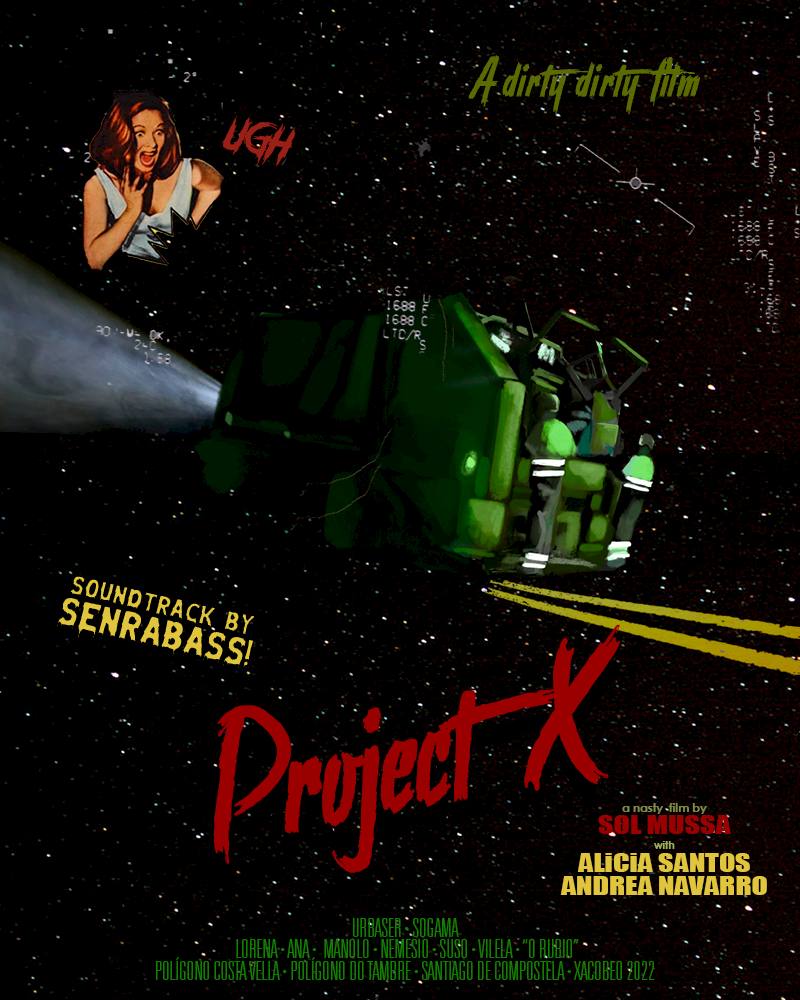
PT: You have directed films such as Proxecto X (2022) and Stockroom (2019), which talk about waste management and social concerns around Brexit. Your work &$@#/°! (2022) displays a collection of porn magazines specialising in Black women. I wondered what made you, as an individual and artist, take this subversive perspective of wanting to speak about trash, hierarchies, and race. What specific experiences do you think have determined your artistic identity?
SM: Since I have never lived in the countryside, I feel some fixation for life in cities. Urban life, in suburbs and in neighbourhoods, are my field of exploration. Especially a metropolis like London, with all its diversity — these are the places where I feel the most comfortable. Here, through precarious jobs, I connected with people of different origins who made a bigger impact on me than many theoretical lectures. That contact with the underground culture – with non-embellished realities – inspires me and puts me in the place from which I want to speak.
PT: You have participated in various exhibitions in London (Lethaby Gallery, Central Saint Martins, Rich Mix), and in other cities abroad, such as Buenos Aires, Porto, Vicenza, and at numerous venues across Galicia. Which of these are you most proud of?
SM: The exhibitions I am most proud of are those with good curation. When there is a real sensitivity connecting the works, when everything makes sense, when the space goes with it … When I feel satisfied not only with the exhibition of my work but also with new readings that arise because of the works around it. In 2023, for instance, I participated in an exhibition I was very happy with, called Materiais. It was curated by Ignacio Pérez-Jofre at the venue Manuel Moldes in Pontevedra, Galicia. It had a cool and clean finish, and all the pieces worked very well together. I like functionality; I am a practical person. White cubes with good lighting, smooth, white walls, and a non-distracting floor are the ideal conditions to display certain things. I also appreciate mindful spatial experimentation.
I am not one of those people who feel comfortable speaking about their own work. I am not good at selling myself, or saying what I do as though doing a pitch. I don’t like talking about myself in spaces where I don’t feel safe. Reading the room is something I have internalised deeply, perhaps too much. Nevertheless, the key is finding people you feel true affinity with; in my case, there are not many. It is thrilling when it happens, and I love to do group projects with these colleagues. Otherwise, I prefer to work alone.
Galician was not something I heard in the street, but in class as a subject — always as something more academic
PT: I was wondering how integrated you might feel as a racialised woman in these art scenes, and what the audience response has been to your work. Do you feel appreciated and celebrated in your home country, or have you been made to feel a sense of disconnection?
SM: Those spaces that are defined as safe – film festivals, inaugurations, talks – are often the opposite for me. With time, I learnt to set boundaries. In most places I showed my work, there was some discomfort that is difficult to explain. I feel everyone experiences it somehow, and I do not like talking in social spaces at all. Sometimes I feel institutions want to take advantage of me being racialised to tick the box of inclusivity or, for instance, to fill in a section of ‘female art’ that comes from a completely white perspective. That sort of tokenism makes me sick.
To be honest, I would like to be able to choose safe spaces where I would share my artistic vision and feel the people around me perfectly understand these kinds of matters. In that regard, in London I feel much more secure; people here know. I would like that to happen in Galicia too.
Read the full article here, free to access and download for the month of August 2026 only.
Cover image: Image from Stockroom, directed by Sol Mussa, 2019


Edited by Marta Fernández Campa and María del Pilar Kaladeen, Wasafiri 126: Impossible Returns – The Spain Issue is a compilation of work by racialised Spanish writers and artists. The contributions, ranging from short stories, interviews, poems, critical essays and art, feature poignant and powerful pieces that ask questions about national memory, colonial history, nationality, and identity.
