Three Poems by Suji Kwock Kim
There is a visceral quality to these three poems ('After/Math'; 'Stones'; 'Self-Portrait') by writer and 2026 Guggenheim Fellow, Suji Kwock Kim. They can each be read separately but, together, the images build: dirt, loss, abandonment, poverty, parenting. This drawing together of themes across disparate works demonstrates Kwock Kim's extraordinary talent, particularly as 'Stones' and 'Self-Portrait' are, in fact, loose translations of works by two Korean poets, Hwang Donggyu and Seo Jeong-ju. Read as well an accompanying author's note on Kwock Kim's process.
This piece is commissioned in tandem with Wasafiri 127: Solidarities.
Supported by a grant from the Open Society Foundations.
Author's note
The poem 'Self-Portrait' is drawn from Seo Jeong-ju’s first collection, 화사집 (Hwasajip, Flower Snake). When it was first published in 1941, it was considered groundbreaking for its frank depiction of rural poverty and a father’s abandonment. Now, it’s considered groundbreaking for the outright fictiveness of its 'self-portrait', its 'auto-poetry'. I’ve read multiple translations of this poem, which is included in almost every anthology of twentieth-century Korean poetry, but felt none adequately conveyed the grit and fierceness of Seo’s sensibility — so I wanted to give it a try. This version is a thank-you to a major Korean poet.
Hwang Tong-gyu was my faculty advisor during my year in Korea as a Fulbright Scholar. Despite teaching a full course load as a Professor at Seoul National University, he generously took the time to meet with a curious graduate student every other week to talk about Korean poetry. This version of his poem 'Stones' is a thank-you to him.
Michael Scammell, commenting on Mikhail Sholokhov’s novel, translated by Stephen Garry, And Quiet Flows the Don (2017), writes: 'The greater the original, the more translations it can bear.' Major writers deserve multiple translations and versions, to carry across different possibilities in the original work or emphasise different threads of thought — if only to reach as many readers as possible and deepen the conversation between nations and generations. These versions weren’t intended to be strict translations. Since both poems have previously been translated into English multiple times, and reprinted in widely used textbooks (The Silence of Love, ed. Peter H Lee, and The Columbia Anthology of Modern Korean Poetry, ed. David McCann), I felt that stricter, more scholarly translations of the same originals already exist, so I could be freer, looser in my versions. Above all, I wanted them to work as poems in English.
If readers want to read more of Seo’s and Hwang’s work, after reading these versions, then that would be the best outcome for what is, in the end, a labour of love.
After/Math
If conception is a country,
I suppose our son is Manchurian.
Mary Mary quite contrary,
marry marry, don’t miscarry.
For pity’s sake: forsake him.
The boy never lived to see the sun.
Isn’t half of nothing still nothing?
You don’t know what dirt is
until you bury your child inside it.
Stones [돌]
(after 황동규 [Hwang Donggyu])
Have you seen a big stone strike and humiliate
a small stone? Have you seen other stones laugh,
then avert their eyes? At dusk, when the boiling sun
cools, and workers begin their long walk home,
have you seen a stone jump alone into the water?
When scything gulls skirl above the cliff’s edge,
and roads ravel, as night falls on the village,
have you seen a stone, crazed by the laughter of others,
leap into the sea?
Self-Portrait
(after 서정주 [Seo Jeong-ju])
Father was a peasant:
he never came home, even in the dead of night.
What he left, when he left,
was grandmother, withered and blanched as the roots of a leek,
and one lone flowering-date tree.
Mother held me in her belly, hungry
for green apricots.
Under an oil-lamp dug into a dirt wall
I was born, a boy with black nails.
People say I look like her father, with the same shock
of dark hair and star-far eyes —
the father who ran off to sea
in the Year of the Revolt, they say, and never came home.
The wind has fathered almost all of me.
Some see a criminal in my eyes,
others an idiot in my mouth,
but I regret nothing.
When dawn breaks, I’ll sink my teeth into life, all of it —
sun and shadow, blood, meat, gristle, bone,
gnawing like a starved dog.
You can read Hwang Donggyu and Seo Jeong-ju's poems in their original Korean here.
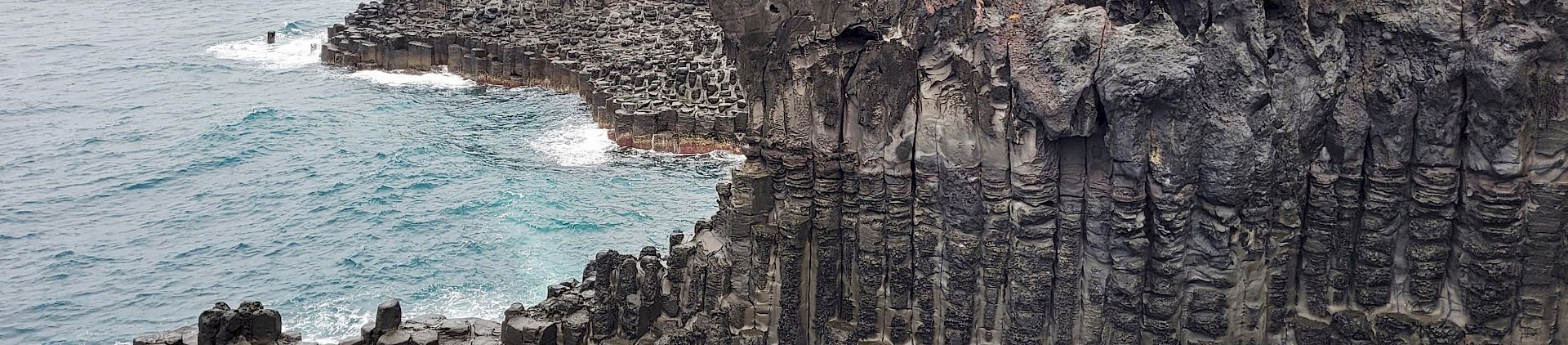
Cover image: Daepo Jusangjeolli Cliff

